Peter Lavache is a marketing chief with the occupationally inconvenient habit of siding with the product. Give him a hypothetical extra dollar and, by his own account, he will usually send it toward engineering and innovation. The confession sounds almost disloyal until he explains the arithmetic: a differentiated product gives marketing something true to say. Without it, promotion becomes a very expensive fog machine.
That instinct now sits inside Avaya, where Lavache became chief marketing officer in November 2024. His assignment involves a company known for the infrastructure behind calls, contact centers and enterprise communications, serving organizations whose technology choices accumulate over years. These customers do not wake up eager to replace everything before lunch. They have regulations, old integrations, security requirements and a healthy fear of interruption. Lavache's preferred vocabulary - focus, choice, feedback, execution - fits the terrain.
His route there passes through several chapters of enterprise technology: video conferencing at PictureTel; the operating culture of EMC; cloud work at Rubicon and Virtustream; contact-center platforms at Aspect and Alvaria; network security at ExtraHop; machine identity at Venafi; and then back to communications at Avaya. The products changed. The basic commercial puzzle did not. A good idea still has to survive contact with a customer.
The excellent product that lost
Lavache likes to begin his professional story before video meetings became ordinary. At PictureTel, a Massachusetts pioneer of room-based video conferencing, he worked around products he considered technically excellent. Yet technical merit did not confer inevitability. His compact summary is blunt: “It's not only the best product that wins.”
This is the marketer's original irritation. Builders can point to features, performance and elegant architecture. The market is allowed to shrug. Distribution matters. Timing matters. A buyer's ability to understand the difference matters. So does the dull work of turning advantages into a decision someone can defend to a finance committee. Lavache did not respond by drifting away from the product. He moved closer to it.
At EMC, where he spent what he calls his formative professional years, he absorbed a culture of scale and follow-through. He remembers learning the difference between activity and progress, a distinction that should be printed above every calendar crowded with recurring meetings. EMC also taught him to respect systems designed for consequential work: products expected to be available, reliable and capable of serving large enterprises without theatrical excuses.
“Vision without execution is hallucination.”A line Lavache adopted as a working reminder
He discovered the line while helping his son with a school project about Thomas Edison. The domestic origin is charming; the managerial use is severe. Ideas are plentiful. The daily sequence that turns one into value is the scarce part. Lavache kept the saying because product marketing lives in that gap. It must understand the invention, translate it for a market, equip sales, listen to objections and return useful information to the people building the next version.
The academic foundation was deliberately mixed. At Plymouth State University in New Hampshire, Lavache earned a bachelor's degree in Business Management and Information Systems in 1994, then completed an MBA in 1996. The pairing anticipated his later job: one foot in the machinery, the other in the market around it. At EMC, that combination produced recognition as well as responsibility. His public record lists the company's President's Award in 2010 and again in 2012, plus Gold and Silver Magellan Awards for business-to-business product communications. Awards can become corporate mantelware, but these particular ones outline the bridge he kept building. The work had to satisfy an enterprise technology company and still make a complex product intelligible beyond the building.
A career drawn as a changing technology stack
video
enterprise scale
cloud
CX and security
orchestration
A marketer crosses the product aisle
Around 2015, Lavache moved into cloud work through EMC's Rubicon initiative, then Virtustream. The transition placed him inside the industry's long migration from equipment and on-premises software toward services, subscriptions and hybrid architectures. Later roles at Aspect and Alvaria put him amid the complicated mechanics of customer service. At Aspect he led product and program-management work during transformation efforts that Avaya says contributed to the company's 2021 acquisition by Abry Partners.
When he joined ExtraHop in 2022 as vice president of product and technical marketing, cybersecurity was the new vendor category, but not a foreign concern. Any portfolio spanning on-premises, cloud and hybrid systems already had to reckon with attack surfaces. His title soon expanded: senior vice president of product, then chief marketing officer. In public conversations, he kept sounding like someone who wanted marketing to earn its claims from telemetry, workflows and customer outcomes.
His description of a successful product marketer resembles a town planner more than a megaphone operator. Time must be divided among product teams, marketing peers, sales and presales, channel partners and customers. The last group matters most because users reveal where value actually occurs. Their observations improve both the story and the roadmap.
This explains the extra dollar. “More often than not, I would vote for investing in the product,” he once said while running product and technical marketing. The remark is less modest than strategic. Technology markets are noisy precisely because many vendors can buy similar language. Products are harder to counterfeit. If engineering produces a meaningful difference, the marketer can replace adjectives with demonstrations.
It also explains his affection for teams that can cross departmental borders. Product marketing fails when it becomes a translation booth visited only at launch. Lavache's version is continuous: the market informs the roadmap, the roadmap sharpens the message, and the message creates another customer conversation. Nobody owns the whole loop. The advantage belongs to the organization capable of passing useful information around it without sanding off the inconvenient details.
Software, live without a net
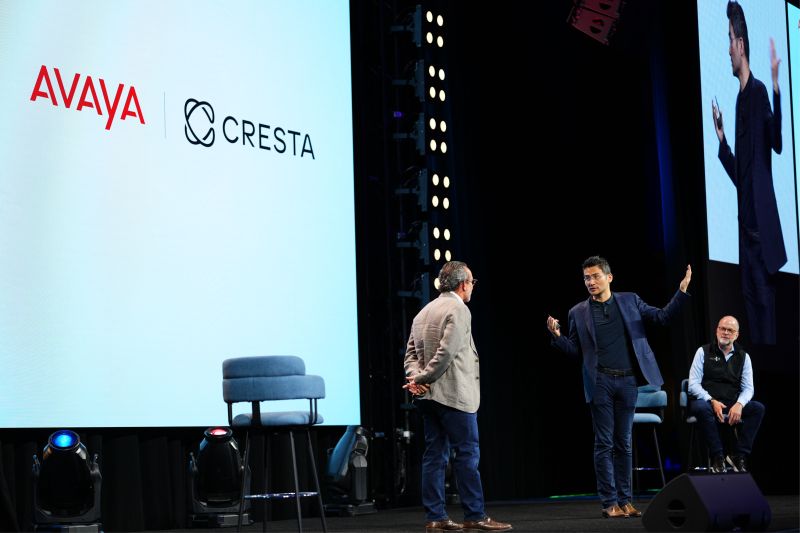
Lavache's favorite arena appears to be the live demonstration. After hosting customers and partners at Avaya's Executive Briefing Center in New York, he described the rush when a customer's challenges meet the things his team is trying to deliver. A live demo is software “without a net.” The phrase contains a marketer's delight and an operator's dread. A slide can glide past ambiguity. A running product must answer the click.
At Avaya, these encounters serve a larger strategy. Lavache argues that the company should concentrate on the large enterprises and government organizations it is equipped to serve. Such customers often cannot accept a one-size-fits-all deployment. Some need on-premises control. Others want private or sovereign cloud. Many require a hybrid arrangement that protects existing infrastructure while introducing new workflows. Lavache presents choice as a product capability rather than an apology for complexity.
The same pragmatism governs his treatment of artificial intelligence. In an industry where two letters have colonized nearly every announcement, he resists making AI the destination. The useful question is what a tool does inside a process. Can it summarize a call, assist an agent, analyze sentiment or reduce an operating cost? Can the organization measure the benefit without degrading customer satisfaction? Can humans trust the output?
“There's not one AI answer for everyone.”Lavache on choosing a practical starting point
His advice is to begin small: choose an important workflow or pain point and test the intervention. This sounds cautious only in comparison with a keynote. In a contact center, a small workflow can touch thousands of conversations. Poor orchestration produces the familiar bot maze, an automated system that saves the company seconds while charging every caller in patience. Good orchestration allows automation to handle the predictable parts and gives people the context to handle the consequential ones.
Lavache also wants customers to retain model choice. Today's favored technology may not be tomorrow's, and enterprise buyers should not need an army of developers each time the fashion changes. Avaya's pitch is an interface and architecture that can connect tools, data, agents and established systems. The attraction is not artificial intelligence in the abstract. It is a shorter, more legible path from new capability to usable workflow.
Quietly, a theory of credibility
Lavache is willing to meet skepticism directly. Avaya has undergone strategy changes and financial restructurings; another set of talking points cannot settle the market's memory. His response has been to narrow the promise: focus on the customers Avaya is built to serve, align investment to them, show real software and keep gathering feedback. He says the business should help customers reach their goals “on their terms - not ours.”
There is a refreshing limit built into this argument. It does not require Avaya to become the answer to every enterprise question or Lavache to join every public conversation. The company can be specific about scale, reliability, deployment and orchestration, then let customers examine the machinery. His public posts reinforce the point by distributing credit: product leaders, architects, sales teams, partners and customers appear by name. The marketing chief is visible, but the work remains plural.
That may be the thread from PictureTel to Avaya. A product can be excellent and still lose. Marketing can be loud and still fail to help. The useful middle is an operating discipline: build something distinct, understand where it creates value, demonstrate it under real conditions and carry the response back to the team. Then do it again, with fewer hallucinations and more execution.
Continue the conversation