Tibor Vass once went online to buy an espresso machine and emerged with a customer-experience parable. He had endured nearly two years with a pod machine. He knew the model he wanted, found a retailer offering an attractive price and put roughly $500 of intent into its shopping cart. Then the checkout refused to make the final cost clear. No chat appeared. No human arrived. Vass left. A few minutes later, the retailer's automation sent him a bright welcome email, blissfully unaware that the sale had already walked out the door.
It is a useful story because it contains the entire Vass method in miniature: begin with an ordinary frustration, inspect the machinery behind it, then ask where software could have noticed what a person needed. The expensive failure was not a lack of technology. The site had forms, email automation and a record of his behavior. It lacked timing, shared context and judgment.
Today Vass is chief marketing officer at Eccentex, a Los Angeles-area enterprise-software company built around low-code development, dynamic case management and business automation. His job is to make complicated systems intelligible to buyers. His longer project, visible across years of articles and presentations, is more interesting: to describe a workable peace between people and machines.
A marketer with a systems operator's toolbox
Long before “AI strategy” became the phrase most likely to materialize in an executive presentation, Vass was collecting credentials in the unfashionable innards of technology. His public certification record begins with Siemens telecommunications systems in 1995, then runs through Oracle database work, Solaris network and system administration, IT service management and Microsoft operations. He later completed an MBA at Oxford Brookes University, along with management studies in IT operations and international business.
This is not the usual equipment list for a marketing executive. It helps explain why his writing tends to linger on handoffs, integrations and controls. Vass is interested in the moment a prediction becomes an action, the point where a bot should summon a person, and the awkward border between a front-office conversation and the back-office process required to keep a promise.
Former Genesys colleagues described the same combination from the other side. One praised his ability to turn complex products into simple, creative stories. Another pointed to a blend of technical command, consultative thinking and competitive energy. The pattern matters more than the compliments: his professional value sits between disciplines. He can inspect the pipes without asking the audience to admire the plumbing.
“AI must think for us and not on behalf of us.”Tibor Vass, writing at Genesys in 2018
The hand stays near the switch
In 2018, Vass reached for a steam engine and a high-speed train to explain his view of artificial intelligence. New machinery has always produced extravagant fears, he argued. The sensible response is control. His train example used a passive mechanism that permits the engine to run only while the operator continues to signal. Interrupt the signal and stopping becomes the default.
The analogy can sound almost quaint beside today's language models, agents and orchestration engines. The principle has aged well. In Vass's formulation, useful AI does not acquire judgment by rhetorical promotion. It analyzes, recommends, translates, classifies or drafts. People remain responsible for high-value and high-risk choices.
By 2026, this argument had become central to Eccentex's public description of “Applied AI Orchestration.” The pitch was not another free-floating assistant. It was a coordinated case lifecycle in which models, decision rules and human tasks share context. A model might examine a document or surface an anomaly; a case worker would retain control over approvals, outcomes and escalations. Vass put the complaint plainly: organizations did not need more disconnected AI tools. They needed structure around what those tools do.
From Genesys to four blunt instructions
Vass joined Genesys in 2013 as a strategic solution director. In 2018 he moved into senior product marketing, and in 2021 into global industry solutions. Those titles chart a gradual widening of the lens: from solving a particular customer's problem, to explaining products, to mapping technology against the habits and constraints of entire industries.
- Begins as Strategic Solution Director at Genesys.
- Moves into senior product marketing, writing about AI, predictive engagement and customer journeys.
- Takes a global industry solutions role at Genesys.
- Joins Eccentex as CMO, responsible for brand, demand generation, product marketing and sales enablement.
- Frames applied AI and workflow-centered public-safety systems around accountability and less administrative friction.
His Genesys essays were often built from household-scale observations. The failed espresso purchase showed how quickly intent expires. A search for a hands-free device for his 2007 Ford illustrated the value of precise context: a recommendation is only helpful if the system understands the customer's actual constraints. Strawberry vendors, online forms and abandoned carts wandered into his explanations because enterprise diagrams are cleaner than real life, and therefore less instructive.
When he moved to Eccentex in April 2023, he already knew the company through its partnership with Genesys. A deeper look at its AppBase platform changed his estimate of what it could do. He saw a way to build high-availability applications through visual tools, with less custom code and without demanding a single heroic transformation project from a customer.
The first marketing plan his team presented was condensed into four directives. They had the pleasing directness of notes stuck to a monitor:
“Add AI,” “Team Up,” “Be Visible” and “Go Big” are marketing language, but their order reveals an operator's instinct. Put something useful in the product. Connect the people required to deliver it. Show the work. Expand the ambition. A less disciplined list would have started with the last instruction and hoped the first three might follow.
Less PowerPoint, more proof
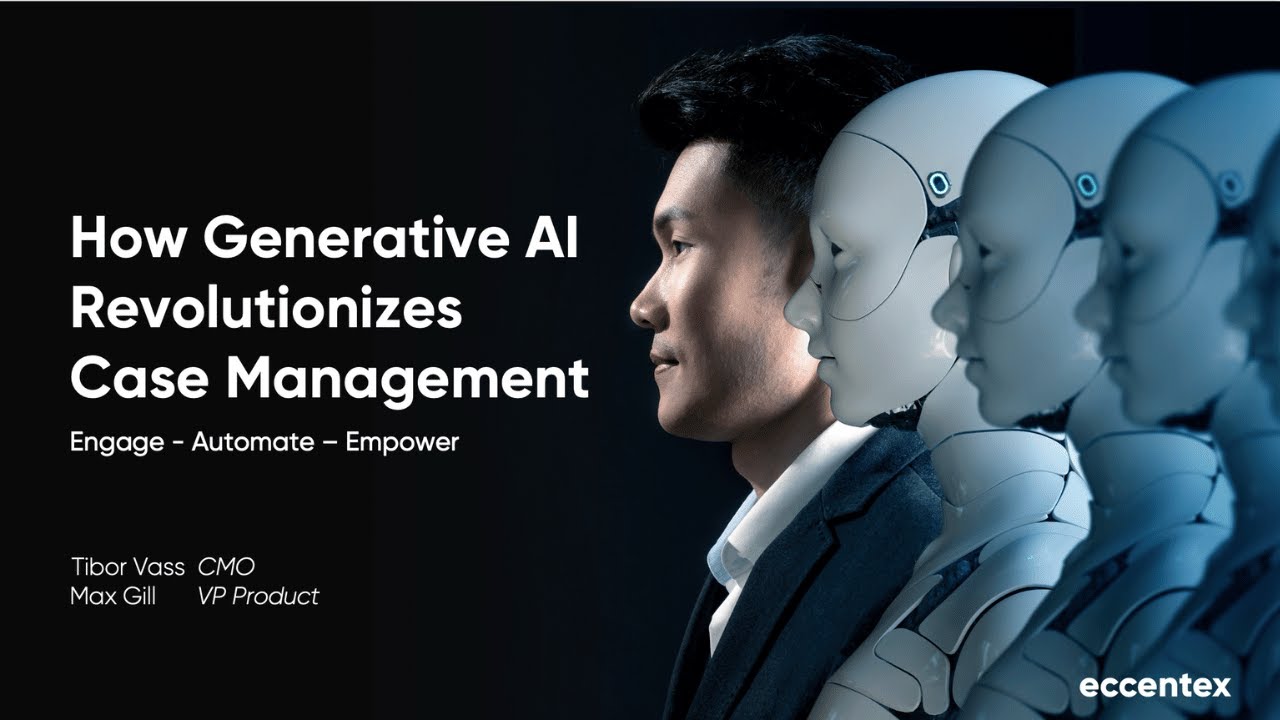
Vass's webinar style follows the same preference for sequence over spectacle. Opening an Eccentex session on AI-assisted email and case management, he promised “less PowerPoint and more live demo.” He and then-VP of Product Maksim Gill divided the story between them: Vass established the problem and the integration logic; Gill put the workflow on screen.
Their subject was the easily ignored middle of customer service. A contact-center platform can receive an interaction and route it. The harder work is deciding who does what next, under which rules, with which documents, on what deadline. Eccentex's role in the presentation was to supply that process layer while appearing inside the Genesys desktop. To the agent, the two systems were meant to feel like one continuous place to work.
This attention to continuity has followed Vass from predictive engagement to case management. A customer's context should survive the trip from bot to person, from website to service desk, from incoming email to final resolution. Without that continuity, automation merely makes disconnected mistakes at greater speed.
“Organizations don't need more disconnected AI tools; they need applied AI orchestration.”Tibor Vass, 2026
The argument underneath the software
The current version of Vass's work reaches beyond the contact center. In early 2026, Eccentex and its Enforce Assist brand announced development of a records-management system for law enforcement. Vass's line was characteristically operational: records systems had historically been systems of record; the next evolution should be systems of productivity. The desired result was less time navigating software and more time performing the mission.
The setting changes, but the test remains stable. Does the software conform to the work, or must the worker conform to the database? Does automation preserve the context a person needs? Is a critical decision visible and reviewable? These questions are not glamorous, which is fortunate. Glamour is unreliable infrastructure.
Vass's stated ambition at Eccentex has been to educate the market, deepen partner and analyst relationships, and break transformation into smaller phases that produce visible results in days or weeks. That incrementalism fits his larger philosophy. Large systems become believable through concrete moments: a well-timed offer of help, a case routed with its history intact, a document summarized before a person makes the call.
There is a gentle irony in a CMO arguing for restraint at the loudest moment in AI marketing. Vass does not lack ambition for the technology. He has been writing about natural-language interfaces, virtual agents and predictive systems since well before the present boom. His restraint concerns authority. Speed belongs to the machine. Accountability stays with us.
The espresso machine was eventually bought elsewhere. The first retailer kept its automated welcome and lost the customer. Somewhere between those two events sits the practical territory Vass has spent a career mapping: the narrow, valuable interval in which a system can notice, a person can help, and a promise can still be kept.