A clean diagram is a dangerous pleasure. Boxes sit obediently in rows. Arrows know exactly where they are going. Every process appears to have a beginning, an owner and the good manners to end on time. Giles Whiting has spent much of his career in the less photogenic territory between those boxes. It is where a decision made in one system waits three days in another, where an exception arrives without an owner, and where a clever machine needs a human being to tell it when cleverness has become risk.
That concern now has a suitably large stage. Whiting is chief executive of Decisions, the enterprise software company that brought Decisions and ProcessMaker together in a 2025 merger. At the time, the combined business said it served more than 700 customers. Its products connect workflow, business rules, process automation, integrations, people and, increasingly, AI agents. Whiting’s assignment is to turn those ingredients into a coherent operating system for work.
His own route to the job was anything but a straight corporate ascent. It moved from astrophysics to public policy, from military service to consulting, from civic development to customer-experience software, then across investment portfolios and several CEO and operating posts. Read chronologically, it can resemble a restless résumé. Read for the recurring question, and the line becomes clearer: how do complex organizations turn intelligence into action without losing control of either?
The physicist notices the policymakers
Whiting grew up in Columbia, South Carolina, fascinated by physics and its habit of turning mysteries into solvable problems. At the United States Air Force Academy, he studied astrophysics, graduated summa cum laude and served as class president. He also ran track and competed in triathlon. Years later, a profile described him training more than two hours a day for marathons and Ironman events. Endurance, in his case, was less a slogan than an appointment on the calendar.
He expected to become a research physicist. Then he noticed that the people setting the priorities and funding for science often lived at some distance from the people doing it. That seam pulled him toward policy. At Harvard, where he was a Presidential Scholar, he earned a Master of Public Policy focused on science and technology questions. The move did not abandon physics so much as enlarge the system under examination. Equations had actors now, along with budgets, incentives and competing definitions of urgency.
After seven years in the Air Force, Whiting joined McKinsey & Company. His consulting work included economic development in the Middle East and Asia, and in 2008 he won the firm’s Global Practice Olympics award for innovation. The path ahead was attractive. That was precisely the problem.
“If I wanted to chart the rest of my career path, I could have picked any age, and I could have told you what I would be doing and what clients I would be serving.”Giles Whiting, on leaving a predictable consulting track
A turn toward the untidy work
In 2011, at 31, Whiting took a job as chief operating officer and executive vice president of the Baton Rouge Area Chamber. The city appealed to him because young professionals shared a belief about what it could become and were prepared to work for it. Economic development offered fewer pristine slides and more stubborn reality. A region cannot be reorganized by dragging a box on a screen. People have to agree, capital has to move and institutions have to keep promises to one another.
There was another clue in his twenties. At 26, he co-founded the Whiting-Leitner Foundation, a scholarship effort designed to reward achievement on a merit basis. It was a compact example of a theme that would follow him: define a rule, make the rule legible and use it to move a real person through a consequential process.
The corporate years that followed put him inside increasingly complicated machines. At TTEC, he served in product and chief-of-staff roles. He became president and CEO of Percepta, a customer-experience services company operating across dozens of international locations. At Medallia he ran the EMEA business, working across markets where a product that travels easily in code still encounters local buyers, budgets and habits.
At SoftBank, Whiting led an operating team across strategic technology assets. At Forsta, created from the combination of Confirmit and FocusVision, he became chief operating officer and managing director. Mergers have a way of making seams visible. Two product families may complement each other beautifully in a press release while their sales habits, customer contracts and internal vocabularies continue to regard one another with suspicion.
The cost of crossing an ocean
Whiting’s public advice to European software companies trying to enter the United States is characteristically unsentimental. International expansion is not a checklist exercise. It depends on product-market fit in the new place, access to the right talent, enough capital to sustain a costly push and a willingness to acknowledge the resource tradeoffs. The United States, he has said, is pay to play.
The observation matters because it resists a familiar executive vanity: the belief that success in one context proves portability. Software can be copied instantly. Trust, distribution and customer understanding cannot. Global expansion is a test of whether leaders see a new market as an empty territory or as a system with its own gravity.
In 2024, Whiting became CEO of parcelLab after joining the post-purchase software company as president earlier that year. The business managed billions of shipment experiences across hundreds of carriers and many countries. A parcel on a doorstep looks simple only because an orchestra of retailers, warehouses, carriers, data feeds and customer messages has behaved itself.
The control tower problem
The Decisions-ProcessMaker merger in November 2025 put Whiting in charge of a new kind of integration. ProcessMaker brought workflow, low-code development and document processing. Decisions brought business rules, decisioning, case management and orchestration. The combination promised a broader platform, but its more interesting proposition was philosophical: the enterprise does not need another isolated island of efficiency. It needs a way to govern the traffic among all the islands it already owns.
Whiting compares that layer to an airport control tower. Airlines can buy similarly capable aircraft. The advantage comes from coordinating hundreds of independent machines safely and quickly through shared space. In a company, those aircraft are applications, automated workflows, AI agents and teams. Without the tower, local speed produces a very modern traffic jam.
“The next advantage isn't hiding in the next automation. It's sitting in the gaps between the ones you already have.”Giles Whiting, The Orchestration Imperative
In June 2026, the merged organization adopted one name, Decisions. Whiting framed the company as a control layer for enterprise AI: a place to coordinate agents, systems and human work while applying rules, permissions, audit trails and exception handling. The pitch is timely because AI agents introduce autonomy into organizations that were already fragmented. A bot followed a script. An agent can interpret, choose and act. The handoff is no longer merely slow. It may also be difficult to reconstruct.
Here the former physicist sounds like an operator. Capability is interesting; boundary conditions decide whether the system survives contact with reality. Whiting’s recent writing asks what happens when an AI service does not fail cleanly. It may remain available while its answers become less reliable. A simple backup model keeps technology running, but the business needs a richer response: route low-risk work through deterministic rules, send uncertain cases to a person, use another approved model or pause when no safe path exists.
His compact formulation is that the process should own the work while AI performs a role within it. The distinction prevents a model from quietly becoming the business process itself. It also gives human judgment a defined place rather than treating it as an embarrassed afterthought.
Service, returned to
There is a public-service strand running beside the operating career. Whiting is a trustee of the Air Force Falcon Foundation, which supports preparatory scholarships for prospective Academy cadets. He has mentored military members moving into technology careers. At the American Enterprise Institute, he serves as a national council co-chair and founded chapters in London and Charleston.
In 2025, after what he described as a 19-year break, Whiting returned to federal service and worked with the Department of Defense and the Air Force. The Aspen Institute now identifies him as a former co-lead of the department’s DOGE effort. In 2026, Aspen selected him for the inaugural class of its Technology Leaders Initiative, a fellowship bringing technology executives into a wider conversation about leadership and public purpose.
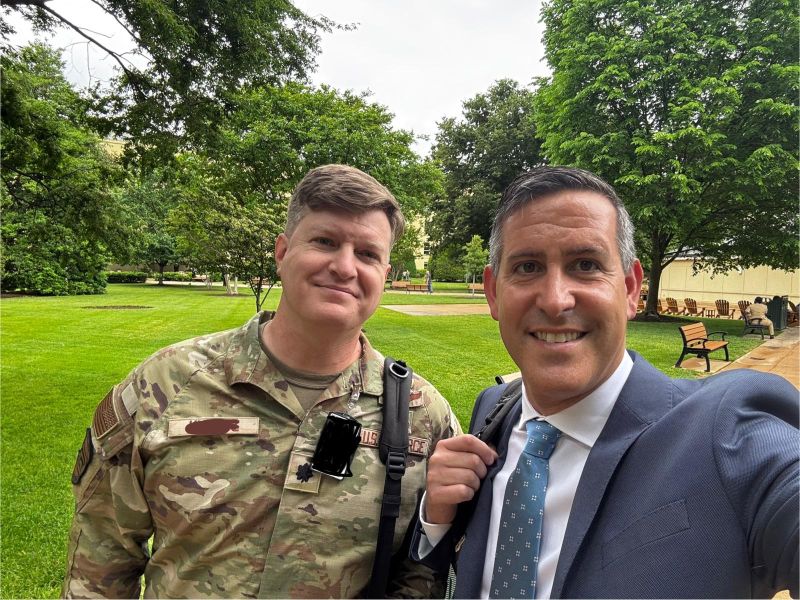
The collection of roles can seem eclectic: physicist, consultant, chamber executive, software operator, investor, athlete, advisor, public servant. Yet each involves coordination under constraint. A race is a negotiation among ambition, pace and distance. A merger is a negotiation among product, culture and cash. An AI-enabled enterprise is a negotiation among judgment, policy and machines that act faster than a committee can meet.
Whiting’s career is an argument for attending to the unglamorous middle. The box gets the budget. The arrow determines whether anything useful happens. As companies fill their diagrams with ever more intelligent parts, the seams will become busier, stranger and more consequential. His wager at Decisions is that the leaders who learn to govern those seams will own the outcome. It is a physicist’s idea with an operator’s shoes on, headed once more for the difficult bit between here and there.