Amway had a problem with arithmetic. In a business spread across dozens of markets, a useful app could become dozens of separate software projects. Every local variation invited another version, another set of decisions, another opportunity to fall behind. By 2019, its leaders were describing a different result: an app launched into 50 markets within nine months.
The detail that matters comes at the end of the explanation: without having to build it 50 times
. Amway had standardized on two core technology platforms, Hybris and Kony, and reorganized how work was coordinated around them. The achievement belonged to the operating model as well as the software. A reusable platform is of limited use if every team insists on beginning again.
- Kony sold tools for building and connecting enterprise apps across channels.
- DBX packaged that expertise into applications for banks and credit unions.
- Temenos bought Kony in 2019 for $559 million enterprise value, plus an earn-out.
- The technology continued along banking and non-banking paths.
Fifty markets, one argument
Founded by Raj Koneru in Orlando in 2007, Kony entered a market in which mobile software was becoming an enterprise concern. Its KonyOne platform arrived in 2009. The underlying problem was straightforward: an organization wanted to offer the same service on different devices without maintaining an entirely separate production line for each.
Kony’s proposition was shared development, with adaptations for the channel. A phone, a tablet and a browser have different demands, but the business behind them often repeats itself. An account still needs authentication. An order still needs a record. A balance still needs to come from somewhere trustworthy. Copying those connections is tedious; keeping the copies consistent is worse.
Amway’s example gave the proposition a concrete scale. It also supplied a useful corrective to the romance of rapid development. Standardization required choices about reuse, simplicity and how teams worked together. The tool made shared work possible. The organization had to agree to share it.
Amway’s reported rollout, 2019.
A shared platform, paired with a change in how work was organized.
The plumbing behind the pretty screen
Kony’s products are easier to understand if you divide an app into what someone sees and what must happen after they touch it. Visualizer handled the first part. Developers assembled interfaces with widgets, themes and reusable components, then added behavior. Fabric handled backend services and integration. Together, they were central pieces of the Quantum platform brand introduced in March 2019.
This was low-code for substantial applications, with room for professional development. Visualizer’s documentation describes native APIs, reusable objects and connections to existing data systems. The visual environment reduced some repetitive work; it did not abolish the need to understand the application. A button can be placed quickly. Deciding who may press it, what it changes and how failures are handled takes rather longer.
The same distinction applies to cost. Historical documentation described Visualizer as free to download and use. Fabric deployment plans involved a sales conversation, and the Standard edition excluded services including certain enterprise adapters, synchronization and custom analytics. A free drawing board was therefore only the beginning of the commercial relationship.
For a buyer, the useful question is what can be reused after launch. An interface may be quick to build but expensive to connect, test and maintain. Kony addressed that backend work as part of its platform proposition. Evaluating it sensibly means considering the runtime, the services included and the integrations the actual project requires.
A platform learns to speak bank
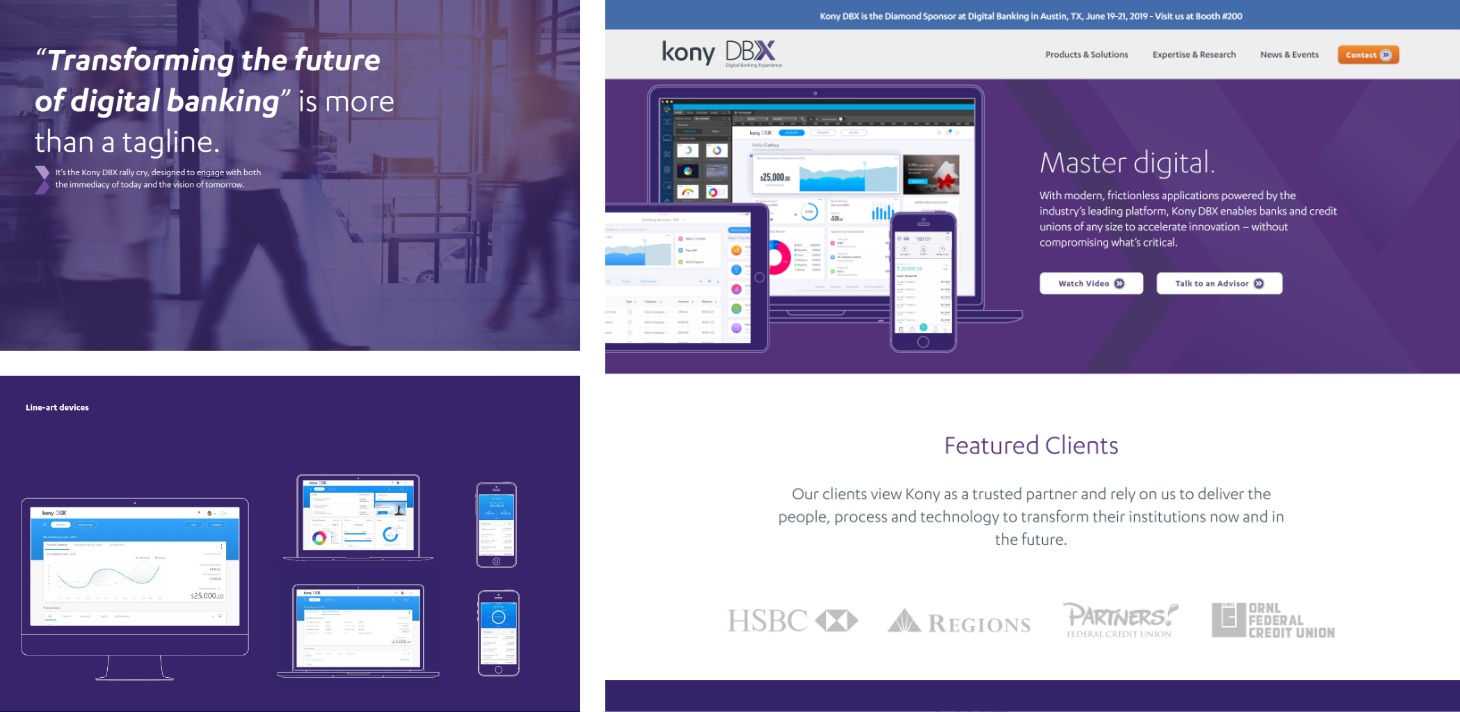
A general-purpose app platform can serve many industries. It also has to explain itself anew to each one. In June 2018, Kony launched DBX, its Digital Banking Experience platform and application suite. The pitch became more specific: banks and credit unions could obtain banking applications along with the machinery to extend them.
Its customers included California Coast Credit Union and CFG Bank. Partnerships supplied adjacent capabilities: MX for personal financial management and spending classification, IDology for identity verification, and Okta for identity management and multifactor authentication. The expertise was partly architectural and partly knowing which jobs a financial institution needed the architecture to perform.
Kony occupied the digital front end of banking: the channels through which customers interact with an institution. That position matters. Improving a mobile journey and replacing a bank’s core transaction system are different undertakings. A front-end platform needs reliable connections to the core; the two do not have to be the same product.
In October 2018, Kony and Umpqua announced an agreement for Kony to buy the assets of Pivotus, Umpqua’s innovation subsidiary. The companies would continue developing Engage, renamed Kony DBX Engage. Its ambition was a more human customer experience
in digital banking. The transaction added a service idea, and the team behind it, to Kony’s technical repertoire.
The valuable shortcut is the work you can reuse without making the customer feel copied.
Editorial takeaway
Metia, the agency that worked on DBX’s launch, describes research into banking decision makers and content mapped to their buying process. This is a revealing detail. Specialization involved learning a customer’s language and procurement habits as well as producing software. Even a platform capable of many things needs a persuasive answer to one buyer’s particular problem.
The price of a narrower pitch
Kony had attracted substantial capital before the sale. A $50 million financing in June 2014 brought SoftBank Capital together with investors including Insight Venture Partners, Telstra Ventures and Georgian Partners. Its archived news listings later announced $37 million in financing from BMO in July 2019. Those figures describe separate financing events, not a neat total of everything the company ever raised.
On August 28, 2019, Temenos announced its agreement to acquire Kony. The transaction closed on September 25. The announced terms were $559 million in enterprise value and a $21 million earn-out. Kony chairman and CEO Thomas E. Hogan became president of Temenos North America.
Enterprise value
The acquisition combined Kony’s digital banking technology with Temenos’s banking software business and expanded the buyer’s US presence. It was also a purchase of a different revenue mix. Temenos forecast roughly $115 million of Kony revenue for 2020, with more than 60 percent recurring, mostly SaaS. That was an acquisition-era forecast; it should be read as one.
The competitive setting was more interesting than a winner swallowing a laggard. Forrester had evaluated both companies as Leaders in its Q3 2019 digital banking engagement platform report. Its analyst also identified the work ahead: bringing products together, retaining expertise and managing a general-purpose platform inside a company focused on financial services.
Two heirs to the same engine
That last issue soon produced a practical arrangement. In June 2020, Temenos granted HCL a seven-year exclusive license to develop, market and support its multiexperience platform for non-banking services. Temenos retained the banking focus; the agreement did not include Infinity. This was a licensing agreement, rather than a second sale of Kony.
HCL announced Volt MX in October 2020. Its documentation provides a translation guide: Visualizer became Iris, Fabric became Foundry, and the kony API namespace became voltmx. These names are useful clues for anyone following an old project through newer documentation. Kony’s technology continued even as the independent company’s name receded.
The successor platform remains active. HCL’s official community listed Volt MX 10.0.6.0 as available in April 2026. That is a development in the product’s later life, rather than a fresh announcement from an independent Kony. For someone evaluating the technology today, the relevant commercial destinations are Temenos and HCL.
Copy the discipline, then inspect the dependencies
The portable lesson is to choose carefully what deserves to be built once. Amway’s experience suggests beginning with repeated work, agreeing on shared infrastructure and arranging teams to use it. Kony’s banking expansion suggests another useful choice: package broad technical capability around a buyer’s recognizable task.
There are limits. A shared platform is less attractive when little can be reused, when existing systems cannot be connected cleanly, or when a team needs control that the platform’s roadmap cannot supply. Kony’s import documentation makes the maintenance obligation tangible: projects created in Studio 6.0 first had to pass through Visualizer Classic 8.4 before moving into Quantum Visualizer.
Those are engineering and purchasing judgments, not reasons to dismiss low-code. They explain why the screen is an incomplete demonstration. Ask a platform to connect to a real system, survive a real change and produce a second useful application. Kony’s story is most instructive there: in the distance between making an app once and making that first effort count again.