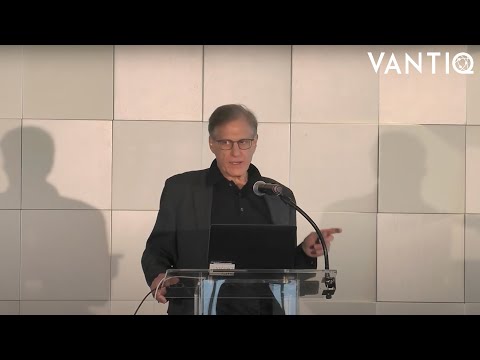
In 2000, Marty Sprinzen timed the market perfectly - selling Forte Software to Sun Microsystems for over a billion dollars just weeks before the dot-com bubble burst. He didn't stay to count the money. He walked away from Silicon Valley, learned to fly jets, developed his skiing technique, and eventually boarded a Russian nuclear-powered icebreaker headed for the geographic North Pole with his children and a group of climate scientists. That trip changed the trajectory of what came next.
The 15-year gap between Forte and VANTIQ is where the story really starts. Not the sabbatical itself, but what Sprinzen absorbed from it: a conviction that the world's hardest problems - climate disruption, healthcare breakdown, disaster response, urban safety - are problems of timing. The right data arrives a second too late. The right decision gets made after the moment has passed. Software can close that gap. That's VANTIQ's thesis, distilled.
VANTIQ is a real-time AI orchestration platform built for mission-critical environments. It coordinates AI models, human workers, sensors, cameras, drones, and enterprise systems - not in sequence, but simultaneously, in the moment an event unfolds. Japan's NTT Data built the country's national disaster resilience platform (D-Resilio) on it. Clinical AI systems from TransformativeMed run through it in hospitals. Defense and public safety operations in multiple countries depend on it. The platform doesn't just process data fast - it maintains context across all those streams, so AI agents can make decisions that actually make sense.
"Context is everything," Sprinzen told one interviewer. "AI doesn't operate in a vacuum. Context isn't a layer you add later. It has to be baked into the architecture from the start." That architectural conviction traces back to 1970, to a basement laboratory at The Cooper Union in lower Manhattan, where a young electrical engineering student learned control systems theory - how feedback loops govern dynamic environments. He's been applying it ever since, just with increasingly consequential environments.
His first job out of Cooper Union was at Consolidated Edison writing blackout detection software - building systems that had to respond to failures across New York City's electrical grid in real time. Call it a footnote if you want; Sprinzen would say it's the whole story compressed into an early career assignment. When he talks about urgency as a leadership value, he means it literally. He's been thinking in failure modes and response times since before most of today's AI founders were born.
The Forte Software era (1991-2000) solidified that instinct at scale. Co-founded with Paul Butterworth and backed by Sutter Hill and Greylock, Forte built an application development platform for the internet before the internet was a mainstream enterprise priority. The company powered systems that could not afford downtime: the NYC 911 dispatch infrastructure, early home banking platforms, critical mission systems that needed both performance and reliability. When Sun Microsystems acquired Forte in 2000, the technology became the foundation for Sun ONE and later parts of Java EE. The timing of the exit - weeks before Nasdaq peaked - was the kind of outcome that makes career retrospectives read like mythology.
But Sprinzen didn't treat the exit as an ending. After a decade and a half outside operating roles (where he stayed sharp through board memberships and, apparently, some genuinely good flying), he returned with VANTIQ in 2015 - this time with a mission statement that sounds almost too large until you look at the customer list. SoftBank Corporation led the company's Series B. The platform has since expanded into healthcare, defense, smart cities, energy, telecommunications, and financial services. In January 2025, he keynoted the Smart Cities Summit North America. A month later, he was in Davos at the Catalyst of Impact Summit. The CODiE Award for Best AI Solution in Healthcare arrived in 2025. VANTIQ has made the Inc. 5000 list of fastest-growing software companies three years in succession.
What distinguishes VANTIQ from the crowded AI platform landscape is the low-code architecture layered on top of genuinely serious event-driven infrastructure. Sprinzen's team claims organizations can build agentic AI systems 80% faster with VANTIQ than with conventional approaches - weeks of deployment time instead of years. The platform handles LLM integration, multi-agent orchestration, real-time data stream management, governance, and fault tolerance. It's designed to work at the edge and in the cloud simultaneously, which matters enormously in scenarios where connectivity cannot be assumed - hospitals, disaster zones, military operations.
The North Pole icebreaker trip keeps coming up because it isn't just a good anecdote. It's the clearest explanation of how Sprinzen thinks about his second act. He went somewhere extreme, watched scientists work at the boundary of what's possible, brought his kids to see something most people never will, and came back convinced that urgency and mission are the same thing. VANTIQ's tagline about "making a difference" doesn't feel like marketing when you understand the path that led there. He means it literally - the platform is built for situations where being a second too slow has consequences that matter.
From Brooklyn to Cooper Union to ConEd to Candle Corporation to Ingres to Nastec to Forte Software to the North Pole to VANTIQ. The thread isn't geography or industry - it's the same question asked in fifty different contexts: what happens when things need to work right now, under conditions that don't cooperate? Sprinzen has spent over fifty years building the answer. The current version runs on agentic AI.