Broccoli is an excellent antidote to software fashion. In WaveMaker’s case study of Flanagan Foodservice, the ordering screen contains cabbage, blueberries, carrots, and a question familiar to anyone who has inherited a business application: how much of this must we replace?
The Canadian distributor’s system had been built with Oracle Forms. Its database procedures already contained business logic. A shiny replacement could have thrown all of that away. Flanagan used WaveMaker to rebuild the front end while reusing what worked behind it. The interesting part of the story is the boundary the team drew.
- What it sells: an application platform combining AI agents, visual tools, and generated code.
- The distinctive mechanism: an intermediate application model separates AI interpretation from final code generation.
- The buyer: professional teams building customized enterprise web and mobile software.
- The lesson to borrow: preserve working logic, review changes, and test AI against real tasks.
The six-week broccoli problem
WaveMaker’s published account says Flanagan completed the modernization in under six weeks, using both the platform and its professional services. It reports half the time and budget of traditional migration. A jumpstart engagement helped implement core functionality within a week; the customer then extended the services work and learned to maintain the application itself.
Keep the logic. Change the interface.
Relative budget index from the company-published case study. Historical modernization project, before the 2026 agentic platform launch.That is a narrower achievement than the phrase “AI builds your app” suggests, and a more useful one. Modernization rewards decisions about what to leave alone. The reported saving belongs to this project and its particular scope. It should not be treated as a price promise for another company’s tangled systems.
Give the model a smaller job
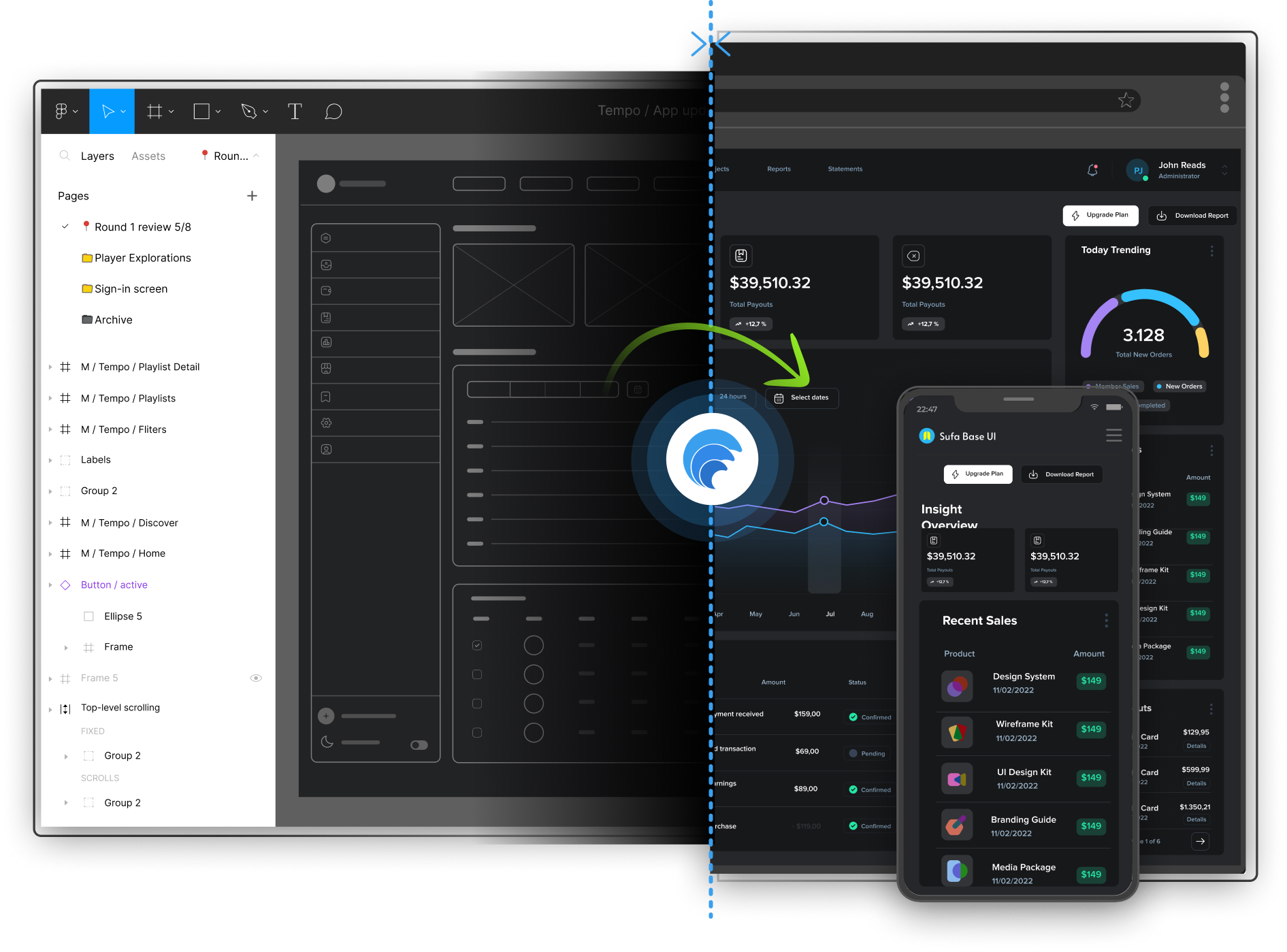
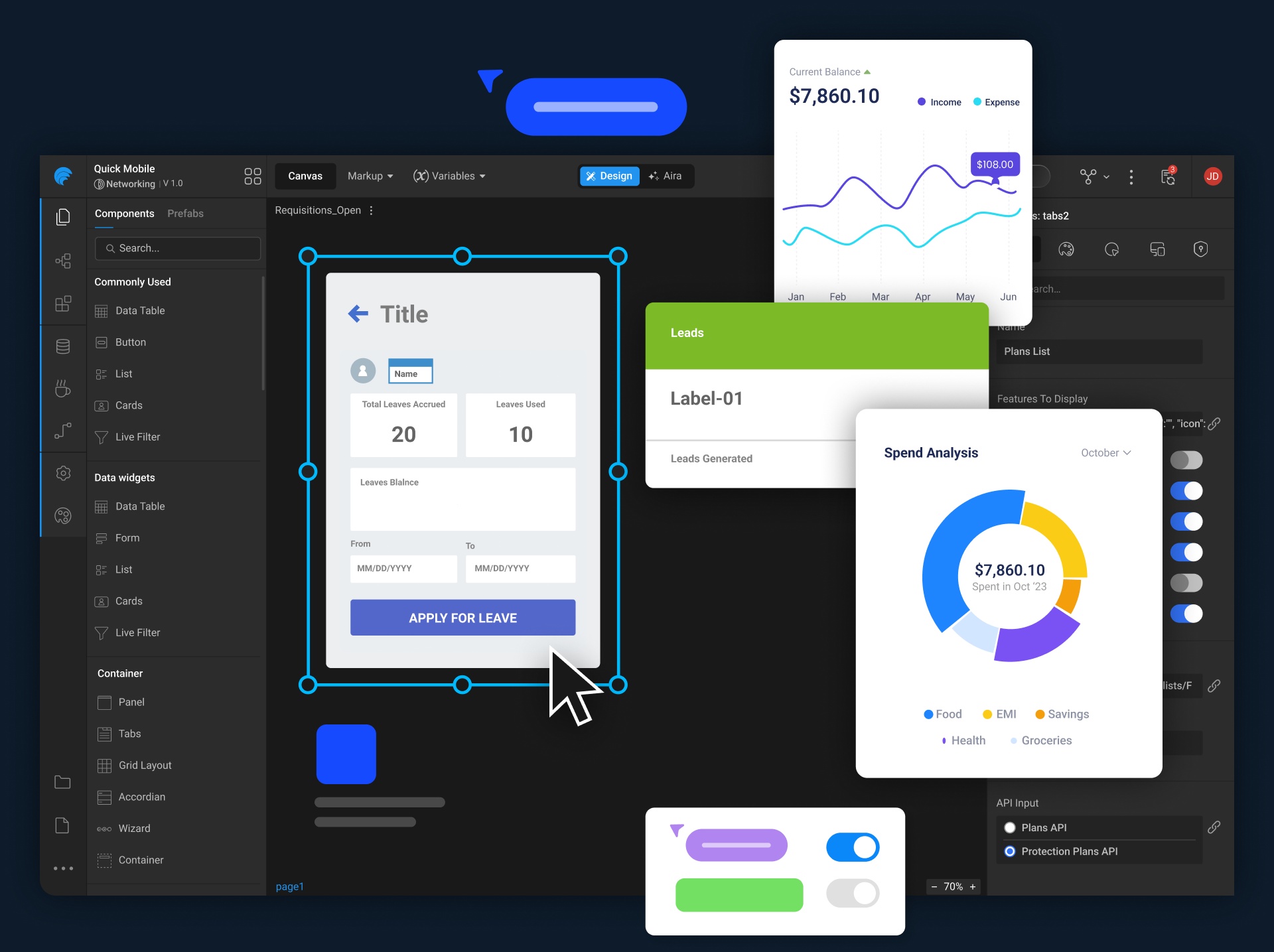
WaveMaker’s current answer to application development is a hybrid studio: prompts, a visual canvas, and a code editor in one working environment. Its February 2026 launch described a two-pass system. Designs and instructions become an application markup that developers can verify; a deterministic engine then turns that representation into code.
Think of the intermediate model as a drawing with agreed symbols. It gives the team something to inspect before the machinery produces the finished parts. That extra stage is the commercial argument. An enterprise buyer needs a way to constrain a generated application, especially when several developers will be changing it over several years.
Interpret the intent
AI maps designs and prompts into WaveMaker application markup.
Generate the code
Code generators translate the reviewed model into the target application stack.
The design-to-code workflow converts Figma inputs into a working design system, including components and styling tokens. WaveMaker’s documentation describes its markup language, WML, as the bridge to Angular, React, or React Native output. The developer can refine the result through the canvas, style workspace, and editors. The platform is selling a shared vocabulary for design and engineering as much as it is selling typing speed.
There are limits to that bargain. A repeatable generation stage does not establish that the requested business rule is correct. If a team misunderstands who may approve a payment, consistently producing the wrong permission rule is still a problem. The useful question is whether reviewers can see and change the decision before it spreads through the application.
The customers who cannot stop at a demo
Medical Wizard, an Australian healthcare software provider, offers another instructive example. WaveMaker’s case study describes a small professional development team modernizing incrementally while keeping existing databases. The resulting modules included theatre management, a patient portal, and a mobile app for doctors. The team cared about code access, customization, and hiring without tying every recruit to a proprietary technology.
These are applications that accumulate obligations. A clinical workflow must fit the people using it. A software vendor must accommodate customers whose processes differ. In that setting, a reusable component matters because someone will adapt it again. An editable screen matters because the next request has already arrived.
WaveMaker’s 2026 launch names Blue Yonder as a user supporting extensibility in supply-chain solutions. Later company-published testimonials describe Colruyt Group’s business applications, Geneva’s on-premises development, and KX trading and research workflows. This is a market of professional teams with existing systems and delivery standards.
The platform sits among enterprise application tools such as OutSystems, Mendix, Appian, and Microsoft Power Apps, while also competing for attention with general AI coding tools. Buyers should compare the actual workflow: supported stack, generated artifacts, deployment options, and effort needed for the next change. The category label will not make that decision for them.
A video is too large an answer
The company’s own engineering stories reveal what happens after the demo. In April 2026, engineering manager Sagar Vemala described an AI knowledge system connecting documentation, tutorials, component specifications, and marketplace artifacts. Its initial Academy retrieval sent developers to whole videos. Production usage showed that a twenty-minute destination was too imprecise. The team rebuilt indexing around transcript segments and timestamps.
The same account describes routing problems and inconsistent multi-source responses. The engineers imposed an answer format containing a summary, video timestamp, code example, and artifact references. That is a wonderfully mundane discovery: a clever assistant still needs to deliver the useful thing in the useful place.
In July, Vemala described the next bottleneck. The team was manually checking answers to developer questions before releases. It assembled fifty initial scenarios from production queries, paired them with expected outcomes, and added automated scoring and a regression gate. A release-day review became a pipeline job.
“Tracing tells you what happened. Evals tell you if it was any good.”
Sagar Vemala / Engineering manager / July 2026
This lesson travels well. Save the awkward questions customers really ask. Specify a satisfactory answer. Check a changed model against those cases before release. A healthy dashboard can show that a system ran successfully while saying little about whether it helped anyone. WaveMaker’s account makes that distinction concrete.
Buy the system, budget for the work
WaveMaker earns money from software licensing and support, alongside engineering services. Its published materials describe developer-seat licensing; the 2026 agentic factsheet directs buyers to sales. The modernization offering lists fixed-price engagements for defined scope and time-and-materials work for evolving requirements.
The practical budget therefore includes more than access to a code generator. Buyers need to count assessment, integration, infrastructure, review, training, and ongoing change. WaveMaker Enterprise AI can be hosted on customer infrastructure, including private or public cloud and on-premises environments. That flexibility comes with decisions about operating the installation.
In April 2026, Accenture and WaveMaker announced strategic intent to combine the platform with engineering expertise, particularly for growth-focused organizations with annual revenue up to $3 billion. The segment makes sense: companies big enough to inherit complicated systems can still lack the people and budget to modernize them comfortably. The announcement describes a delivery ambition rather than a measured customer outcome.
The useful constraint
WaveMaker’s history helps explain its emphasis. Pramati acquired predecessor platform assets from VMware in 2013, on undisclosed terms. The present company dates its founding to 2014. Deepak Anupalli’s retrospective recalls an aging codebase, a Studio rewrite from Dojo to AngularJS, and a browser-based launch that September. The business had to modernize its own tools before helping customers modernize theirs.
Today, agents handle work within that structured environment. The documentation lists specialists for interfaces, backend development, screenshots, and review, with availability varying by project and configuration. The review agent reports findings rather than editing the project. Even within an agentic system, different jobs receive different permissions.
For a team whose framework or workflow falls outside the supported environment, the imposed structure could become extra work. For a team with a suitable stack, reusable designs, and engineers willing to inspect the result, it could reduce the number of decisions they must reconstruct each time. That is the proposition worth testing on a real application slice.
WaveMaker’s most persuasive idea is that software speed depends on where a team permits variation. Let the interface change. Keep the business rules that still work. Give generated changes a reviewable form. Then measure what survives the next iteration. Broccoli orders are a less glamorous test than a launch demo, but they have the advantage of coming back tomorrow.