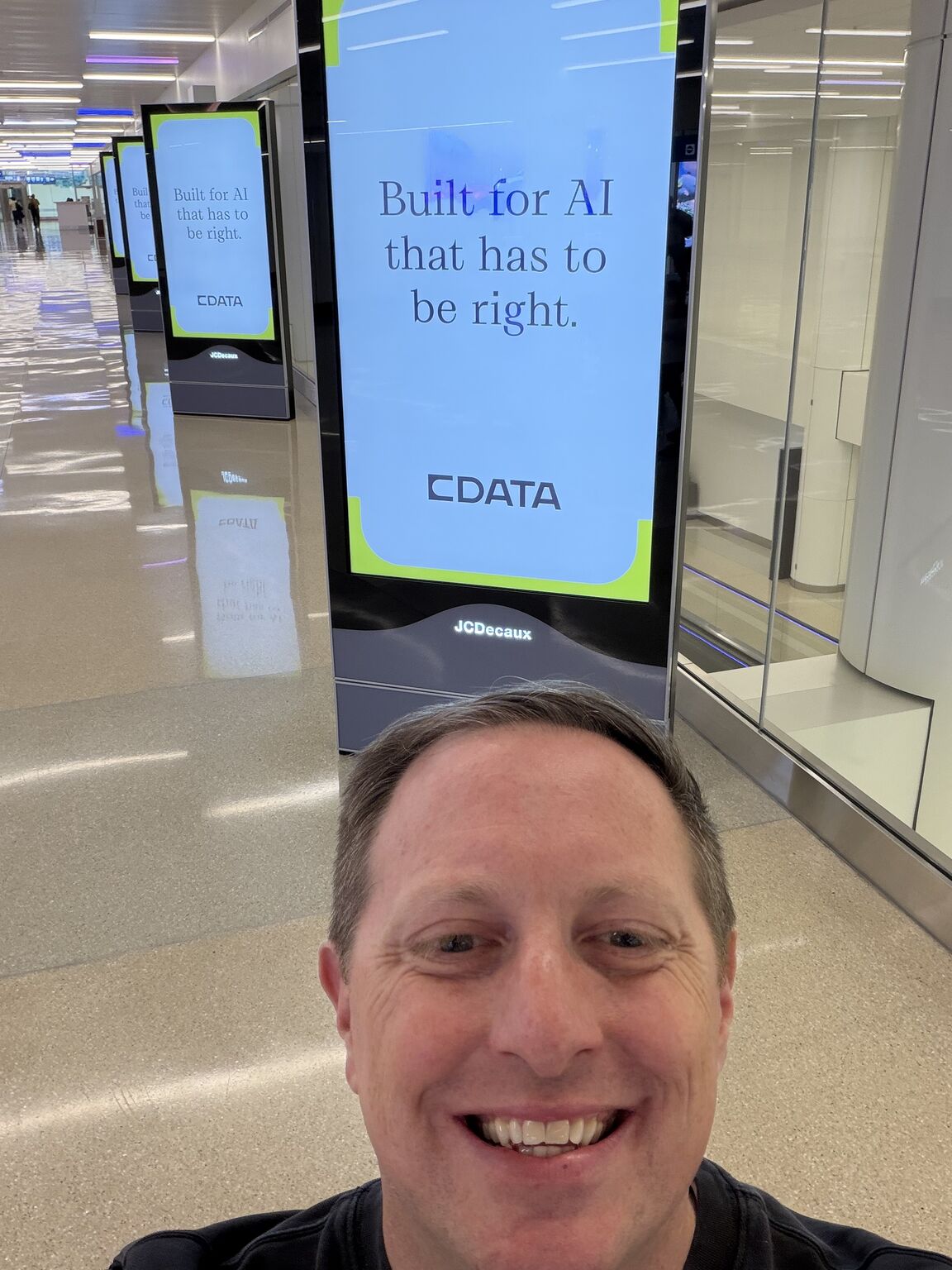
Will Davis arrived at Orlando International Airport in March 2026 and found his work waiting at baggage-claim scale. CData advertisements marched down the concourse: pale blue, blunt typography, a promise that AI “has to be right.” He did what any marketing chief confronted by months of strategy rendered forty feet tall might do. He took a selfie. His forehead fills the lower third; the campaign rises behind him in a row of glowing screens. The expression is less polished executive portrait than delighted proof of life.
The setting suited the argument. Thousands of data and analytics leaders were landing for Gartner’s summit. They had models, pilots, copilots, agents, road maps, and probably an alarming number of slide decks. CData wanted to talk about what all those clever systems must reach before they can do useful work: the scattered, permissioned, inconsistent reality of enterprise data.
This has become Davis’s professional territory. As CData Software’s chief marketing officer, he leads global marketing for a company that builds connectors between business systems and the applications, analytics tools, and AI agents that need them. His job is to turn infrastructure into a story. The trick is not to make plumbing sound glamorous. It is to show what stops working when the pipes are missing.
A historian walks into a data stack
Davis did not begin with a computer-science degree. At Brown University, he studied history from 2003 to 2007. He also played varsity men’s lacrosse and joined a volunteer mentoring program with an elementary school. The degree looks pleasantly out of place on a résumé thick with data products. It also fits. History asks how systems acquire power, how categories change, and why the latest revolution contains so much of the previous one.
His early marketing career moved through Presence TeleCare, GoodData, Pivotal Software, and ClearStory Data. The company names changed; the problem stayed recognizable. Businesses possessed more information than their people could comfortably use. Each wave of software promised a better route through the mess: analytics, cloud platforms, data intelligence, self-service tools.
In 2014, Davis joined Trifacta, the data-wrangling company built from research into making raw data easier to clean and shape. He stayed more than six years, eventually becoming vice president of marketing. The work demanded a particular kind of translation. “Data preparation” had to become a category that executives could budget for, analysts could evaluate, and practitioners could explain to one another.
One thread, three chapters
Prepare and understand the data.
Connect apps and automate the work.
Give people and AI governed access.
Davis’s memories of Trifacta are revealingly architectural. He once contrasted the company’s 2017 kickoff, held in a small hotel conference room in Oakland, with its 2020 gathering, which took over a Las Vegas complex and featured customers and partners from IBM, Atlassian, EY, Booz Allen Hamilton, Autodesk, and others. Growth, in his telling, was measurable in rooms and relationships. When he left in 2021, he wrote that he would remain a shareholder, fan, and friend. His sign-off was inevitable: “Wrangle on.”
“One without the other is incomplete and doesn’t solve the needs of an organization.”Will Davis, on live data access and replication
The category changes; the bottleneck survives
At Workato, Davis became vice president of product marketing. Automation widened the frame. Employees were not only trying to understand data; they were bouncing among applications to find it and act on it. He wrote about custom apps inside Slack and Microsoft Teams, arguing that the friction of constant app hopping could be replaced by workflows that brought information and action into the places people already worked.
He also treated competitive intelligence as an operating system rather than a folder of battlecards. In a published case study, Davis said Workato increased competitive coverage fourfold after implementing its “Compete” program. The point was shared understanding: in a fast-moving market, salespeople, partners, and marketers needed the same answer to how and why the company won.
That instinct matters because enterprise software has a vocabulary problem. Its products are densely technical, its buying groups are crowded, and its fashionable nouns expire quickly. The marketer’s task is to locate the durable inconvenience beneath the jargon. Davis kept returning to access: who can reach which data, through what tool, at what moment, with enough confidence to act.
CData hired Davis in May 2023 to lead go-to-market strategy, demand generation, brand awareness, and the global marketing team. He arrived from Workato after Alteryx had acquired Trifacta the previous year. CData was profitable, established, and deeply embedded in the practical machinery of data. Its technologies helped major software vendors and enterprise customers connect applications, databases, and APIs through familiar standards such as SQL, ODBC, and JDBC.
Davis said he was drawn to the breadth of the company’s connectivity portfolio and its potential to change the data-integration market. A year later, CData announced roughly $350 million in strategic growth funding led by Warburg Pincus, with Accel participating and Updata Partners remaining an investor. The capital gave the company room to expand. AI gave its old specialty new urgency.
When the plumbing becomes the plot
A language model can draft a charming answer while knowing nothing about a company’s current inventory, customer entitlements, renewal dates, or internal definitions. An agent can act quickly and still act on the wrong record. Davis has argued that the gap between a demo and a production system comes down to access to the right business data, plus the business context that makes the data intelligible.
CData condensed that argument into three words: connectivity, context, and control. Connectivity reaches the systems. Context explains what the fields and relationships mean. Control governs what the AI may see or do and records the interaction. The sequence makes infrastructure legible to a non-specialist without pretending the problem is simple.
The production AI data layer
The argument also resolves an older debate. In a 2024 event with CData co-founder and CEO Amit Sharma, Davis explained why companies should not have to choose between virtualized, live access and replicated pipelines. Live access serves current operational questions. Replication serves use cases such as historical analysis across aggregated data. Modern organizations need both. His line was admirably final: one without the other is incomplete.
By 2025, the audience for that idea included builders of AI assistants, workflow products, and agent frameworks. Davis described a single platform for establishing and managing connections to enterprise sources. The emphasis was not on inventing another model. It was on evolving years of connectivity work for systems that would query and act with far less human mediation.
Then came the 2026 rebrand. Davis wrote that it was not cosmetic. CData’s identity had been designed for an earlier company and an earlier market. The team rebuilt it around the data layer for AI and timed the public arrival with a Connect AI release, agent tooling, a security story, and a benchmark reporting 98.5 percent accuracy across 378 enterprise queries. The airport screens were the visible tip of a strategic decision.
“For most of those years it read as plumbing...it now decides whether enterprise AI works.”Will Davis, August 2026
The useful theft
There is a marketing lesson in Davis’s route from wrangling to automation to AI. New categories are rarely detached from old frustrations. They rearrange them. The useful operator follows the frustration, not the fashionable label. For Davis, that frustration is the distance between information and action. Trifacta cleaned the material. Workato moved it through a process. CData connects it to the person, application, or agent that needs it.
His public manner reinforces the continuity. Colleagues have described a leader capable of setting strategy, executing at scale, and contributing to culture. His own posts tend to thank teams, name collaborators, and anchor progress in concrete scenes: the tiny hotel room, the Las Vegas complex, the airport billboard. Outside work, published biographies list biking, tennis, music, and time with family. The details keep a highly abstract career attached to ordinary life.
In August 2026, CData appeared on the Inc. 5000 for a third consecutive year. Davis used the occasion to point past the rank. What interested him was the long work of structuring access to enterprise systems and then structuring the relationships across them. For years, that work looked like plumbing. In the age of agents, it determines whether an answer can be trusted and whether an action should be allowed.
That is Davis’s present aspiration in practical form: make the hidden layer visible enough that enterprises build AI on purpose. The future may still arrive with a dazzling interface. Somewhere beneath it, a connector will authenticate, a semantic layer will explain, and a policy will decide. Boring parts are often like that. Ignore them, and they become the most exciting problem in the room.