Allogene Therapeutics had a problem that will sound familiar to anyone who has waited for a report. The information existed. It just lived in different places: SAP S/4HANA, clinical-trial software, manufacturing systems and other applications. Getting a useful picture meant bringing those pieces together. The Silicon Partners, or TSP, helped connect them through SAP’s integration technology and a cloud data lake. In TSP’s published account, data availability for reporting improved by 85%. The interesting achievement was the connection between systems.
- TSP implements, migrates and supports SAP systems for mid-market and large enterprises.
- Its tools tackle process discovery, project knowledge, migration and testing.
- The practical lesson: preserve decisions, automate repeatable tasks and budget for the human work.
The work hiding between systems
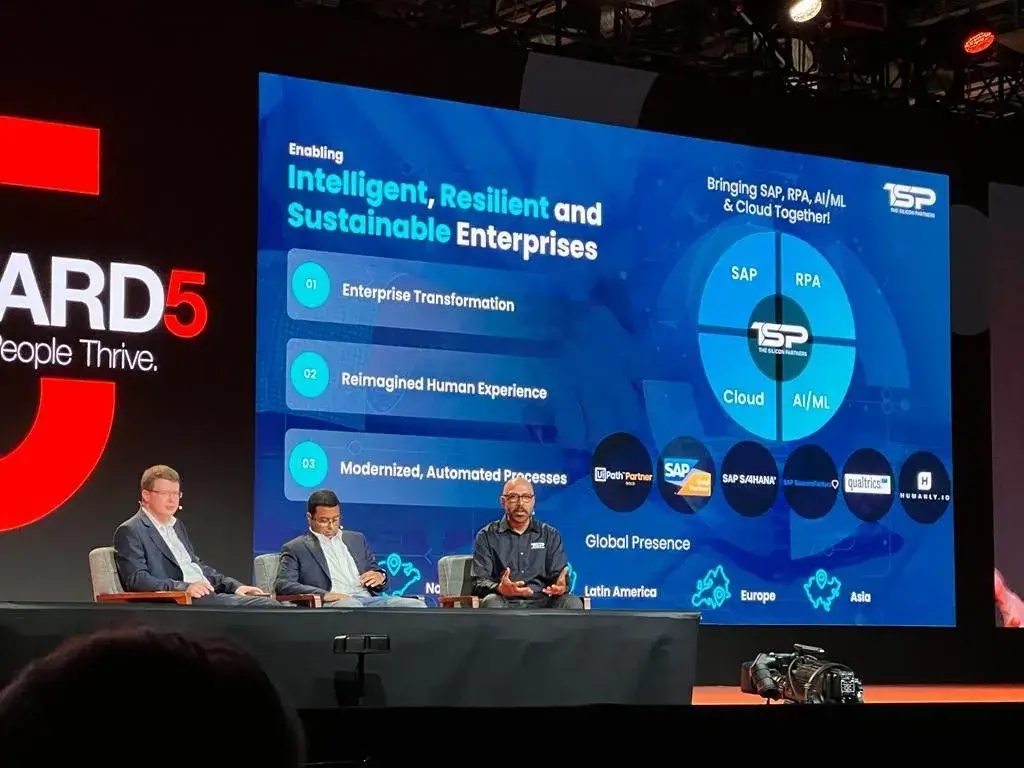
This is TSP’s territory: the awkward space between enterprise software and the business trying to use it. SAP provides the platform. TSP supplies implementation, integration, automation and ongoing support. Customers include manufacturers, distributors and life-sciences businesses whose operations depend on getting ordinary transactions right. An inventory record, an employee’s onboarding form, a report arriving on time: each is small until it holds something else up.
Consider EPACK, the Indian manufacturer. TSP’s case study describes disorganized factory financial records, maintenance management and inventory processes. The response was a fresh S/4HANA implementation with embedded warehouse management, plant maintenance, quality management and revised security roles. The case illustrates what sits underneath the phrase “digital transformation.” Someone has to decide how stock moves between companies and who is allowed to change the record.
The project needs a memory
TSP’s newer products address another kind of fragmentation. A transformation generates workshop discussions, configuration choices, test plans and explanations. Its ARIA product is designed to capture that knowledge and use it across delivery. The premise is easy to appreciate: a decision loses much of its value if the next person cannot recover the reasoning behind it.
In June 2026, TSP announced AI Hub, a framework spanning assessment, delivery and support. ARIA sits alongside ATLAS, its process-intelligence tool, and ATOM, an internal assistant for consultants. The company is trying to give repeated project experience a durable home in software. That is the product argument inside its consulting business.
“Every capability in TSP AI Hub comes from patterns we’ve seen across 300+ SAP transformations.”
Chris York · SVP, SAP Delivery · June 2026
Experience becomes more interesting when the next team can use it. TSP’s claim is that project knowledge can accumulate through the delivery cycle. The buyer’s test is concrete: can the team retrieve a decision, explain a configuration and hand over a useful record? Those questions make the AI proposition inspectable.
First, find what the business uses
ATLAS begins earlier. TSP says it connects to a live SAP ECC system in read-only mode and maps active processes, custom objects and migration implications. Its outputs include a process inventory, a usage heatmap, customization analysis and a migration roadmap. In plain English: take an inventory before deciding what to move.
The wider toolkit follows that logic. Kelvin helps prioritize migration through analytics and complexity mapping. AutoMig combines automation with migration accelerators. TestGenius identifies migration test cases and can work with TSP’s testing bots. Each targets a task that consultants would otherwise repeat. In August 2026, TSP announced a Tricentis partnership to embed testing across SAP delivery, adding a specialist testing platform to the mix.
The percentage that needs a footnote
The most revealing number in TSP’s material comes from its SuccessFactors onboarding migration explanation. Based on internal testing and customer projects, the company reported 40%-60% less effort than a new implementation, with configuration tasks handled by bots. Every bot process was triggered and validated by a consultant. Automation had a supervisor.
TSP’s comparison with a fresh implementation. Its typical reported schedule reduction was about 35%; testing, training and change management still take time.
Then comes the useful qualification. TSP says elapsed project time typically falls by around 35%, with results depending on resources, integrations and testing needs. Saving configuration hours cannot remove the need to train people or validate a new process. A buyer can copy that distinction immediately: ask separately about hours saved, calendar time saved and work that still requires the customer’s attention.
A services business with a tool kit
Founder and CEO Ravi Chowdhury came through IT services companies including Rapidigm, Fujitsu, Sparta Consulting and KPIT. COO Pankaj Banka’s background includes application management and automation tools at KPIT. The combination helps explain TSP’s commercial shape: experienced delivery teams supported by repeatable tools, with SAP and UiPath partnerships connecting the two.

The business extends beyond an implementation contract. CloudCare provides ongoing SuccessFactors support and improvements. Its operating details are unusually tangible: consultants enter time against tickets, clients can inspect consumption, and hours are approved before invoicing. That gives buyers a way to watch what they are purchasing. TSP also offers pre-built automation through a cloud Bots-as-a-Service model.
Ameri100 joined forces with TSP in April 2025, backed by Delta-v Capital and Moneta Ventures. The announcement put combined capacity above 700 consultants across North America, India and Latin America. The expansion added delivery reach to a business already arguing for reusable expertise.
The part worth borrowing
For buyers comparing SAP specialists and larger consulting firms, TSP’s proposition rests on the combination of practitioners and proprietary accelerators. The fit is clearest where an enterprise has an existing SAP landscape, recurring manual work and a substantial migration or support burden.
The transferable idea is modest enough to use tomorrow. Record why a decision was made. Discover the current process before redesigning it. Measure automation against the whole job, including testing and training. TSP packages those habits into services and software. Their value ultimately shows up in a less theatrical place: the next report, the next handover, the next person who needs to know why.