The least romantic moment in an AI demo comes right after someone says, “Now connect it to our actual data.” Actual data lives in Salesforce and SAP, a Snowflake warehouse, a stubborn on-premises SQL Server, fourteen departmental SaaS accounts and the spreadsheet Janet still updates on Thursdays. Each system has its own authentication, schema, rate limits, permissions and talent for changing at an inconvenient hour. CData Software exists for the moment the demo meets that mess.
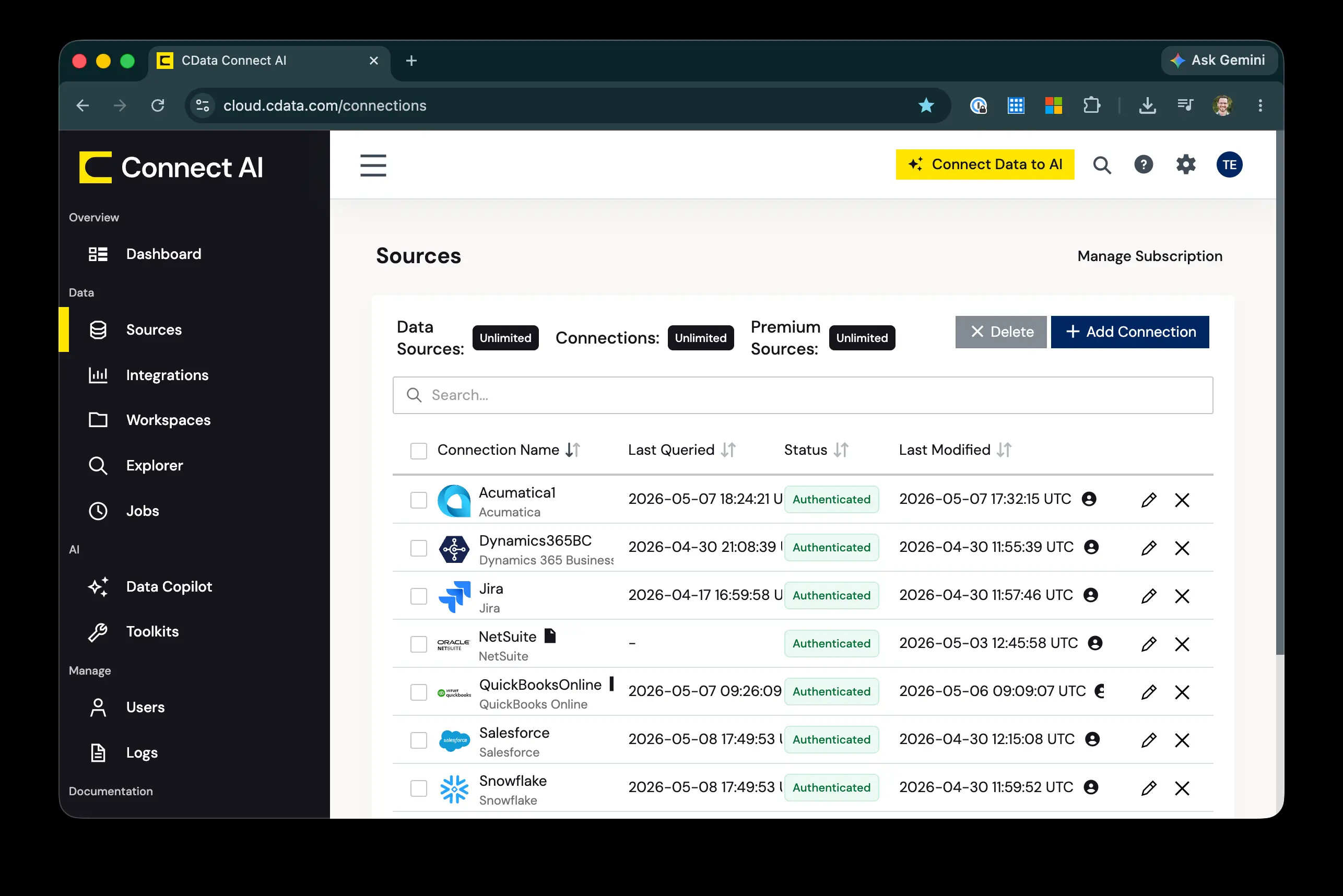
Founded in 2014 by technologists Amit Sharma and Eric Madariaga, the Chapel Hill company makes enterprise systems behave as though they agreed on a common language. Its drivers expose web applications and APIs through interfaces developers already know - ODBC, JDBC, ADO.NET, Python and SQL. Its other products replicate data, virtualize it, move business documents and embed those connections inside somebody else's software. Connect AI now presents the same estate to assistants and agents through managed Model Context Protocol, or MCP, with permissions and audit controls attached.
The word “connector” makes this sound like a tray of adapters from an airport electronics shop. The hard part is not making one connection once. It is keeping hundreds of them useful after vendors revise APIs, customers invent custom fields, security teams tighten access and production traffic discovers the edge case the demo never met. CData has turned that recurring nuisance into a product catalog, a subscription business and an OEM layer used inside other software.
A database costume for every unruly API
CData's original trick is sensible and durable: wrap a service's peculiar API in a standard data interface. An analyst can query a SaaS application from Power BI. A Java application can reach cloud data through JDBC. A software vendor can ship a white-labeled integration library instead of hiring a small army to reverse-engineer NetSuite, Workday and Salesforce. Underneath, CData handles pagination, authentication and the source system's particular dialect.
One request, three layers
BI tool
Application
schema + policy
translation
SAP
Snowflake
That creates several businesses under one roof. CData Drivers are point-to-point access tools. Sync handles replication and data pipelines. Arc tackles EDI and managed file transfer. DBAmp focuses on Salesforce and SQL Server. The 2024 acquisition of Germany's Data Virtuality added an enterprise virtualization layer, giving CData a way to combine live access across sources without copying every record into a new home. Embed sells the connector estate to independent software vendors.
Then AI changed the packaging. Connect AI, introduced in 2025, gives assistants and agents live access to enterprise systems while preserving identity, scoping which tools an agent may use and logging queries. In June 2026, CData released a free Developer Edition, an open-source Python SDK and a command-line interface. In July it extended Connect AI to HIPAA-regulated environments. The company did not abandon its old craft. It put a fashionable protocol on ten years of unfashionable maintenance.
What customers actually bought
The customer list stretches from individual developers to large enterprises and the software companies that serve them. CData publicly names Office Depot, Holiday Inn Club Vacations, GSK, Adobe, UiPath and Palantir. Google, Salesforce and Informatica are among vendors that have embedded its technology. This is not one audience. It is three: internal data teams moving or querying information, product teams adding integrations, and now AI teams trying to let models work against live systems without giving them the keys to every cupboard.
Office Depot offers the cleanest picture of the first job. The retailer was moving from a legacy data warehouse to Snowflake but wanted to keep the multidimensional analytics cubes used by internal teams. CData supplied an ADO.NET provider as a drop-in connection. The implementation took four weeks, and users could continue querying current performance data without a custom rewrite. The value was continuity, not theater.
The embedded case exposes what fails first. Dashboard maker Klipfolio once had five to seven developers maintaining separate connectors. As endpoints multiplied, the team could not keep pace. It evaluated 22 vendors and chose CData for breadth, standards support, white-labeling and scale. The initial integration did not fail. Maintenance capacity did. That distinction should change how a product manager calculates cost.
“Relying on stable CData connectivity to each of our integrated systems has saved us at least 25% of our R&D time.”Dylan Sherry, co-founder and CTO, Euphonic AI
The bill, visible and invisible
CData earns money through software subscriptions, licenses, support and negotiated enterprise or OEM contracts. Public Connect AI pricing is unusually concrete. When billed annually, Standard starts at $79 a month for one user and one source; Growth starts at $159. Monthly billing is $99 and $199. Extra users and sources cost more, while business plans, embedded products and large deployments require a sales conversation. Drivers and the broader platform vary by product and deployment.
The invisible bill is the alternative. A home-grown connector requires design, code, security review, testing, documentation and an owner for the next API revision. CData estimates four to six weeks for an average connector and much longer for complex sources. Those are vendor estimates, but the mechanism is plain: every integration creates a permanent maintenance claim. One CData OEM partner calculated it would need 120 full-time developers to reproduce more than 300 embedded connectors.
Investors bought that cost curve. Updata Partners put in $20 million in 2020 and $140 million in 2021. Warburg Pincus led an approximately $350 million growth investment in 2024, joined by Accel, with Updata remaining involved. Total disclosed funding is roughly $510 million. CData has not announced a valuation. The capital supported product work, sales expansion and a push further into enterprise integration just as AI made access to scattered data more urgent.
Where the pitch bends - and breaks
CData is differentiated by connector depth, standards support and deployment range. It can sit in a developer's desktop tool, a cloud pipeline, an enterprise virtualization layer or inside a software vendor's product. That puts it beside several competitor sets rather than one neat rival: Progress DataDirect in drivers; Fivetran, Airbyte and Matillion in pipelines; Denodo in virtualization; MuleSoft, Boomi and Workato in integration; Merge and Apideck in unified APIs. An internal engineering team is always the final alternative.
It will not work equally well everywhere. A company with one stable API and a capable developer may not need a platform. Proprietary systems and unusual business rules can still demand custom code. A team that requires complete control over source behavior may dislike a vendor abstraction. Pricing can also become less transparent as users, premium sources and enterprise requirements grow. And live access does not repeal physics: source rate limits, network latency, permissions and poor underlying data still matter.
Buy the standard 80%
- Popular SaaS and databases
- Commodity authentication
- Broad customer demand
- Long maintenance tail
Build the weird 20%
- Proprietary internal systems
- Product-defining logic
- Unusual residency constraints
- No adequate vendor coverage
The useful thing to steal
CData's most copyable move is not “build 350 connectors.” Please do not. It is to find the repetitive work every customer must perform, standardize the interface and accept responsibility for the boring years after installation. The company chose known standards before inventing new ones. It sold the same core capability through several distribution paths: direct tools for users, platform software for enterprises and embedded components for vendors. When AI arrived, CData reused the connector estate instead of pretending to have discovered data access last Tuesday.
For a product team, the practical playbook is short. Inventory the integrations customers request. Separate common systems from genuinely proprietary ones. Calculate three-year ownership, including maintenance, incidents and delayed features - not just the first sprint. Pilot a vendor against real production volume and permissions. Buy the common surface; build where the integration itself creates differentiation. Assign an explicit owner to anything you keep.
The approach fails when the standard layer erases the detail your product needs, when vendor dependency is unacceptable, or when the connector catalog covers the logos but not the required objects and workflows. Depth matters more than a large source count. An AI system can return a plausible wrong answer when metadata is thin, which is more dangerous than an obvious error. The test is not “Can it connect?” It is “Can it preserve our meaning, permissions and performance under load?”
The company still sounds like its engineering roots. Its stated mission is to simplify how users and applications connect with data, and its brand values emphasize work that is pioneering, transformative and proven. The last adjective is the revealing one. Infrastructure buyers care less about a dazzling launch than whether Friday's Salesforce update ruins Monday's report. CData says its engineers optimize drivers down to the socket level and positions support as an extension of the customer's team. Recognition followed the growth: the company appeared on the Inc. 5000 for a third consecutive year in 2026 and on Forbes' list of America's Best Startup Employers. Those badges are secondary to the underlying promise - the pipe stays open.
CData's timing looks clever because its original bet was patient. Enterprise software keeps producing new consumers of data - dashboards, warehouses, SaaS products and now agents - while the source systems remain fragmented. Each wave needs the same pipes with a different fitting. The company in the basement keeps getting invited upstairs.
Keep digging
Company pages, product material, community resources and demos from CData.