At Swiss Post, a Kafka application can help tell a sorting facility what to do next. This is a poor place for guesswork. Yet the platform faced a problem familiar to less consequential workplaces: people needed to see their data, and the specialists who could help them were becoming a queue.
The organization’s published Conduktor story describes growth from 60 to more than 300 Kafka applications, with the same platform team. More than 800 internal users gained controlled access. The interesting number is the unchanged team. How do you let more people touch important infrastructure without making its custodians permanently nervous?
- Console makes Kafka visible and gives teams governed self-service.
- Gateway applies rules inside Kafka traffic, including encryption and validation.
- You keep your Kafka provider and host Conduktor yourself.
- The business case is fewer bottlenecks, with responsibility still attached.
The problem arrived wearing a developer’s badge
Apache Kafka carries streams of events: an order placed, a payment attempted, a machine reporting its condition. Other applications consume those events and act. Conduktor occupies the space around that transport: who can inspect a stream, who owns it, what rules it obeys, and what happens when something goes wrong.
Nicolas Orban met Stéphane Derosiaux and Stéphane Maarek through a mutual friend in Paris. The two Stéphanes knew Kafka’s frustrations firsthand. Orban had worked at Deliveroo and Meero. The company dates its founding to 2020; its early attraction was a desktop interface that made a demanding technology easier to navigate.
There was also unusual distribution expertise in the founding team. By Accel’s 2021 account, Maarek had taught more than a million Udemy students. That same account reported 60,000 Conduktor users across more than 9,000 companies, acquired organically. Those were adoption numbers, rather than a count of paying enterprise contracts, but they showed the irritation was widely shared.

Then customers changed the question. A developer wanted an easier way to work. A central platform team needed everyone’s work to remain secure and reliable. In his 2025 investor interview, Orban described customer feedback pulling Conduktor toward central teams, security operations and data architects. More stakeholders meant longer sales cycles. The purchase had become organizational.
A window, and a checkpoint
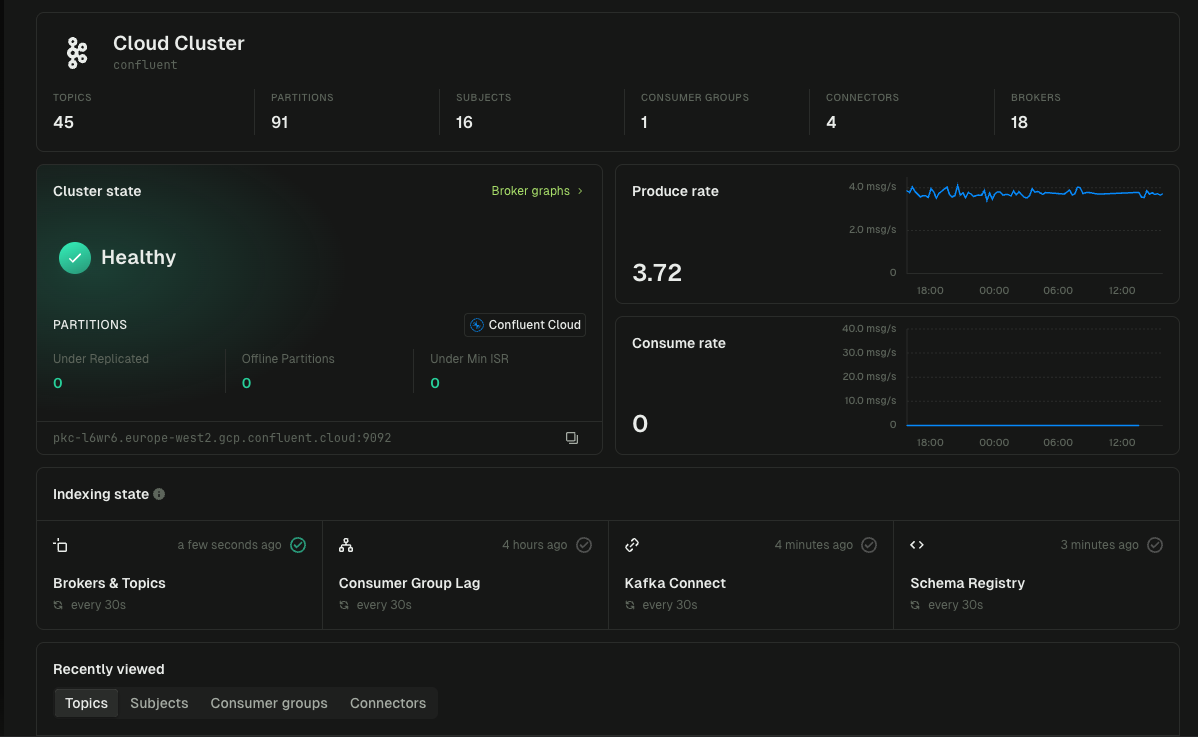
Today, Console is the window. Its web interface lets users browse messages, investigate consumers falling behind, manage schemas and connectors, and explore multiple clusters. Paid governance capabilities add ownership, approval workflows, masking and audit logs. A developer can request another team’s topic; its owner can approve access without sending everything through the platform team.
Gateway is the checkpoint. It is a proxy between Kafka clients and brokers, where configured policies can encrypt fields, validate messages, control traffic or isolate tenants. Clients still speak Kafka. They point their bootstrap configuration at the proxy rather than requiring an application rewrite. The placement matters: a rule enforced as data travels can stop trouble before downstream systems inherit it.
Produces events
Applies policies
Your existing cluster
A separate Schema Registry Proxy adds permissions and authentication to schema operations. These layers work with infrastructure such as Confluent, Amazon MSK, Aiven and Redpanda. That makes Conduktor’s competitive position peculiar in a useful way. A Kafka provider supplies the transport and its own tooling; Conduktor sells an additional control layer across the estate.
Alternatives depend on the complaint. Provider-native tooling may satisfy a single-platform operation. A Kafka interface may answer a visibility problem. A proxy framework may suit engineers willing to build their own enforcement. Conduktor’s pitch combines these operating concerns; whether that combination earns its keep depends on how much coordination your organization needs.
Sixty applications become three hundred
Swiss Post’s case makes the coordination problem tangible. Developers lacked safe ways to investigate independently; analysts struggled to discover usable data. Role-based access gave different groups different boundaries. Developers could reach the topics their applications used, analysts received time-limited investigative access, and platform engineers retained oversight.
Same platform team. 800+ internal users. Customer-reported results.
“Conduktor gave us time back.”Anke Raich · Swiss Post
Elsewhere, Bitvavo’s case describes masking, audit trails and controlled access for more than 100 team members. An unnamed agricultural equipment manufacturer reports 70% faster provisioning on Amazon MSK. Neither result promises what your team will achieve. Both identify a repeatable intervention: replace recurring manual decisions with explicit policies, then delegate within them.
The bill, and the expensive lesson
Console’s free Community edition permits up to 50 users and three clusters. Team Edition costs $125 per seat monthly or $1,200 annually. Ten annual seats therefore cost $12,000 before infrastructure costs. Enterprise terms are quoted; Enterprise Gateway uses per-cluster pricing with a three-cluster minimum and optional security and disaster-recovery add-ons.
The company’s own growth carried another cost. After an Accel-led $20 million Series A in 2021, the hiring assumptions of that market proved difficult to sustain. Orban told RTP Global that nearly half the team was let go in 2022. His account describes a subsequent focus on financial efficiency. A $30 million Series B followed in November 2024, led by RTP Global with M12, Ansa and Accel.
Freedom needs someone to write the rules
The lesson extends inside the company. For its 2023 offsite, Conduktor shortened an exhausting week-long format to three nights and broadened activities beyond sports. Employees booked travel within guidelines. It is a modest cultural detail, but a revealing one: autonomy becomes practical when the boundaries are clear.
In August 2026, product updates added live lineage, application-level cost visibility and a preview Flink SQL workbench. The practical direction is toward showing who depends on a stream and who pays for it. Those are questions a platform team needs answered before another application joins the crowd.
This approach asks something of the buyer. Self-hosted software needs operators. An inline proxy needs capacity planning and resilient deployment. Owners must define policies worth enforcing. A small team with uncomplicated Kafka access may find its existing tools sufficient. Conduktor becomes interesting when the waiting room is full - and the people holding the keys need their time back.