Consider the word “customer.” It looks harmless on a dashboard. In a hypothetical subscription business, however, it might mean someone who registered, someone who paid, or someone whose contract remains active despite an overdue invoice. Ask an AI agent how many customers you have and it may return a beautifully formatted number. The awkward question comes afterward: whose definition did it use?
- Jedify connects enterprise data to the business rules behind it.
- Its context graph feeds both its own analytics agents and outside applications.
- The useful test is whether an answer matches an agreed business definition.
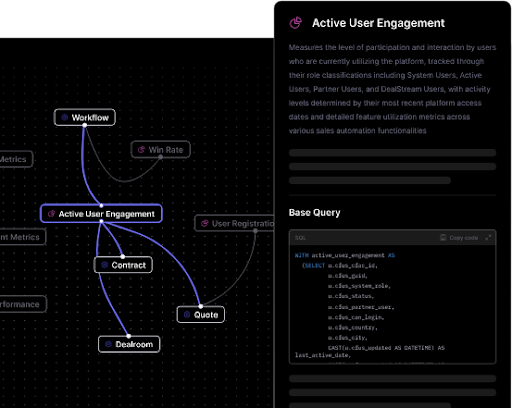
This is Jedify’s territory. The company develops a layer between corporate information and the AI applications trying to use it. Its proprietary Semantic Fusion technology combines structured records with documents and institutional knowledge, creating what it calls a context graph. The ambition is straightforward: give software some of the understanding that an experienced employee brings to a seemingly simple question.
The spreadsheet has an accent
A conventional database describes its contents through tables, columns, and relationships. A business adds another vocabulary: fiscal periods, customer segments, exceptions, approval rules. Those meanings may appear in a dashboard calculation, an internal playbook, or a document someone remembers updating. Access to the database does not automatically confer access to that vocabulary. Connecting more systems can make the ambiguity larger.
Jedify’s connectors reach into databases, warehouses, BI tools, and systems of record. They also accept knowledge from places such as Notion, Jira, Google Docs, SharePoint, and file repositories. The distinction matters. A transaction tells you what happened; an operating document may explain how to interpret it. Jedify’s proposition is to put those two kinds of information into a shared reasoning layer.
Semantic Fusion maps concepts such as a churned customer to the relevant data and logic. Jedify says the graph adapts as schemas and definitions change. Teams can inspect lineage and edit the model in natural language or SQL. That editing capability is central to the product’s appeal: business meaning must remain something people can question, rather than something software quietly declares settled.
Accuracy arrives after the introductions
The most revealing public example concerns The Weather Company. Norwest, Jedify’s Series A lead investor, reports that the customer moved from 40-45% accuracy out of the box to over 85% after a focused refinement process. These are investor-reported figures for one deployment. They describe a result achieved with adjustment, and should be read with that condition attached.
The starting point deserves attention. A tool intended to understand a company still needed help learning that company. The improvement suggests that the durable work happens in reconciliation: comparing an answer with a reference, examining the difference, and correcting the interpretation. Anyone shopping for enterprise AI should be curious about that interval between installation and confidence.
Norwest also describes Jedify mining query logs, parsing dashboards for metric definitions, and using existing dashboards to tune accuracy. That offers a practical explanation for the improvement. The organization’s previous analytical work becomes teaching material. A dashboard that once answered a question can also help establish whether a new agent is answering it correctly.
One dictionary, several ways to ask
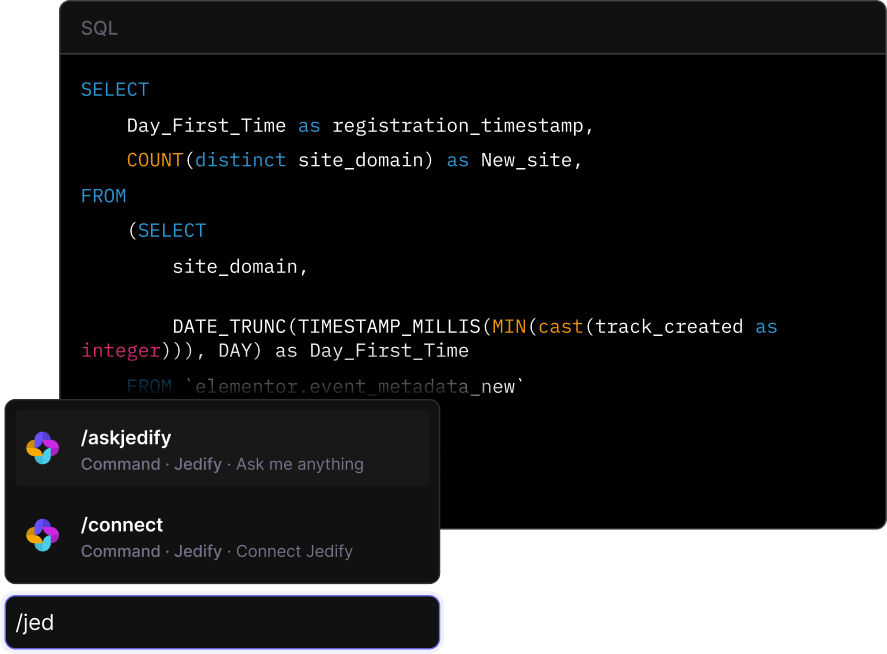
Jedify sells more than the graph. Ask Jedify provides conversational analytics, returning charts and explanations to questions expressed in ordinary language. Data and Deep Research Agents extend that approach to multi-step investigations, including internal information and external web research. Smart Scenarios supports prompt-driven reports, documents, and presentations; an Insights Library stores reusable contextual prompts.
For application builders, the Contextual MCP Server supplies the same business context to other agentic applications. Embedded AI Analytics lets product teams put customizable dashboards and conversational experiences inside their own software. These are different entrances to the same proposed asset: a maintained model of the business that can support several tools.
The intended customers include data teams, product builders, and business functions that depend on analysis. Jedify publishes testimonials from organizations including Kiteworks, SoundCloud, and Exodigo. Those examples span distinct data problems, but the buying question is recognizably similar: can people investigate the business without requesting another custom query every time?
“The agents themselves weren’t the hard problem.”Kumud Kokal, Kiteworks CIO · Jedify-published testimonial
A warehouse partner buys into the meaning
Jedify’s three founders are Assaf Henkin, Adi Elimelech, and Erik Shani. Public reporting dates the company’s formation to 2023; its own account dates the platform launch to 2024. Their expertise lies in data and AI. The important commercial development came in June 2026: a $24 million Series A led by Norwest, with Snowflake Ventures among the participating investors.
Snowflake describes a relationship that began through its Startup Accelerator. In June, it identified Jedify’s Native App as being in private preview. The collaboration focuses on creating and maintaining governed Semantic Views, monitoring definition and schema drift, and making context useful to Snowflake’s AI tools. It gives Jedify a place beside established infrastructure that customers already operate.

Start with a number worth arguing about
Commercially, Jedify is a B2B SaaS proposition with free signup and sales-led enterprise conversations. Buyers should evaluate licensing alongside integration, review, and ongoing model ownership. Cube and dbt Semantic Layer occupy adjacent territory around shared definitions; building internally remains another option. Jedify’s distinctive pitch is automated construction and maintenance across both data and business knowledge.
A reader can copy the evaluation method without buying anything. Choose one consequential metric. Collect its approved definition, underlying records, and reference answer. Then ask the agent questions involving exceptions, time periods, and permissions. Inspect the reasoning when the numbers diverge. A fluent response is pleasant; an answer that survives this exercise earns its place in a workflow.
That approach depends on accessible sources, usable reference answers, and someone authorized to resolve disagreements. Where definitions conflict or knowledge is missing, automation cannot settle the organizational argument by itself. Jedify’s wager is that companies will invest in making meaning maintainable. The little word “customer” turns out to require quite a lot of infrastructure.