Suppose a company asks its AI assistant for customer churn. The database has a number. The sales team has an exception: one enterprise account cancelled on paper but is still migrating to a new contract. Finance has another: trial accounts never belonged in the denominator. A model can produce a chart before anyone finishes explaining these details. It can also produce a beautiful chart of the wrong thing.
This is the awkward territory PromptQL inhabits. Its founders spent years making company data easier to reach through Hasura, the GraphQL developer platform. Their newer company-facing product asks what happens after access is solved. It places people, agents, shared conversations and a living record of business rules around the query. The ambition is plain: when someone corrects the answer, the next person should not have to make the same correction again.
- PromptQL lets teams ask questions of connected business systems, build analyses and direct AI agents from a shared workspace.
- Its distinctive bet is a team wiki and multiplayer threads that capture the definitions and exceptions missing from raw data.
- Hasura's data access technology supplies the federation and permissions underneath; public plans span free use, metered team budgets and enterprise contracts.
A very fast answer to the wrong question
Hasura's first act was a practical one. Its GraphQL Engine turned databases into APIs so developers could build applications without writing every data endpoint by hand. Co-founders Tanmai Gopal and Rajoshi Ghosh took that idea into large enterprises and raised $100 million in a 2022 Series C for Hasura. By then, the company's financing totaled $136.5 million, and the round valued it at $1 billion. Those numbers belong to Hasura's funding history, not to a fresh PromptQL fundraise.
The move to AI was logical. If a service can securely reach data across systems, why should a person need to know SQL to ask what happened last Tuesday? PromptQL first appeared publicly as a data access agent: ask in natural language, let the system plan and run the query, inspect the result. Its 2025 beta widened the pitch from fetching records to generating programs and business logic for the question at hand.
But reach is not meaning. A database can say a customer is “active.” It cannot settle whether active means a payment this month, a login this week or a contract that has not expired. Those definitions change by department and circumstance. This was the first thing to fail in the simple AI analyst story: the model could get to the tables, then confidently misread the business.
The company changed its mind about the manual
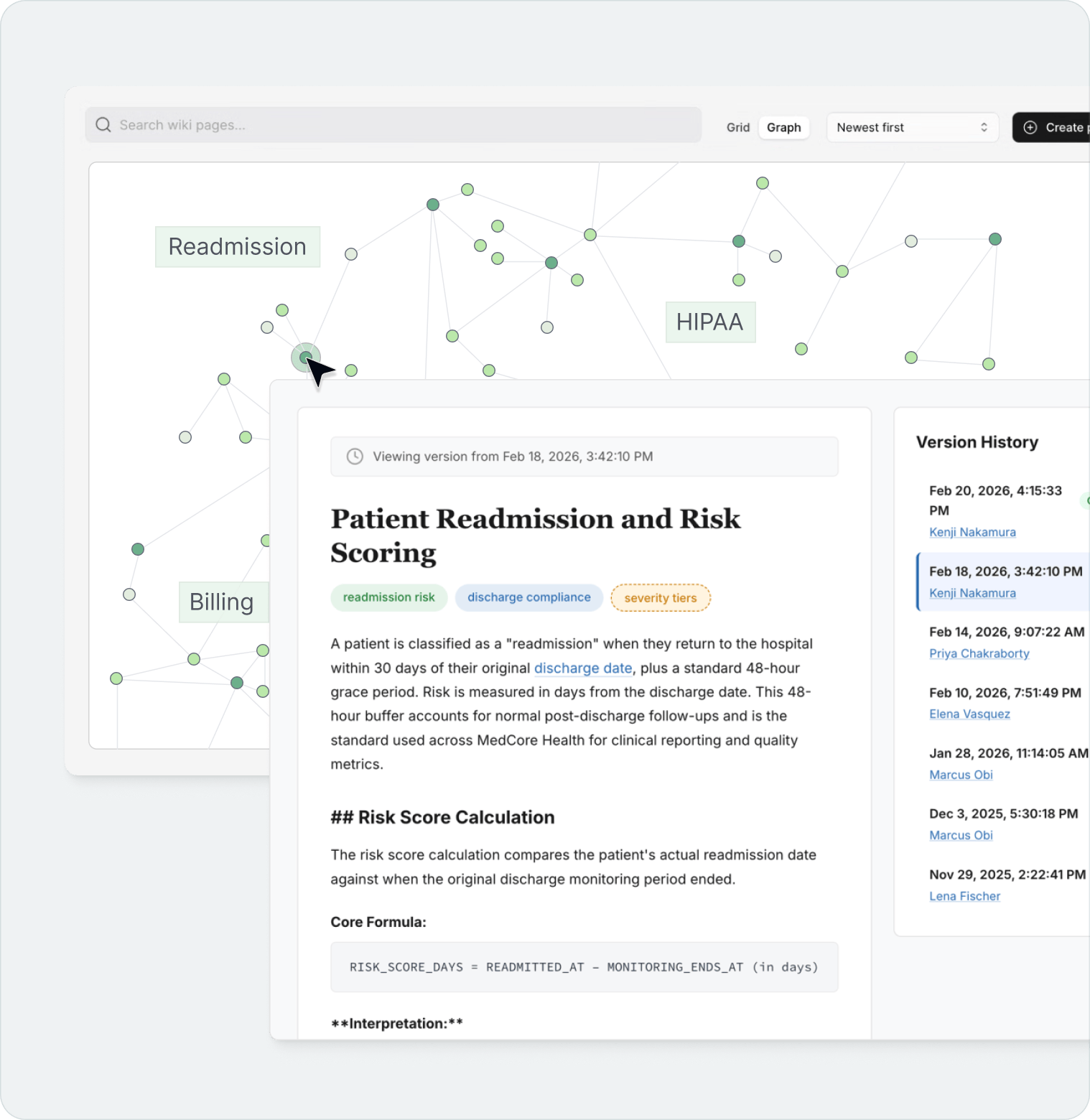
PromptQL initially described the answer in the language of semantic layers: a governed map of metrics, relationships and rules that a model can use instead of guessing. That is sensible, as far as it goes. Yet in a December 2025 essay, Gopal argued that a perfect semantic layer was too brittle and too expensive to maintain as the sole home for company meaning. Real organizations disagree, revise, make exceptions and forget to update the glossary. The new metaphor was a wiki: small contributions, recorded disputes, revision history and meaning assembled while people work.
“A perfect semantic layer is neither sufficient nor operable.”Tanmai Gopal, writing about PromptQL's approach to company knowledge
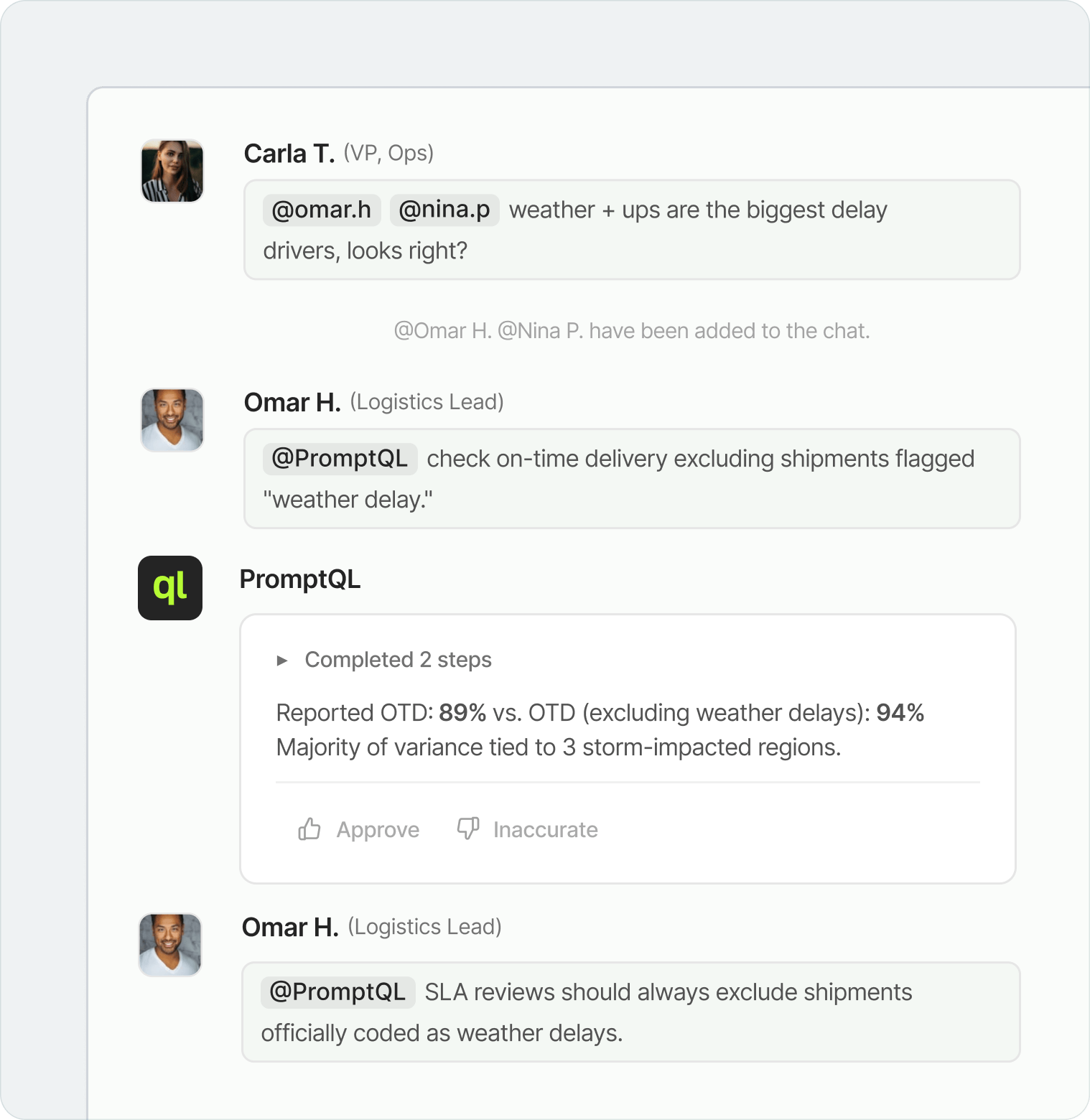
That change of mind is more interesting than a new interface. PromptQL's current workspace uses shared threads, rooms, a wiki and task-focused bots. A teammate can enter the same thread, challenge an assumption and leave a useful correction for the next task. The agent can query connected systems, produce an analysis or draft an artifact; the people can see and revise what it did. In its channel product, PromptQL Tag, the agent can also be mentioned in Microsoft Teams. The company says it acts with the requesting person's permissions rather than one blanket bot identity.
Where the claim meets a real warehouse
The company's public case studies give the idea some scale, with the usual caveat that the customers and outcomes are described by PromptQL itself. A grocery technology business connected an enterprise warehouse of more than 800 tables, spanning operations, pricing, workforce and customer engagement. The case study says analysts could answer complex questions in minutes that had taken hours, then operations staff began using the tool directly. In another account, a global restaurant chain with 40,000 locations across more than 100 countries chose PromptQL after reviewing more than 100 build-or-buy options. Its regional teams wanted answers beyond dashboards without waiting for scarce SQL specialists.
Those cases explain both the customer and the market. PromptQL is selling to organizations whose data sits in warehouses, applications and operational systems, and whose questions do not arrive neatly packaged as dashboard filters. It can serve analysts, engineering teams, finance, operations, sales and executives. Its website names Cisco, McDonald's, Instacart, Swiggy and Lightspeed among customers. A financial technology case study describes using it to make explainable recommendations for credit unions; a Fortune 100 account concerns supply chain intelligence. The company has not published a total user count or an audited measure of accuracy across these deployments.
The meter is running
PromptQL's commercial model follows the work done rather than merely the number of seats. Its public site lists a free playground, a team plan beginning at $40 per paid user each month in usage budget, and enterprise plans with a $1,000 monthly minimum. A separate pricing page describes normalized usage units for model tokens, infrastructure and agent execution; larger customers can discuss dedicated infrastructure, their own cloud or self-hosting. The exact bill depends on model and task complexity. This is a useful distinction for buyers: an impressive ten-second answer and a deep, multi-step investigation are not the same unit of work.
A team could copy the operating method without buying PromptQL. Start with one stubborn, recurring question. Write down the metric definition, the exceptions and who can see the underlying records. Give colleagues a visible place to correct the first answer. Test whether the second answer actually uses that correction, and whether a different user still sees only permitted data. The cost is the labor of tending the shared knowledge as work changes. That is true whether the infrastructure is bought or built.
The limitation is equally practical. Shared context only improves an answer if people expose their disagreements, resolve what matters and keep old rules from masquerading as current ones. Permissions can prevent the wrong person from seeing a record; they cannot decide what “healthy pipeline” should mean this quarter. PromptQL's wager is that the software can make this work small enough to do in the moment, while the answer is still on the screen. The machine may be quick. The business, as ever, is complicated.