Give a new employee access to the company GitHub account, Jira board and Slack workspace, and someone will ask three questions. What can they see? What can they change? Who approved it? Give the same access to an AI agent and the questions sometimes arrive after the agent has already started work. Guild.ai exists in that awkward interval.
- Guild builds a control plane for AI agents: a place to run them, limit access, trace actions and track cost.
- Its developer tools are open source; its commercial product is the managed operating layer.
- The company says it raised $44 million by March 2026 and lists Turo, Sovrn and WorkWhile among early users.
- Its bet: reusable agents are useful only when every copy remains accountable.
The San Francisco company was founded in 2025 by James Everingham, its CEO, and Chris Waterson, its CTO. Everingham had led developer infrastructure at Meta, where his remit covered tools used by a vast engineering organization. As agents multiplied there, the first strain was prosaic: budgets vanished and servers ran out, according to Everingham’s account. The experience helped turn his attention from what an agent could do to who could govern it. At small scale, a clever script can be managed by the person who wrote it. At large scale, the script acquires colleagues, credentials, a budget and a habit of surprising people.
The first agent is charming. The fiftieth needs management.
Guild’s product is easiest to understand by following a mundane request. A support issue appears in Jira. An agent reads it, searches documentation, checks a related pull request in GitHub and posts a summary to Slack. None of those steps is exotic. The difficulty is deciding whether the agent may read that repository, whether it may write to that channel, which model it can call, what a run costs and what happened when the answer is wrong.
Guild puts those decisions in a common control plane. An agent gets its own identity. Administrators keep service credentials outside agent code and scope access to particular actions or endpoints. The runtime records sessions, tool calls and model use. Teams can set approval gates for sensitive moves and inspect costs by agent, model or workspace. It is a software platform for the least theatrical part of AI: the rules that let a good idea survive contact with production.
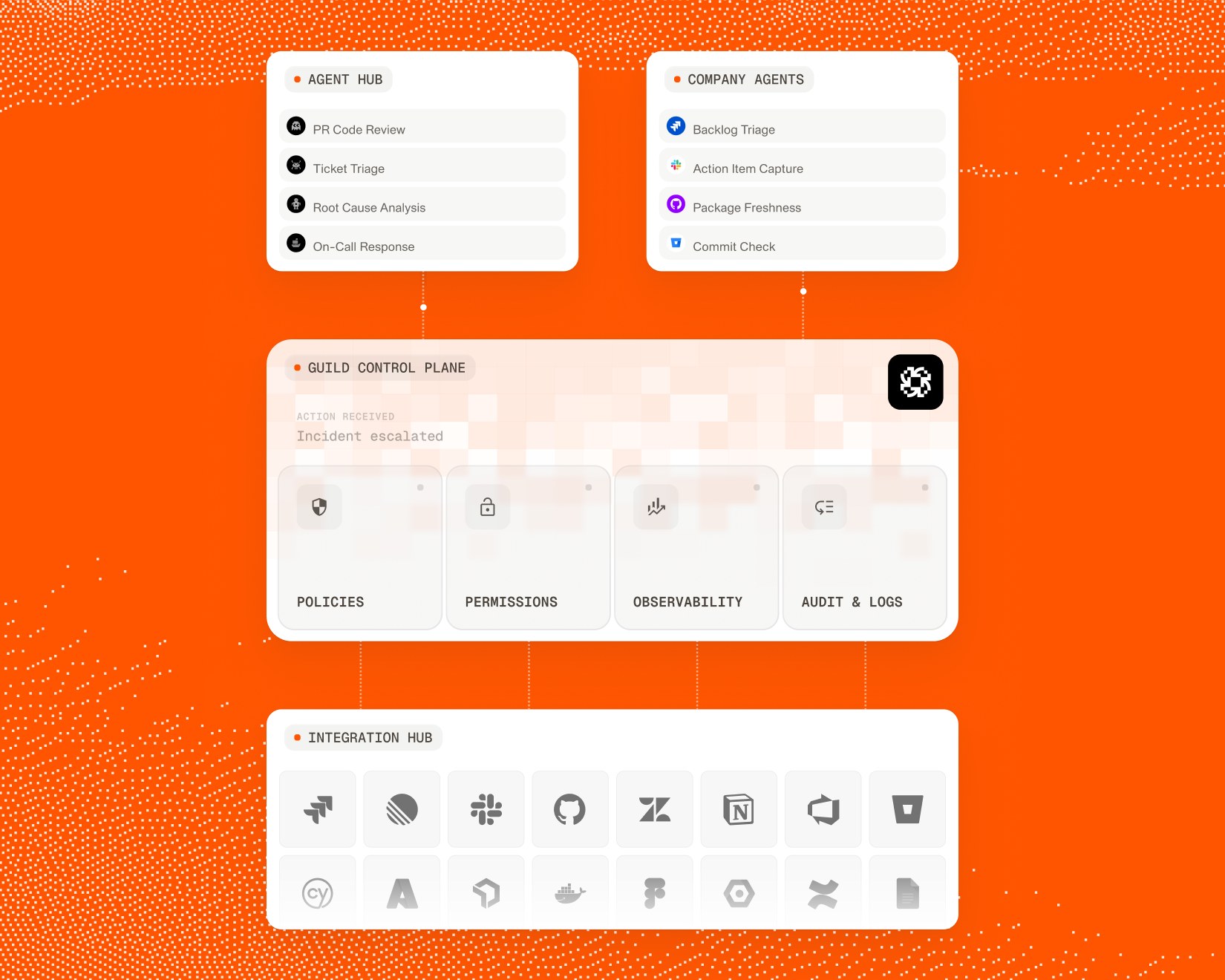
For developers, Guild offers a TypeScript SDK and command-line tools to create, test, version and publish agents. Teams can start with examples for ticket triage, code review, Slack interaction or technical support. The Agent Hub lets them discover and fork agents, then run those copies under their own workspace controls. That last detail is the point: sharing the recipe need not mean sharing the keys.
“It’s like gremlins. The first one’s fine until they start multiplying and taking over and pulling levers in your infrastructure.”James Everingham, describing the agent control problem
A company built around a missing layer
The crowded agent market has builders, frameworks, model vendors, gateways and dashboards. Guild’s pitch is that companies should not have to stitch each of those into a separate management system. It sells a runtime and governance layer that sits where agents meet company tools. In a market fond of bigger models, this is a bet on smaller permissions.
The distinction is practical. An observability dashboard may explain a mistake after it occurs. Guild says its permission checks operate during execution, before an unauthorized tool call goes through. A model provider can show its own usage; Guild Insights aims to gather spending across multiple providers and tools. Its newer Optimizer then tests cheaper configurations against evaluations built from existing production sessions, and presents changes for a human to accept. Guild reported one internal four-agent optimization that moved the cost of a run from roughly $13 to $7.50. That is an internal example, not a forecast for customers.
What did the company spend to take this position? It raised $14 million in seed money and a $30 million Series A, according to its March announcement, with GV leading the latest round and other investors including NfX, Khosla Ventures, Scribble Ventures, Acrew Capital and Webb Investment Network. Axios reported a valuation of about $300 million at the time. Guild advertises a free starting point, a $199-per-month Starter plan with 1,500 agent automations and 500,000 tokens, and enterprise plans with additional controls. The exact bill for a large deployment depends on a sales agreement.
The customers reveal the shape of the problem
Guild names Turo, Sovrn and WorkWhile on its site. They are different businesses, but their public comments cluster around the same concern: keeping track of what agents touch and what they cost. BasicOps offers a more detailed account. Its chief revenue officer, Justin Oberbauer, experimented with agents that could hold their own BasicOps seats. They were assigned tasks, drafted documents, saved work to Drive and linked it back to the task. Guild supplied the agents; BasicOps supplied a workplace for them.
The BasicOps story is useful partly because it admits a snag. Users still have to leave BasicOps to set up Guild and configure an agent. The partners want provisioning to become simpler. The lesson is familiar from every enterprise software rollout: even good automation meets the stubborn geometry of accounts, permissions and setup screens.

James Everingham / co-founder and CEOHis earlier work on developer infrastructure at Meta supplied a useful perspective: when tools multiply, the management layer becomes part of the product.
Guild has also joined the Linux Foundation’s Agentic AI Foundation as a Silver Member and says it is working with the Linux Foundation on internal agents. That relationship pushed Guild toward support for Goose, an outside agent framework. It is a telling test of the company’s claim to neutrality. A control plane becomes more useful when it can govern work that was not born inside its own builder.
The copyable part is the permission slip
A team need not buy Guild to learn from its design. List the agents already running. Give each one a named owner and a separate identity. Limit its tool calls to the narrowest useful actions. Keep credentials outside its code. Record what it did and what it spent. Put a human approval step before high-impact changes. Make every agent version recoverable. These are ordinary software habits, applied to software that can improvise.
They matter most when agents touch real systems: source repositories, customer records, incident workflows and the monthly model bill. If a team has only a harmless local experiment, the full control plane may be more apparatus than it needs. Once agents are shared across teams or allowed to act on production systems, improvisation becomes an expensive management philosophy.
In September, Guild published a survey with Morning Consult that captured the contradiction it is selling into. Among surveyed IT decision-makers, 96.4% believed their organization had a complete agent inventory. Yet 66.7% of organizations with agents reported an agent-related operational consequence in the previous year. The survey is Guild-sponsored and describes respondents, not every company. Still, the mismatch is arresting. Confidence can be very cheap when nobody has counted the keys.
Guild’s wager is that AI agents will become common enough for that count to be routine. It may be right. The first question for any agent will then sound less like science fiction and more like the first morning in a new job: where is your badge, and what exactly does it open?