Numbers Station is for the person who asks, “How many customers churned after the price change?” and would prefer an answer before the analyst queue reaches next Thursday. It sits between ordinary employees and an organization’s analytical sprawl, translating plain language into searches, SQL, charts, explanations, and actions. The promise sounds familiar. The machinery beneath it is more interesting.
Most “chat with your data” demos begin with a clean table and end before anyone asks what “customer” means. In a real company, that word may exclude trials, include subsidiaries, change by quarter, and be defined differently in Finance and Sales. Numbers Station’s central argument is that a capable language model still needs a map of the local terrain. It calls that map the Knowledge Layer.
This makes the product a fit for established, data-heavy organizations with functioning warehouses and overworked data teams. Business users get a conversational front door. Analysts get a chance to stop answering repeat questions. Administrators keep controls over who can see which rows and columns. Developers can embed the experience in another product or call it through APIs. A two-person startup with three spreadsheets can buy far less machinery.
The origin story
A radio name for the least glamorous job in AI
Founded in 2021, Numbers Station came out of the Stanford AI Lab orbit. The founding group brought together Stanford PhDs Chris Aberger, Ines Chami, and Sen Wu with associate professor Chris Ré. They noticed that much of the AI crowd was chasing content and images while enterprises were still paying people to clean records, reconcile systems, and handcraft repetitive transformations. Their first product territory included natural-language SQL transformation, AI-assisted transformations, and record matching.
The name is a sly choice. Historical numbers stations broadcast coded sequences over shortwave radio, supposedly for distant agents. This Numbers Station also converts messages into operations, although its intended recipient is a warehouse rather than a spy with a one-time pad. The joke has a cost: search for reviews and you will quickly meet hobbyists debating mysterious broadcasts. The standalone software has little public conversation on Reddit and only a small crop of customer commentary elsewhere.
Money arrived early. A $17.5 million Series A led by Madrona was announced in March 2023, with Norwest Venture Partners, Factory, and several angels participating. In March 2024 the company opened early access to Numbers Station Cloud, bringing its managed conversational analytics product to a wider enterprise audience. Alation acquired the company on May 20, 2025. Terms were not disclosed.
What the user sees
A chat box with a committee behind it
The interface is deliberately legible. Start a chat, tag the dataset or dashboard you want, and ask a question. Answers may arrive as prose, a table, a chart, or a combination. Suggested prompts help first-time users escape the blank box. A broad objective can trigger a deeper exploration rather than one narrowly generated query.
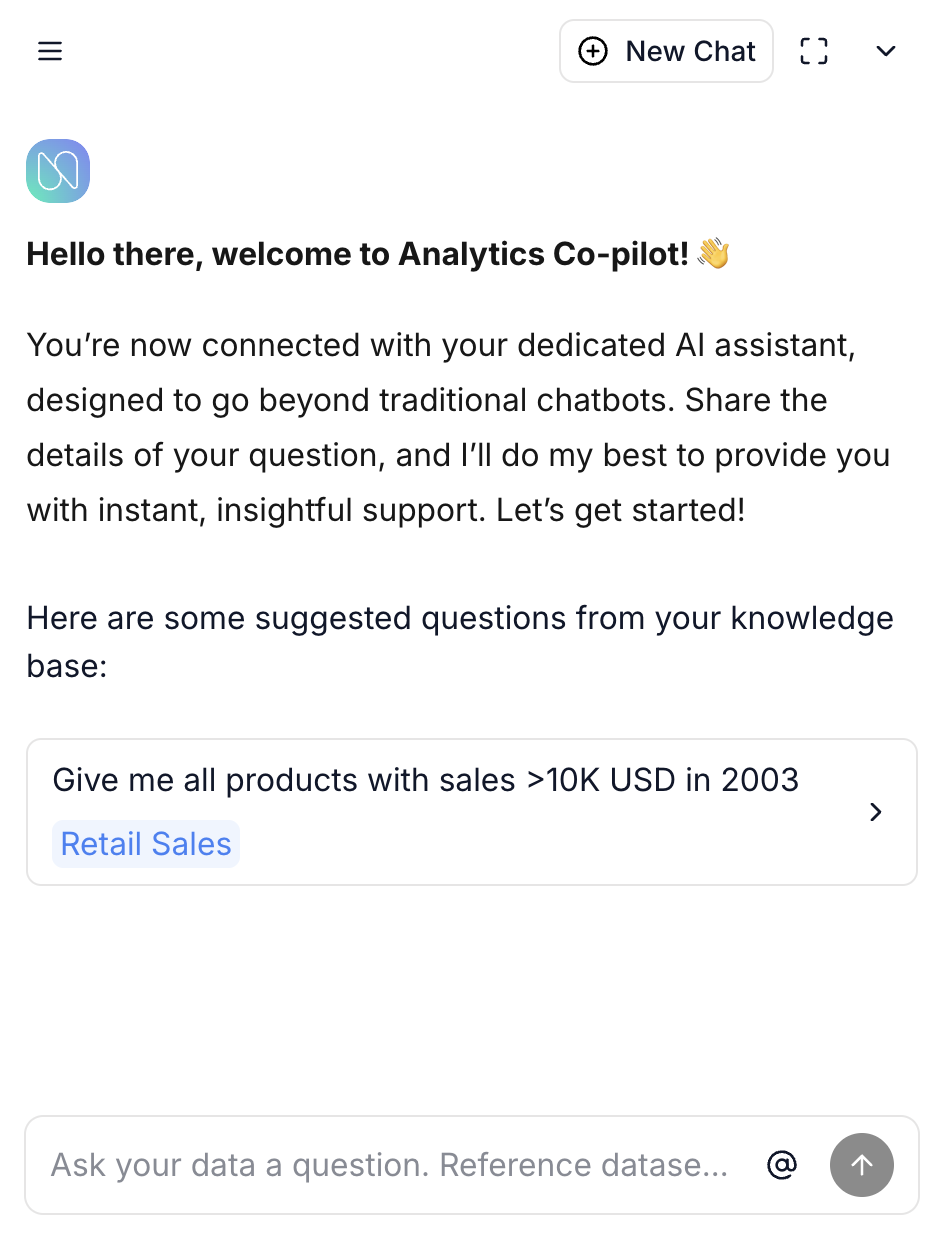
Behind that calm screen, a planner breaks a request into jobs. A search agent checks dashboards, documents, and previous answers. An intent agent asks for clarification when “last quarter” or “revenue” needs pinning down. A query agent writes and executes SQL. A charting agent draws the result. A review agent inspects odd outputs, including empty values and zeros. An action agent can pass work into a downstream process.
One question, several desks
This division of labor matters because analytics questions fail in different ways. A missing table is a search problem. A vague time range is an intent problem. An invalid join is a query problem. Numbers Station’s agentic loop can read a database error, revise the SQL, and try again. The goal is less theatrical autonomy and more practical recovery from the little failures that kill polished demos in production.
The part worth buying
Company memory, organized enough to query
The Knowledge Layer ingests warehouse schemas, semantic definitions, historical SQL, dashboard metadata, dbt or LookML assets, documents, slides, and, where connected, conversations from tools such as Slack or Teams. It links metrics, dimensions, entities, relationships, and business language. Human administrators can correct it. Feedback from actual questions is folded back into the system.
Numbers Station says roughly 80 to 90 percent of enterprise questions refer to something already answered in a dashboard, document, or conversation. Treat that figure as the company’s operating observation, not a universal constant. Still, the design choice is sound: search for the accepted answer before spending compute inventing a fresh one. Reuse also reduces the chance that Tuesday’s “net revenue” quietly differs from Monday’s.
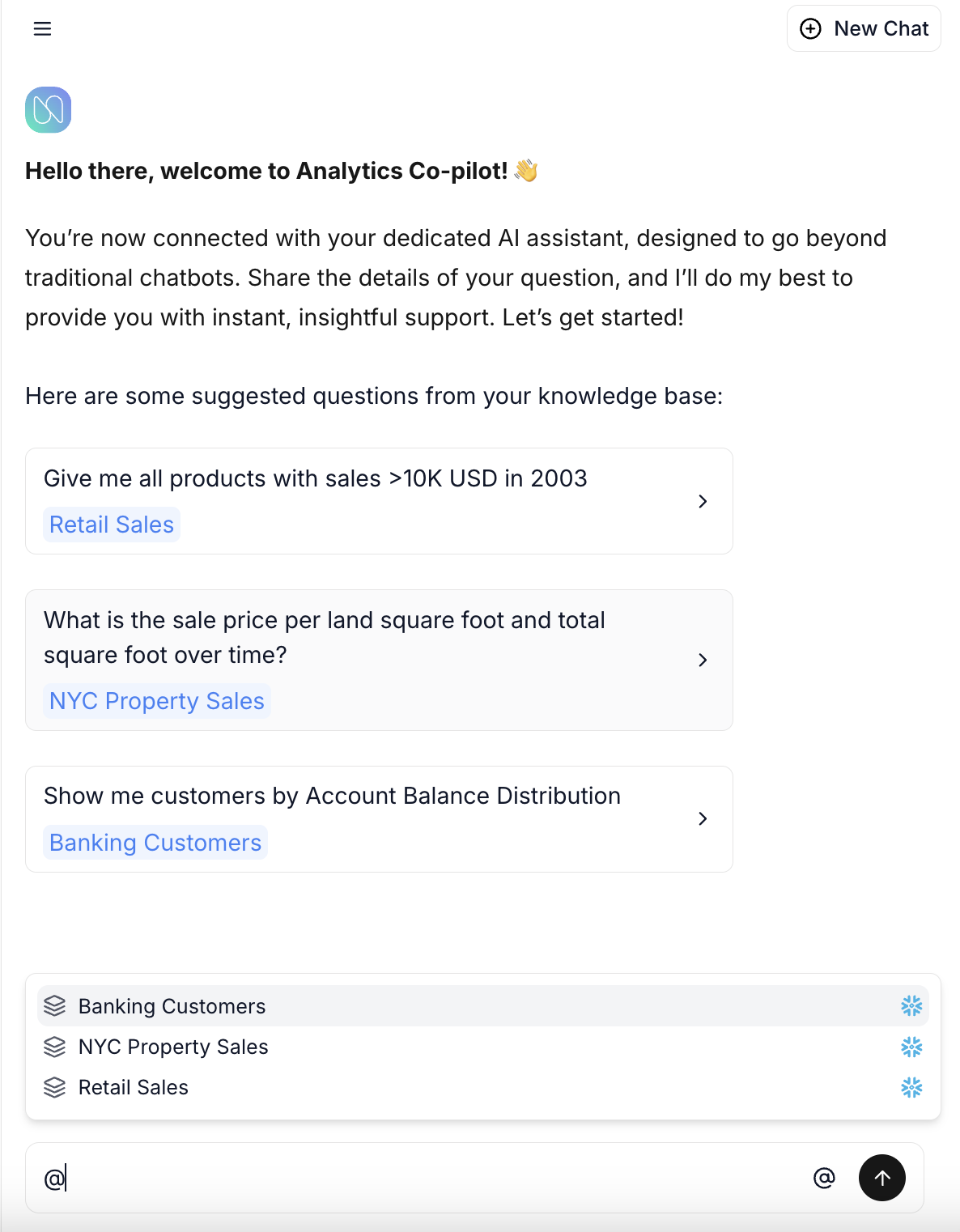
Connections include Snowflake, BigQuery, Redshift, and Databricks, with later release notes adding Microsoft SQL Server and Elasticsearch capabilities. The product can index analytics assets and communication channels, then call external services described with OpenAPI. Results can remain in the Numbers Station web experience, appear through a branded JavaScript widget, stream through APIs, or become part of a workflow such as building presentation slides.
| Need | Numbers Station’s approach | Buyer should verify |
|---|---|---|
| Self-service answers | Natural-language chat, generated SQL, tables, charts, follow-ups | Accuracy on your hardest joins and internal vocabulary |
| Reuse old analysis | Searches dashboards, documents, query history, and conversations | Coverage of your existing BI and documentation tools |
| Governed access | Source permissions, SSO, row and column controls, sensitivity settings | Identity mapping and audit requirements in your deployment |
| Product embedding | Customizable widget, open-source UI option, REST and streaming APIs | Branding depth, latency, quotas, and maintenance ownership |
Security and deployment
The warehouse keeps the valuables
Numbers Station’s documentation says raw data stays in the customer’s environment and queries run against the connected source. Customers can use the managed SaaS environment, described as SOC 2 Type 2 compliant, or deploy in their own AWS, Google Cloud, or Azure VPC. The private option keeps processing and query generation inside the customer’s network controls.
Model choice is part of that posture. The platform documents support for OpenAI models through Azure, Anthropic models on AWS, Gemini on Google Cloud, Meta models on Databricks, and self-hosted options. In July 2025, release 196.12.1 made GPT-4.1 the default, including for customer VPCs. The meaningful buyer question is not which logo appears on the model picker. It is whether permissions, prompt context, logs, and generated queries follow your governance policy end to end.
How it compares
This is an analytics layer, not a prettier dashboard shelf
Traditional BI products such as Tableau and Power BI lead with dashboards and mature visualization ecosystems. ThoughtSpot has long sold search-driven analytics. Sigma and Hex emphasize collaborative analysis with spreadsheet or notebook sensibilities. Dataiku spans a broader data science and machine-learning workflow. Seek AI is closer to the natural-language SQL lane. Numbers Station’s distinction is the combination of a business-context layer, multiple specialized agents, embedded delivery, and flexible enterprise deployment.
| If your priority is… | Shortlist first | Why |
|---|---|---|
| Governed conversational analysis across existing assets | Numbers Station / Alation, ThoughtSpot | Both focus on natural-language discovery; test contextual accuracy closely |
| Rich dashboard authoring and a large skills market | Tableau, Power BI | Visualization depth and ecosystem may matter more than agent workflows |
| Collaborative hands-on analysis | Hex, Sigma | Analysts may prefer notebooks, SQL, or spreadsheet interaction |
| Broad data science operations | Dataiku | Wider model-building and operational tooling |
Pricing is the least conversational part of the experience. No public price list or self-serve plan is available. This is a contact-sales product with implementation implications, and acquisition by Alation reinforces its enterprise direction. Ask for a paid proof of concept using your data, your permissions, and a fixed test set. A canned demo cannot reveal whether the system understands the difference between a booking, a bill, and recognized revenue at your company.
Customer guide
Bring twenty nasty questions to the demo
Start with the questions that currently bounce between teams. Include ambiguous phrasing, metrics with contested definitions, joins across systems, permission-sensitive rows, and one request whose correct answer is “I don’t know.” Score the returned SQL as well as the prose. Measure how often the product finds an existing trusted answer, how long corrections take to enter the Knowledge Layer, and whether the next user benefits from that correction.
Then test the boring work: connection setup, SSO, data lineage, audit logs, model routing, timeouts, failed queries, and ownership when a source schema changes. Numbers Station has shipped detailed controls and administration APIs, but fit depends on the connectors and governance patterns already in your estate. Its public material cites Jones Lang LaSalle using the platform across millions of commercial-real-estate data points. Vouch has also been named as a conversational analytics customer. Those examples show range, not a substitute for your own evaluation.
Public reviews are too sparse to support a crowd-sourced verdict. One vendor-published JLL comment praised the platform’s ability to learn through use and help data teams test hypotheses. The more telling evidence is the product’s release cadence after acquisition: 2025 updates added Deep Research, directed-graph workflows, enterprise keys, permission APIs, widget branding, advanced reasoning, and longer SQL timeouts. This is infrastructure still being worked, not a frozen acquisition trophy.
The verdict
Numbers Station makes sense when a company already owns plenty of analytics but cannot reliably deliver them to the people asking questions. Its best idea is modest and durable: language models need institutional memory, explicit permissions, and colleagues that check their work. Small teams should look for a lighter tool. Enterprises evaluating Alation’s agent strategy should put this one through a demanding, company-specific trial.
Keep listening