The visitors had come and gone before the answer arrived. In GoodData’s account of Zartico, a company serving destination marketing organizations, traditional tourism surveys took six to nine months to complete and analyze. Imagine trying to decide which event deserves public money when your evidence belongs to a season that has already packed its bags. The immediate problem was time. The larger problem was who could turn data into something useful.
- GoodData.AI lets companies put dashboards, assistants and analytics agents inside their own products.
- A shared semantic layer gives those interfaces the same definitions of business metrics.
- Its commercial model and multi-tenant architecture suit analytics delivered to many customer environments.
- AI still needs sound data, deliberate permissions and someone responsible for reviewing its work.
The survey was already late
Zartico’s co-founder and CIO, Jay Kinghorn, wanted destination organizations to have the kind of analytical resources private companies used. His team evaluated more than 12 analytics and business intelligence providers. According to the published customer story, flexible pricing, usability and the ability to scale helped decide the contest in GoodData’s favor.
The resulting Destination Operating System let customers investigate events and visitation patterns, build campaign reports and explain results to public and private stakeholders. GoodData supplied a logical data model, dashboards, self-service analysis and automated change management. Zartico supplied the particular knowledge of destinations. That division of labor is central to this company’s business: provide the machinery on which somebody else builds a useful service.
The case study also reports more than 80 product enhancements released in six months. For a software business, that number is particularly revealing. Adding customers matters. Updating their experience without rebuilding everything for each one is what makes growth manageable.
“from four clients to well over 120 clients”Jay Kinghorn, Zartico co-founder and CIO / excerpt
Revenue needs a dictionary
There is a quieter problem underneath the tourism story. A business number has a definition. In a hypothetical finance meeting, one person might mean booked revenue, another recognized revenue, and a third cash received. All three can produce an attractive chart. Put an AI assistant in the room and the disagreement acquires a very fluent spokesperson.
GoodData.AI’s semantic layer makes business meaning explicit. Teams define metrics, dimensions and rules in a shared model that dashboards, APIs and AI experiences can reuse. A question phrased differently should still reach the same business definition. Permissions determine which data the person asking is entitled to use.
Fuelfinance makes the point concrete. The financial platform wanted tailored analytics for individual clients, including custom data sources, without expanding its internal analytics team. Its March 2026 case study says competing options lacked the semantic foundation, financial context or assistant customization it wanted. GoodData offered shared metric definitions, flexible dashboards and developer tools.
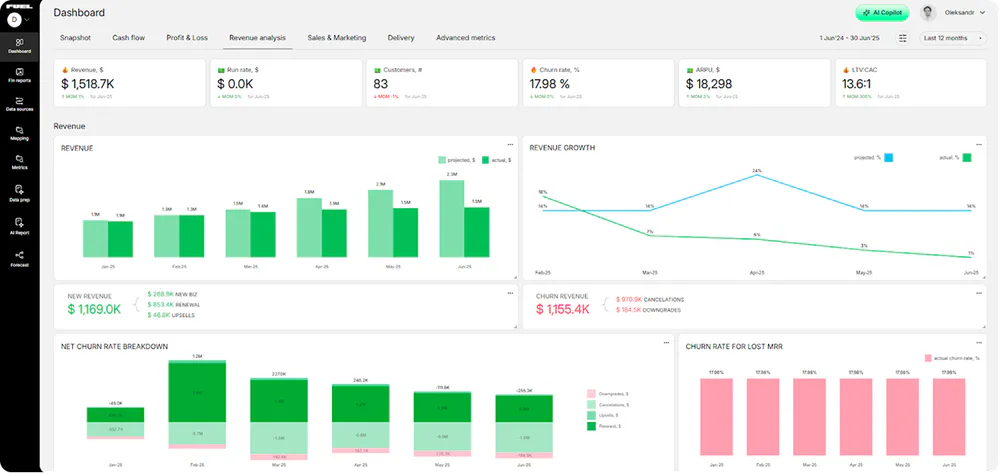
The account describes further AI integration as a next step. That distinction matters: choosing infrastructure for an AI strategy is an observable decision; proving every future assistant workflow is another task. The useful lesson is available already. Start by making the business vocabulary reusable, then expand what consumes it.
The dashboard travels incognito
GoodData occupies an interesting position in enterprise software. People can use its analytics without encountering its brand. A software provider embeds the charts in its own application, applies its own colors and serves its own customers. The user gets answers where the work happens, without another destination to remember.
The platform offers several routes into that application: iFrames for straightforward embedding, Web Components for broader web integration, and a React SDK for more customized interfaces. Python tools and APIs help manage the environment behind those screens. Self-service dashboards remain part of the offering, alongside assistants and agents.
Multi-tenancy gives that proposition its commercial shape. Separate customer workspaces can receive shared analytics content while keeping access distinct. A provider can maintain common definitions and distribute changes across its customer base. The work is to balance reuse with the genuine differences between customers, rather than letting every request become a separate little software kingdom.
Analytics as Code applies familiar software practices to this maintenance: versioning, pull requests, automated deployment and rollback. Those practices give teams a way to inspect changes to definitions and configurations. GoodData’s public GitHub repositories, including its UI and Python SDKs, make the developer emphasis tangible.
Power BI, Tableau, Looker, ThoughtSpot and Sisense are among the alternatives buyers consider. The sensible comparison starts with the job: internal reporting, customer-facing embedding, semantic consistency, or governed agent operation. GoodData’s distinctive pitch ties these needs together through reusable definitions, tenant management and programmable analytics. Whether that combination earns its keep depends on the application.
A name catches up with a product

Roman Stanek founded GoodData in 2007, after founding NetBeans and Systinet. The history makes the current AI branding more interesting. GoodData has spent years dealing with how enterprises build, distribute and govern analytics. Those existing concerns now sit underneath the agent proposition.
In 2020, Visa announced an investment and partnership around data products and customer insights. In July 2021, GoodData announced a $45 million J.P. Morgan credit facility to support sales, engineering and cloud-native development. A credit facility is financing capacity, not an equity valuation. That year’s GoodData.CN launch also gave enterprises a customer-controlled deployment option.
The AI sequence is unusually easy to follow. GoodData acquired Understand Labs in September 2025, adding data storytelling and agentic expertise. It publicly launched its MCP Server on January 21, 2026, introduced Context Management in March, and launched Agent Builder on April 22. Eight days later, it announced the GoodData.AI name.
MCP, the Model Context Protocol, gives compatible AI tools a route to operate analytics assets through governed interfaces. Agent Builder lets teams configure roles, skills, knowledge and permissions, then distribute those configurations across workspaces. The ambition is to let agents participate in analytical work, including changing and running its underlying assets. Reviews and access controls become more consequential when the assistant can do things.

The bill follows the workspace
On the current pricing page, Professional combines a platform fee with the number of workspaces and includes unlimited users and data. Enterprise uses custom pricing, with additional governance, agent and support capabilities. AI query allowances depend on the tier. A buyer needs a quote that covers the planned customer environments, AI consumption, deployment and service requirements.
The economic attraction for a software provider is understandable: more people using one customer’s analytics does not automatically become a per-seat purchasing exercise under the advertised workspace model. But integration, modeling, security decisions and ongoing maintenance still require work. The vendor’s invoice is one part of the cost of delivering a data product.
Zartico’s selection story offers a useful purchasing habit. Compare the cost of the starting customer base with the cost of the business you hope to become. A platform that fits the prototype and makes each new customer cumbersome can charge its most expensive fee in engineering time.
Give the answer a paper trail
On September 23, 2026, GoodData.AI announced AI Observability. It connects adoption, quality and cost with traces of individual interactions. Teams can inspect skills, retrieved knowledge, memory, model calls and failure points, and look for recurring problems. The promise is operational: when an answer goes wrong, the people responsible should have something to investigate.
- Choose one recurring business question.
- Agree on its metrics and authorized data.
- Test the answer across real customer permissions.
- Review changes, inspect failures, then expand.
This sequence is an editorial recommendation, not a customer result. Shared semantics cannot repair missing transactions or turn an incorrect metric definition into a correct one. Tracing helps only when someone examines it. For a team that needs a simple report in one environment, the modeling and administration may be more machinery than the job deserves.
For a company delivering analytics to many customers, those chores can become the product’s foundation. GoodData.AI’s most useful idea is that the dashboard, the embedded application and the agent should inherit the same carefully maintained understanding of the business. The accountant still gets a say. Increasingly, so does the person who has to explain what the machine did.
Try the machinery
Explore the platform, plans, company blog and developer repositories. For walkthroughs, visit the product tours, YouTube demos and conversations or company overview video.
Follow GoodData.AI on LinkedIn, X and Facebook, or browse its latest announcements.