The short version
- Euno maps lineage, definitions, usage, ownership and rules into context that people and AI agents can query.
- Its public proof point is Bolt: 15,000-plus Looker dashboards, 5,000-plus metrics and more than 70 practitioners.
- It sells quote-based SaaS by managed data resources, with unlimited users and agents.
- The bet works best inside a sprawling modern data stack. Simpler shops may be buying a map for a village with one road.
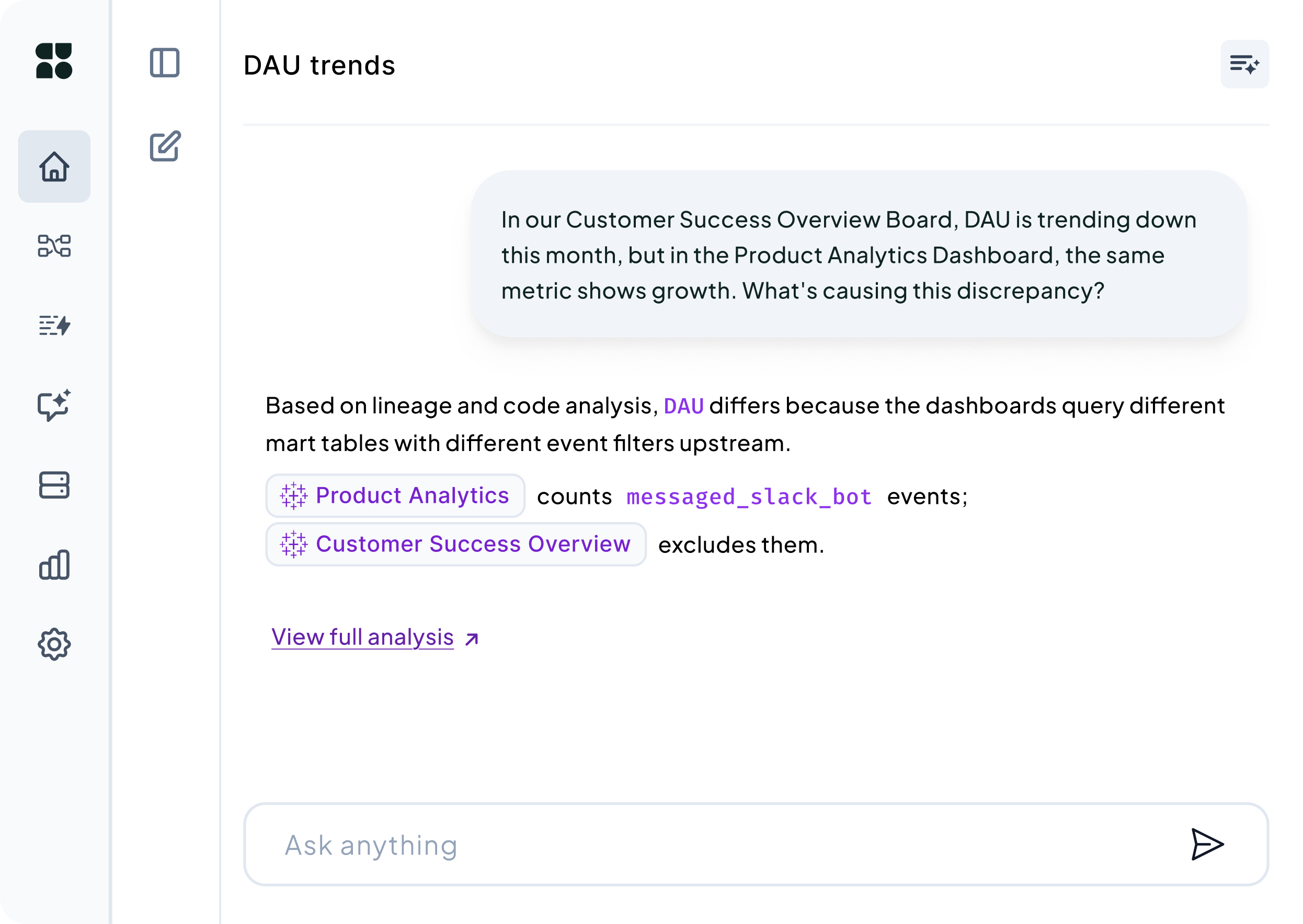
The dangerous thing about a number is not that it lies. It is that it can tell several truths at once. Ask a sales chief, a finance director and a product manager for “revenue,” and you may receive three defensible figures, each assembled from a different table, filtered on a different date and polished for a different meeting. A human analyst sees the discrepancy and calls a colleague. An AI agent sees three columns with promising names and chooses.
This is the small, awkward gap Euno has chosen to occupy. The Sunnyvale company connects to warehouses, transformation tools and business-intelligence systems, then reconstructs how data moves and what the organization believes about it. Tables, columns, dashboards, metrics, owners, usage, classifications and definitions become a graph. From that graph, a person can ask which dashboards depend on a model; an automated workflow can flag an uncertified asset; an agent can receive only the context appropriate to its user and task.
The phrase “AI context platform” has the atmospheric quality of a weather report. In practice, Euno is selling plumbing with a memory. It wants to know not merely where a pipe runs, but which tap people actually drink from, who maintains it, whether the water is sensitive and which sign says it is safe.
First, the humans stopped asking
Sarah Levy and Eyal Firstenberg founded Euno in 2023. Levy had spent two decades around data in cybersecurity, medical technology and finance; Firstenberg had built the cybersecurity company LightCyber. Both had made homegrown tools for definitions, calculations and data models. They might have treated that experience as proof. Instead, before hiring their first employee, they spent roughly six months interviewing data leaders at more than 300 companies.
The interviews changed the emphasis. The recurring complaint was not a lack of dashboards. It was the loss of trust as logic multiplied across them. Euno emerged from stealth in March 2024 with $6.25 million and the language of “soft governance”: let analysts keep moving in SQL and BI tools, detect the useful logic they create, then help a central team turn it into consistent, reusable models. Governance would follow the work instead of standing at the door with a clipboard.

Then generative AI moved the queue. A data catalog designed for a patient human could tolerate stale documentation and missing lineage because that human supplied the error correction. The analyst frowned. The steward checked a policy. The engineer remembered why a field had been renamed. An agent does not grow suspicious in quite the same way. It moves at machine speed through whatever context it has been given.
A metric without lineage is not quite a fact. It is a rumor with decimal places.The practical case for Euno
Euno did not discard its original product. It promoted the underlying map. In 2026, the company presented its system as the context layer behind enterprise agents: continuously assemble metadata, apply governance labels, scope the result by persona and task, and deliver it when an agent queries data. The old promise was peace between analysts and governance teams. The new promise is that Claude, Cursor or a warehouse agent can tell the certified revenue metric from its persuasive cousin.
Fifteen thousand dashboards walk into a catalog
The least theoretical evidence comes from Bolt, the European mobility company. Its analytics estate includes more than 15,000 Looker dashboards, thousands of dbt models, over 200 schemas and more than 5,000 metrics. It also has six catalog tools, including Euno and DataHub. This is not a clean-room demonstration. It is the kind of environment in which a column can acquire history, political constituency and an obscure dependency before lunch.
Bolt used Euno to synchronize dbt tables with Looker views, combine ownership and usage with lineage, and search the resulting model. The practical before-and-after is pleasingly unromantic: less manual alignment, easier dependency tracing, clearer ownership and a place to find trusted metrics. More than 70 practitioners use it, with adoption expanding quarterly. The governance work Bolt needed anyway becomes the foundation for deciding which assets are ready to expose to Databricks Genie, Looker agents and other AI systems.
The bill follows the map
Euno is a business-to-business cloud subscription sold through demos and negotiated quotes. There are no public dollar prices. The unusual part is the meter: unlimited users and AI agents, with plans scaling by the number of managed resources - tables, columns, dashboards, models, metrics, users and groups. The Start tier covers up to 150,000 resources; Scale covers up to 1.5 million; Enterprise goes beyond that with custom integrations and support.
This is more than packaging. Seat pricing assumes value grows when another human opens the software. Euno assumes value grows with the breadth and complexity of the graph, especially when software agents may outnumber their human supervisors. The model also reveals the target customer. A startup with one warehouse, twenty dashboards and definitions everyone remembers over lunch may not need a context platform. A multinational with Snowflake, Databricks, dbt, Tableau, Looker and several security regimes has forgotten more than a small company has documented.
Its competitive set is consequently broad. Alation, Collibra, Atlan and open-source DataHub occupy parts of the catalog and governance market. Observability tools map failures. Semantic-layer products centralize metrics. Internal platforms stitch together whatever remains. Euno's distinction is to make the metadata active: rule-based labels change as the environment changes, workflows respond to policy deviations, and a scoped slice of context is served to an agent at query time.
The integrations make the claim tangible. Cyera classifications can travel from warehouse columns into BI reports and dashboards, showing where sensitive data reaches business users. Omni logic can enter Euno's lineage graph and then reach an agent. Connectors cover Snowflake, BigQuery, Databricks, dbt, Fivetran, Tableau, Looker, Power BI, Sigma, ThoughtSpot, Hex, Okta and others. Euno's own public GitHub organization offers Terraform tooling and an API collection - small but useful signals that this is infrastructure meant to be operated, not admired.
The trick worth stealing
In September 2026, N47 led a $23 million Series A, joined by existing investor 10D and founders or executives from Wiz, Cyera, Eon, Tavily and Tableau. Together with the seed round, Euno has announced $29.25 million, which it rounds to $29 million. The capital is intended for sales, marketing and AI research. Funding is not evidence that the product works. It is evidence that investors believe the question has become expensive enough to matter.
What another team can copy
- Interview across stacks and company sizes before treating personal pain as a market.
- Start with one repeated job - Euno chose trust in business logic - before announcing a platform.
- Harvest signals from work already happening; do not make documentation another unpaid shift.
- Prove the workflow with concrete estate numbers, adoption and a named operator.
There are conditions. Automated context is only as useful as the metadata and access Euno can observe. Novel business intent still needs a person to declare it. A system that infers policy from existing behavior risks canonizing bad behavior, a problem Firstenberg has explicitly acknowledged in writing about self-improving context. And the organizational work does not disappear because the graph is handsome: someone must still decide which definition should win.
That restraint may be the more interesting part of Euno's thesis. The company is not claiming that metadata makes judgment obsolete. It is claiming that judgment should be captured close enough to the work that the next human - or machine - does not begin from ignorance. Enterprise AI is often sold as a substitute for asking around. Euno is building a system that has already asked.