Somewhere in your company, a dashboard is lying. Not maliciously. It simply inherited a stale table, a renamed column, and a calculation whose author now works at a fintech. The analyst knows this. The finance team does not. A Slack thread begins. Secoda exists for the messy interval between “we have the data” and “we know what this number means.” It connects to the tools in a modern data stack, inventories their metadata, draws the dependencies, stores the definitions, and gives both humans and software agents a governed place to ask questions.
The immediate audience is a data team that has outgrown tribal memory. Analytics engineers get impact analysis before changing a model. Governance leads get owners, policies, PII workflows, audit trails, and access requests. Business users get search and natural-language answers without learning which Snowflake schema contains the good version of “customer.” Leaders get a chance to retire a few overlapping catalog, observability, documentation, and request-management tools. That consolidation is Secoda’s most credible pitch.
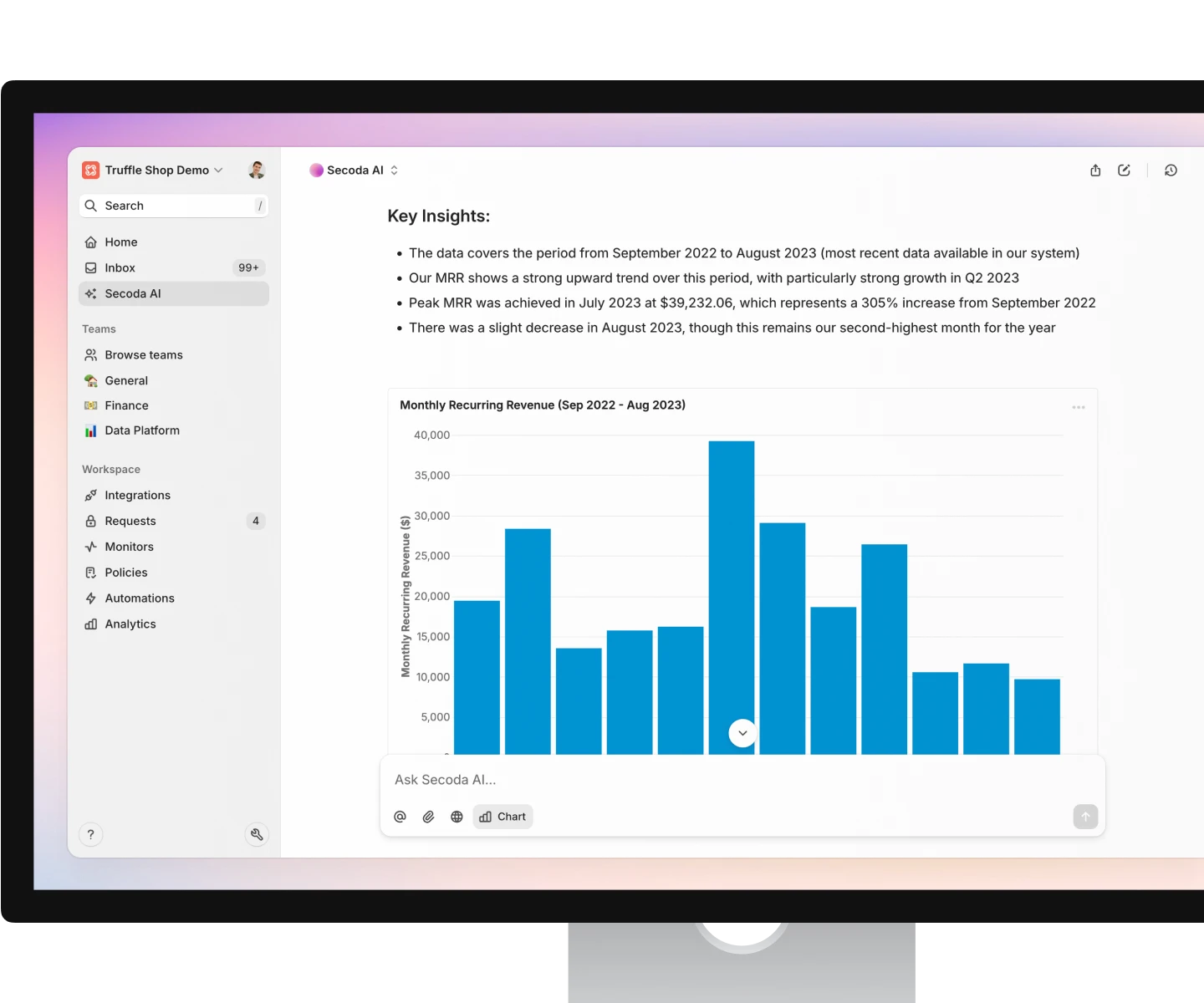
The clever part is not that Secoda added a chatbot. Nearly every data vendor did. The useful part is what sits behind the chat: lineage, ownership, usage, documentation, quality signals, and permissions. An AI answer about revenue is only as trustworthy as the table it chose and the rules it obeyed. Secoda makes that context visible enough for a person to inspect. For buyers, this distinction matters more than how charming the demo conversation sounds.
Who needs this, exactly?
Secoda starts making sense when the cost of finding data becomes visible. A six-person startup with one warehouse and a conscientious analytics engineer can often survive with dbt docs, a wiki, and good manners. Add several business units, thousands of tables, multiple BI tools, sensitive fields, and a queue of repeated questions, and “just document it” becomes a running joke.
Put it on the shortlist
- Your definitions live in Slack, Notion, and people’s heads.
- Schema changes routinely surprise dashboard owners.
- Business users wait days for routine cuts of data.
- You want a managed catalog plus monitoring and governance.
- AI tools need permission-aware company context.
Keep your wallet closed
- Your stack is small and already well documented.
- You require transparent self-serve pricing.
- You want an open-source project you can deeply modify.
- Your team lacks owners for cleanup and adoption.
- You only need a BI dashboard, not a metadata layer.
That fourth warning deserves ink. A catalog can automate ingestion and descriptions, but it cannot settle a fight over what “active customer” means. It can assign an owner; it cannot make the owner answer. Secoda reduces the clerical burden around governance. It does not abolish governance meetings, incentives, or judgment.
The tour: from table hunt to family tree
Connect a warehouse, database, transformation layer, pipeline, or BI tool and Secoda pulls in resource names, descriptions, popularity, lineage, queries, and usage metadata. The company is careful to say it generally catalogs metadata rather than copying source data. Some optional features do read or query underlying data, so a security review should examine each connector and permission, not stop at the slogan.
Search is the front door. Results can include tables, columns, dashboards, queries, documents, glossary terms, and previously answered questions. Collections group resources by domain or data product. The Chrome extension carries discovery and editing into the browser; Slack and Microsoft Teams integrations bring answers closer to the request. An accepted answer can remain searchable, which is a modest feature with excellent office economics: the fifth person asking the same question may find the first answer.
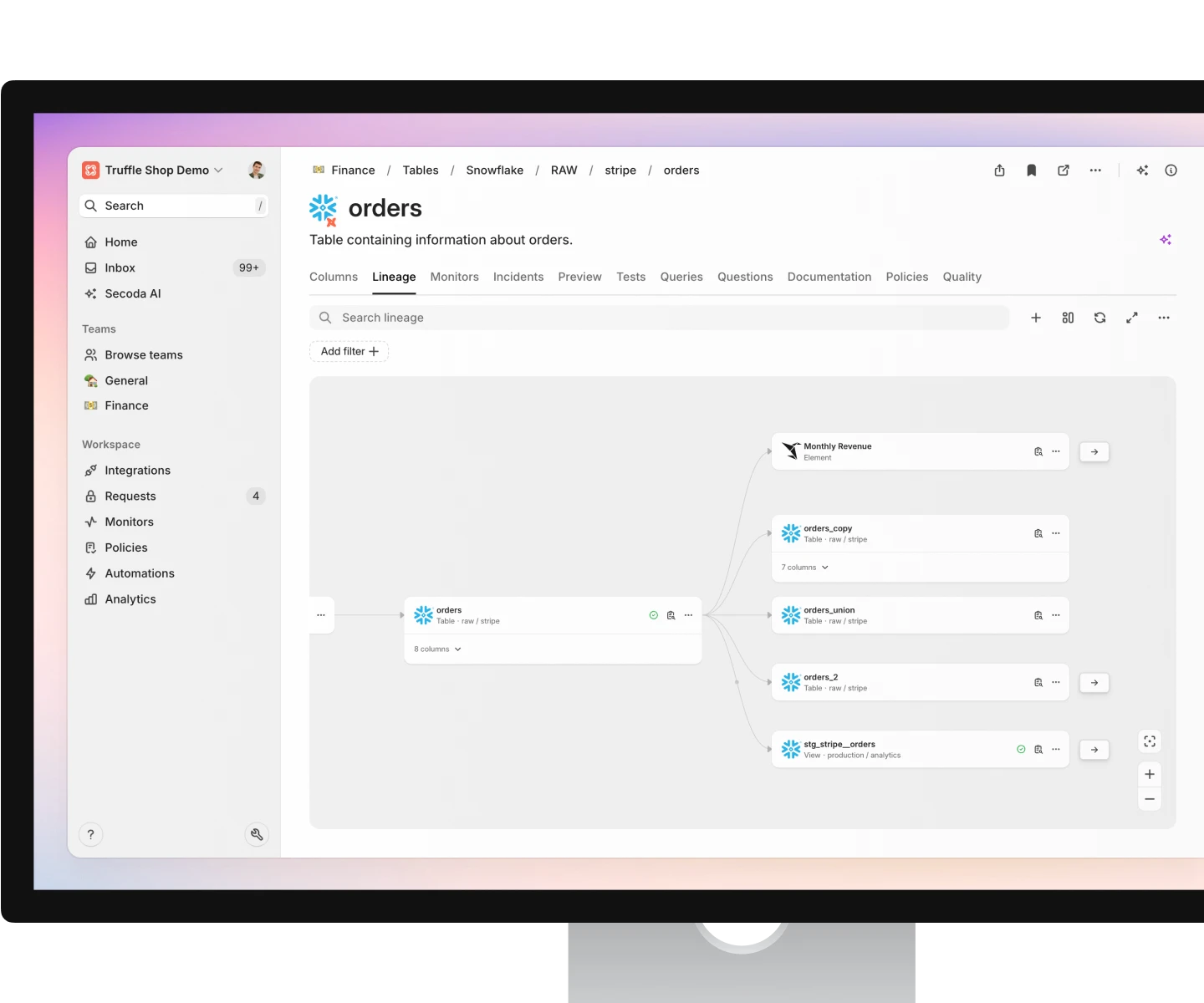
Lineage maps upstream and downstream relationships at table and column level. This is the feature an engineer opens before changing a model and the feature an incident responder opens after a metric goes sideways. Monitoring adds checks for freshness, anomalies, job performance, and warehouse cost. The catalog supplies business meaning; monitoring supplies a pulse. Housing both together lets a failing asset point toward its owner, consumers, and documentation instead of producing one more anonymous alert.
The AI moved past Q&A
By 2025, Secoda AI could search catalog context, write permitted SQL, run queries, explain results, and generate charts. Its May update moved to Anthropic’s Claude Sonnet 4 and Opus 4, with one model planning and another executing. Secoda also launched a Model Context Protocol interface so tools such as Claude, Cursor, Windsurf, and VS Code can retrieve governed metadata, explore lineage, and execute authorized queries without each team rebuilding the context layer.
September brought a coordinated multi-agent system. Specialist agents handle SQL, policy checks, documentation, visualization, and interpretation while an orchestrator divides the job. Configurable agents can trace an anomaly across Snowflake, dbt, and Tableau or propose a batch of catalog changes. Automation Blocks handle repetitive chores such as filling missing descriptions and tagging undocumented tables. Importantly, users can preview and approve the results. The product’s best AI design choice may be leaving a human-shaped brake pedal.
What changed after launch
The acquisition is not a footnote. Atlassian already maps people, projects, and workplace knowledge through its Teamwork Graph and Rovo. Secoda maps structured data and its business meaning. Put together, the ambition is an “ontology of work,” where an agent can understand both the quarterly plan and the governed numbers underneath it. The strategic fit is legible. The product-level consequences remain a buyer question: integration timelines, packaging, road-map priorities, and the eventual relationship with Atlassian Cloud should be discussed in writing.
Features, trade-offs, and the sales call
| Job | What Secoda brings | Question to ask |
|---|---|---|
| Discovery | Cross-stack search, catalog, glossary, collections, browser and chat access | How quickly do our actual sources index, and how is relevance tuned? |
| Trust | Automated lineage, owners, documentation, quality scores, accepted answers | Which lineage paths need manual work in our stack? |
| Governance | Policies, PII scanning, roles, access requests, audit and deployment options | Which controls require Premium or Enterprise? |
| AI analysis | Natural-language queries, SQL, charts, memory, agents, MCP | How are permissions enforced at query time and outputs audited? |
| Operations | No-code monitors, anomaly and cost signals, workflow automation | Can this replace our current observability tool or merely complement it? |
Public pricing is the weak point in the buying experience. Secoda lists Core, Premium, and Enterprise plans but no dollar amounts. Contracts are described as varying with team size, data resources, integrations, and extra features. Core includes the catalog, lineage, automations, API access, SAML, and role controls. Premium adds quality scoring, policies, PII scanning, guest accounts, VPC peering, and single-tenant deployment. Enterprise adds custom roles, SIEM logging, unlimited integrations, self-hosting, disaster recovery, and professional services. A free trial exists; a lasting free plan does not appear on the current official page.
Ask for a three-year cost model, not a first-year quote. Include connector add-ons, resource growth, non-editor seats, onboarding, support, deployment, and AI usage limits. Run the trial against ugly data, not a polished sample. Pick one broken lineage chain, one disputed metric, one PII workflow, and one recurring executive question. If the proof of concept cannot improve those four, the catalog will become an expensive address book.
The crowded catalog shelf
Atlan, Alation, Collibra, Select Star, Microsoft Purview, data.world, DataHub, and OpenMetadata will appear in a serious comparison. Collibra and Alation carry long enterprise histories. Atlan competes on a modern managed experience. Purview is natural to inspect in Microsoft-heavy estates. DataHub and OpenMetadata appeal to teams that prefer open source and can supply engineering time. Select Star focuses on automated discovery and lineage.
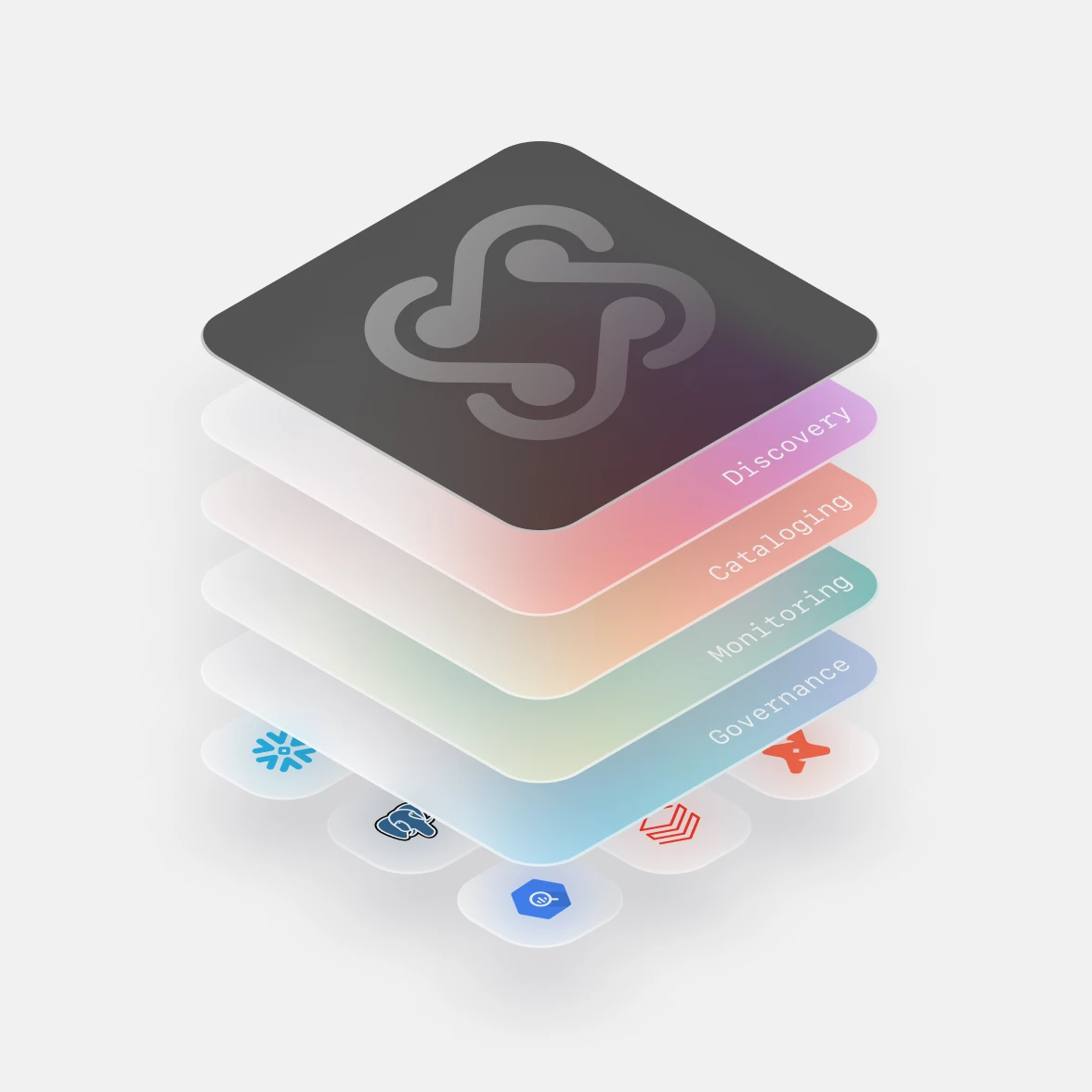
Secoda’s angle is breadth in one approachable workspace: catalog, lineage, documentation, governance, monitoring, and AI analysis. That can reduce vendor seams, but breadth must be tested against the specialist tools already in place. G2 reviewers repeatedly praise usability, integrations, lineage, and responsive support; they also mention occasional bugs and product immaturity. Reddit is thinner and noisier. Some practitioners call Secoda effective or user-friendly, while another large-scale user complained about bugs and poor UX across several catalog products, Secoda included. The fair reading is neither worship nor dismissal: test with your metadata volume and your least patient business user.
The YesPress take
Secoda is for organizations that feel the hidden tax of data confusion every week. It offers a coherent answer to a familiar mess: inventory the assets, show where they came from, record who owns them, watch whether they break, and give people a decent way to ask what they mean. Its evolution into AI analytics feels earned because the assistant sits on top of the catalog rather than floating beside it.
The purchase still demands adult supervision. Quote-only pricing makes comparison harder. AI-generated SQL needs scoped permissions and audit. Automated descriptions need review. Atlassian ownership introduces both opportunity and integration uncertainty. None of these are reasons to reject the product. They are reasons to make the demo earn its calendar slot.
If your analysts are human search engines, Secoda can give the company a better interface. If your real problem is unresolved definitions and absent ownership, buy lunch for the governance team first. Software can map the swamp. People still have to agree which patch of ground is revenue.