Twenty-four hours is a useful antidote to a software demonstration. In Ataccama’s published account, T-Mobile set a clock running and asked vendors to scan as much data as they could. Ataccama scanned 138,972 tables, then used extraction rules to identify 22,494 containing sensitive information. Suddenly, an abstract promise about governing data had something wonderfully concrete: a deadline and a count.
- Ataccama checks, organizes, and improves enterprise data.
- Its customers include banks, insurers, and T-Mobile.
- The same checks now help supply context to AI agents.
A stopwatch, then a system
The urgency had a history. The case study identifies T-Mobile’s 2021 breach as a catalyst for rethinking data management. Its estate included thousands of applications and databases. The assignment was to find sensitive information, classify it, and keep finding it as systems changed.
The resulting workflow connected scanning to classification, remediation tickets, and reporting. That sequence matters. Discovering a problem leaves work unfinished; routing it to someone who can fix it begins to close the loop. For a buyer, the interesting part is the distance between those two events.
Published T-Mobile customer account. Classification results, not a security guarantee.
The trouble beneath the dashboard
Ataccama sells software for enterprises whose information lives in many systems and means different things to different people. A customer can appear twice. A country code can be valid in one application and rejected in another. A beautifully labeled dataset can contain yesterday’s numbers. These are the kinds of defects its platform is built to address.
Ataccama ONE combines data quality with a catalog, governance, lineage, observability, and master and reference data management. In ordinary language: find the information, understand it, test it, trace its journey, watch for changes, and reconcile the records and codes that other systems share.
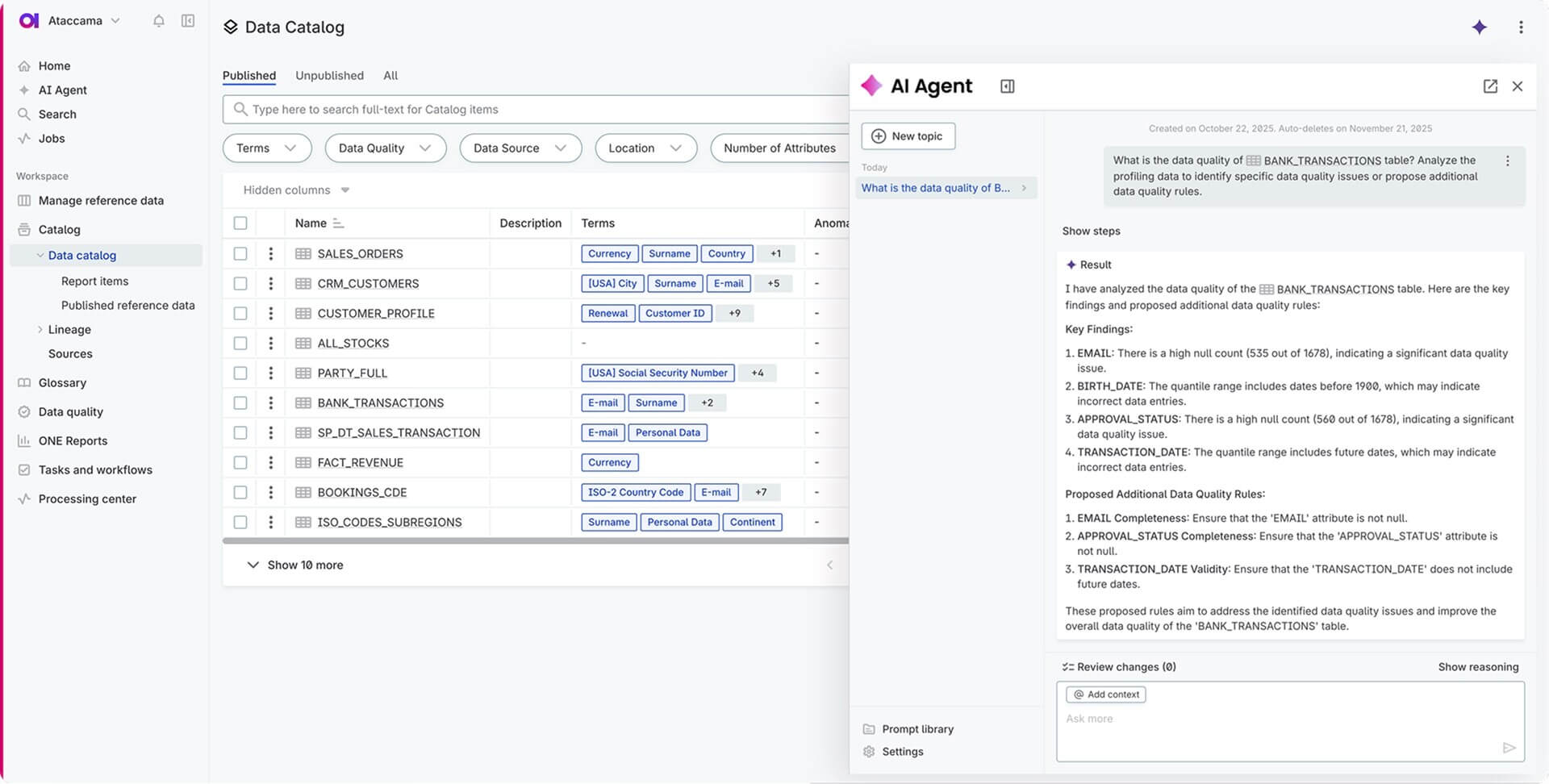
The useful distinction is between knowing a dataset exists and knowing whether it meets a particular standard. A catalog supplies the first answer. Quality rules help supply the second. Putting them together lets a steward see definitions, ownership, and reliability in the same working environment.
Born in the cleanup crew
The company’s origins help explain this arrangement. Ataccama grew out of Adastra, a consultancy that encountered clients struggling with inconsistent data. Founding CEO Michal Klaus described the opportunity as turning that recurring problem into a product company. Ataccama dates its spin-off to 2007; its careers history records independent-company formation in 2008.
ONE arrived in 2017, followed by a second generation in 2020. The accumulated expertise is in the unglamorous junctions: connecting systems, applying repeatable rules, reconciling entities, and giving business people a way to participate. Its careers materials emphasize collaboration and international teams. The work itself requires both.
Ataccama competes with Informatica and Collibra across overlapping markets. Its pitch centers on combining the quality engine with the surrounding management tools. For buyers, that creates a practical comparison: how many handoffs between products disappear, and how much integration work remains?
The bank that needed two kinds of scale
Judo Bank offers a quieter illustration. The Australian small-business bank needed an architecture that could adapt as it grew. Its published customer story describes Snowflake providing elastic storage and compute, with Ataccama supplying automated quality checks, monitoring, and validation across data flows.
The combination separates capacity from confidence. A platform can process more information without making that information more reliable. Judo’s approach gives those jobs different machinery. A similar distinction explains Ataccama’s place in the market: it works alongside the data platforms enterprises already operate.
The bill has two columns
This is an enterprise software business, sold through negotiated licenses and cloud subscriptions. Bain Capital Tech Opportunities invested $150 million for a minority stake in 2022. Snowflake Ventures added a strategic investment in December 2025, without disclosing its size.
What does a customer spend? A 2024 Forrester study commissioned by Ataccama offers a useful model. Drawing on six customer interviews, it constructed a composite organization with $20 billion in annual revenue. Three-year, risk-adjusted present-value costs included $1.6 million in licensing and $1.9 million in implementation and ongoing management.
The study calculated 348% ROI. That is a modeled result, not a promised return or an average every customer achieved. The more useful budgeting lesson sits in the cost split: putting the software to work can cost more than licensing it. Someone still has to connect systems, define acceptable data, and run the process.
Now the reader is a machine
In August 2026, Martin Zahumensky became CEO, succeeding Mike McKee. Enterprises increasingly want to know whether their information can safely support an AI agent.
“What our customers are asking for has changed.”
Martin Zahumensky · CEO · August 2026

The company’s hosted MCP Trust Layer lets supported external AI clients retrieve selected definitions, ownership details, and quality metrics. The documentation specifies authenticated, permission-controlled, read-only access. That boundary matters: retrieving evidence about a defect and repairing the underlying record are separate operations.
A June 2026 Databricks integration extended these signals into another major platform. In September, Ataccama announced plans to open-source an Apache Ossie converter so definitions could travel with quality warnings. The idea is practical: an agent should see a warning when it encounters questionable data, while it can still change its answer.
For a data team, the attraction is fewer trips between a glossary, a monitoring screen, and an incident queue. For a business owner, it is a clearer question to answer: what would make this dataset acceptable for this decision? Neither answer comes from a score alone. A complete set of records can still use the wrong definition of an active customer. A correct definition can still point to incomplete records. The platform brings these questions together; the organization must decide what the answers mean for its work.
Borrow the test
The lesson worth copying is T-Mobile’s stopwatch. Choose a consequential dataset. Define what counts as failure. Measure discovery, classification, and the handoff to repair. Without source access, meaningful rules, and people responsible for resolving problems, a quality score has little authority. Give those pieces a timed rehearsal before trusting the next automated decision.