AtScale exists because the future arrived before the spreadsheet was ready for it. At Yahoo in the late 2000s, Dave Mariani and Sarah Gerweck helped build enormous systems for examining advertising data. One multidimensional cube reached 24 terabytes. Mariani later said it generated roughly $50 million a year in additional advertising lift. The business users loved what the cube let them do. The machinery underneath was sweating.
When Hadoop spread through corporate data centers, the first thing to fail was not storage. It was the comfortable path from a pile of data to a decision. Excel, Tableau and other business-intelligence tools were built for an earlier scale. Teams responded by shrinking the dataset, copying it, building extracts or assigning a new pipeline and logic layer to every tool. More data had produced less agreement.
Mariani and Gerweck founded AtScale in 2013 around a stubborn idea: do not ask the analyst to abandon the interface. Put a translation and acceleration layer between the interface and the data. Let users keep the pivot table. Let the warehouse keep the rows. Define the business logic in one place.
“How people want to access the data hasn't changed, only the data has changed.”Dave Mariani, co-founder and CTO
The product is a treaty between rival dashboards
A semantic layer is the portion of a data system where cryptic tables acquire business meaning. It says which rows count as an order, which calendar defines a quarter, how margin is calculated, who may see a store number and how a product rolls up into a category. AtScale puts those definitions in a shared model and translates requests from different consumers into queries against live data.
METRICS + LOGIC + SECURITY
This is why the company calls its product “universal.” It speaks SQL for general analytics, DAX for Power BI, MDX for Excel-style multidimensional work, Python for data science and Model Context Protocol for AI tools. It can model visually in Design Center or as YAML files in AtScale's Semantic Modeling Language. Those files live in Git, where teams can review a metric change the same way engineers review code.
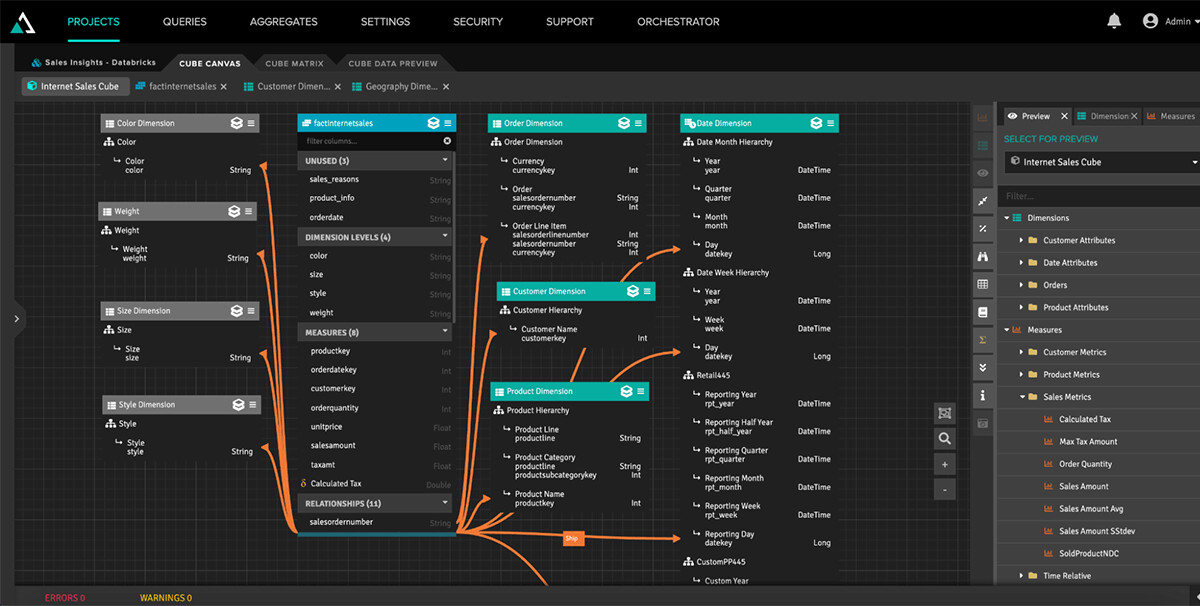
AtScale also watches query patterns and builds aggregates so repeated questions do not scan every raw row. The claim is not that every query becomes free. It is that common questions can hit smaller, optimized structures while the semantic model preserves the same answer across interfaces. Governance is applied when the query runs, rather than trusted to a forgotten extract on someone's laptop.
The bet nobody in the Series A meeting wanted
In 2015, venture investors urged AtScale to become a full-stack BI company with its own visualization layer. That was the fashionable route: own the whole experience, own the customer. AtScale declined. It chose to be the missing middle between Hadoop distributions and the dashboard companies. Mariani called Excel the “Trojan horse” because a user with Excel could become an AtScale user without learning a new visualization product.
That restraint is the company's best strategic decision and its permanent risk. Remaining independent makes AtScale useful across Snowflake, Databricks, BigQuery, Redshift and several BI tools. It also leaves the company surrounded by larger vendors that keep absorbing semantic features. Power BI has semantic models. Looker has LookML. dbt and Cube sell their own shared-metrics approaches. Snowflake has Semantic Views - and Snowflake Ventures led AtScale's largest financing in late 2025.
The partnership is both validation and a neat piece of tension. AtScale now extends Snowflake Semantic Views into live Power BI and Excel workflows. Snowflake gets an interoperability story; AtScale gets distribution and strategic capital. But warehouse-native semantics will keep improving. AtScale has to prove that a neutral layer is more valuable than the convenience of staying entirely inside one platform.
The customer does not buy “semantics.” It buys Tuesday back.
The product makes more sense through customer complaints. Papa Johns had fragmented franchise analytics and aging Essbase infrastructure. After moving metric logic into AtScale, the company reported that dashboards which took 30 to 45 seconds came back within a three-second target. A franchise owner in Excel and an analyst in Tableau could see the same definitions for sales, delivery time, margin and staffing.
Rakuten used AtScale while shifting analytics from on-premises Hadoop to Snowflake on AWS. Because AtScale insulated Tableau users from the storage change, the company said it avoided a broad retraining exercise. In one 10-terabyte comparison, the AtScale route ran 14 times faster at one-quarter the cost. Rakuten associated the broader migration with $10 million in savings and reported an immediate 30 percent reduction in load on its old cluster.
One baseline unit versus fourteen
Other customers reveal the range. Cardinal Health used AtScale with BigQuery, Excel and Tableau to centralize governance for more than 200 business users after acquisitions left it with fragmented systems. Toyota used it while moving legacy warehouse workloads to Redshift. Wayfair applied a governed view across hundreds of modelers and analysts. The users are not only data engineers. They are finance teams, franchise operators, marketers and executives who want familiar tools to stop disagreeing.
AI did not change the thesis. It made the penalty larger.
AtScale has worn several labels: BI on Hadoop, data warehouse virtualization, cloud OLAP and now the universal semantic layer for AI and analytics. The labels followed the infrastructure. The job stayed surprisingly stable. A new consumer asks a business question; AtScale maps that request to governed logic; the warehouse computes the answer.
An AI agent raises the stakes because it can invent a plausible join, misunderstand a metric and explain the wrong answer with alarming fluency. AtScale's MCP server exposes defined metrics and relationships to compatible agents. Instead of asking a language model to improvise SQL against raw tables, the system asks it to work through semantic objects that already know how revenue, time and hierarchy fit together. The result can still be wrong for many reasons, but one large category of ambiguity has been removed.
In 2024, AtScale open-sourced SML under an Apache license. In 2026, it joined Snowflake's Open Semantic Interchange effort. Both moves answer the lock-in objection: a layer claiming to be universal looks less convincing if its definitions cannot travel. SML is also a practical recruiting device. Analytics engineers already understand YAML, Git reviews and deployment pipelines.
The layer cannot settle an argument
AtScale publicly described entry pricing as low as $2,500 a month, based on consumption rather than user seats. That makes the software bill legible. The larger cost is organizational. Someone must decide what “active customer” means, document the exception for returned orders, assign ownership, model the hierarchy, test permissions and keep all of it current. A semantic layer can encode a decision. It cannot make the decision for a room full of department heads.
What a team can copy before buying anything
- Choose one disputed metric and name a single owner.
- Put its definition, dimensions, tests and access rules in version control.
- Serve that definition to two different tools before expanding the model.
- Measure query time, warehouse spend and conflicting answers before and after.
The approach is excessive for a small company with one clean warehouse, one BI tool and a handful of stable metrics. It also disappoints when source data is unreliable, teams refuse common definitions or nobody funds model maintenance. If every workload already lives comfortably inside one vendor, that platform's native semantic model may be simpler. And live query systems need careful capacity planning; eliminating extracts does not eliminate compute.
AtScale's achievement is not making those tradeoffs disappear. It is preserving a useful boundary while almost everything around it changed. The company refused to build another charting tool, survived Hadoop's retreat, followed data into cloud warehouses and found that AI agents need the same adult supervision as spreadsheets. The interface keeps getting smarter. The business still needs one place to write down what it means.
That makes AtScale less a bet on any single data fashion than a bet on corporate disagreement. Warehouses will consolidate, agents will multiply and dashboards will be renamed. Finance and sales will still arrive with two definitions of revenue. The winner in this market will be the layer both sides are willing to trust.