Enterprise software has a comic habit of describing clarity with seventeen nouns. Platforms unify data, orchestrate workflows, enrich forecasts, activate insights, and then wonder why the customer quietly reaches for a spreadsheet. Ross Daniels has spent more than a quarter-century on the other side of that problem. His job has been to make dense technology legible without sanding away the thing that makes it valuable.
Today Daniels is Chief Marketing Officer at Board, where planning software sits between finance, supply chain, retail operations, and the executive appetite for a better answer before the quarter has already happened. His remit is broad: demand generation, communications, product, digital, field, and partner marketing. The list sounds like a small government. The governing idea is much simpler. Explain what the company does, make the distinction memorable, and help that message travel.
He describes himself as a professional marketer who balances the traditional with the modern. That modest sentence contains a useful resistance to fashion. B2B marketing loves a new apparatus. Buyers, less thrillingly, still want a credible promise, evidence that it works, and confidence that the company will answer the telephone after the contract is signed.
01 · The long apprenticeship
Clarity, learned at Cisco scale
Daniels came to technology with a BA in English from Harvard and later added an MBA from Babson College. It is an unexpectedly apt pairing. Enterprise marketing is business conducted through acts of translation: product architecture into customer value, engineering possibility into a sales conversation, a portfolio full of acquired names into one sentence an audience can keep in its head.
He spent 18 years at Cisco across product management, product marketing, and marketing. During that run, he helped build the company's contact-center business from $30 million to $300 million. Later he led marketing for Cisco's collaboration software business, a portfolio approaching $5 billion. Scale changes the vocabulary of a job. A campaign becomes a system. A partner is not merely a logo on a slide but a route by which the product reaches thousands of customers.
Ten times the starting scale
A career marker, not a solo credit: Daniels helped build the business as part of Cisco's wider team.
The word “helped” matters. Daniels's public habit is to name the people and partnerships around the result. That is not false humility. In enterprise technology, distribution is collective choreography. Engineering, sales, services, resellers, and platform partners all have to tell compatible versions of the truth.
02 · Widening the road
Keep the strong partner. Build the next ones.
In 2017 Daniels left Cisco for Calabrio, initially as Vice President of Strategic Partnerships. Calabrio made workforce optimization software for contact centers and had deep Cisco roots. The obvious move might have been to declare independence with trumpets. The wiser move was to keep a productive relationship growing while making the company useful across a wider ecosystem.
At the time, Calabrio's channel program included 166 partners, and the company was adding relationships with cloud contact-center providers. Daniels spoke about formalizing connections with CRM and service-management platforms, as well as expanding in Europe. His “lion's share” was making sure the integrations and routes to market worked with strategic partners. This is marketing in work boots: less slogan, more connective tissue.
The change became measurable. By 2020, 74 percent of Calabrio's new deals were in the cloud. Well under half of new seats came on top of Cisco systems, even as Cisco-related business continued to grow. The newer partnerships were simply growing faster. Calabrio had not burned the old bridge. It had built several more beside it.
“We can be on a broader range of strategic platforms than we are today.”Ross Daniels, on Calabrio's ecosystem ambitions
That year Calabrio added 130 employees and finished integrating Teleopti, the Swedish workforce-management company it had acquired. Daniels became CMO while retaining his partner responsibilities. Board later summarized Calabrio's growth during his CMO period at more than 40 percent annually. Thoma Bravo acquired the company in 2021.
03 · Listen for the useful signal
The dashboard should know what matters now
Long before “decision intelligence” became a category label, Daniels was making an argument about where useful information hides. Contact centers do not merely handle complaints. They are giant listening devices. A service call may reveal a faulty product, a confusing bill, a late shipment, or a marketing promise that reality has declined to honor.
In one interview, he explained that business-intelligence reporting could connect several data sources and expose a problem that only appeared to belong to customer service. Sometimes, he said, the real fault was in supply chain or marketing. The call was the smoke; the fire lived elsewhere.
He also offered a wonderfully ordinary insurance story. Daniels began in a mobile app, authenticated information through an automated phone system, and finally reached an agent. She already knew where he had been and what he needed. He called the experience rare. Anyone who has repeated an account number to three departments may consider “rare” a diplomatic masterpiece.
Daniels's recurring operating loop
calls · markets · operations
context · analytics · priority
clearer · faster · informed
His preferred destination was not another ornamental dashboard. He described a screen that showed a supervisor, manager, or agent the top five things requiring attention at the start of the day. The crucial metric was not the volume of data but the reduction of hesitation.
“When you have a happy agent, you have a happy customer - and that means quality interactions.”Ross Daniels
04 · Two exits, then a new category
Acquisitions are punctuation, not the sentence
Daniels joined Acqueon as CMO in June 2023. Sixteen months later he marked his final day there, after Five9 had agreed to acquire the company. Five9 reported completing the deal for approximately $173.8 million. The neat resume version is one line: CMO, acquisition, next role. Daniels's own farewell was longer and more revealing.
He thanked his direct team, then moved function by function through product, engineering, support, services, customer success, human resources, finance, and sales. He named partners across Avaya, AWS, Cisco, Genesys, NICE, Twilio, Zoom, and others. The post reads less like a victory lap than the closing credits after a very technical film. It makes visible the network required to get enterprise software adopted.
In November 2024 he arrived at Board. The assignment brought his career's two recurring ideas together: a broad partner system and a product designed to surface the right signal. Board's platform connects financial and operational planning. Its customers are trying to reconcile budgets with demand, inventory with supply, and long-range strategy with the impolite arrival of new facts.
The timing was brisk. Six days after Board announced Daniels's appointment, the company announced its acquisition of Prevedere, adding external economic data and predictive models to the platform. The marketing puzzle expanded at once. It was no longer enough to explain how a business could understand its own performance. The story now included what the wider economy might do to it next.
05 · Planning for the moving target
A category built around changed minds
Daniels said he joined Board to articulate and amplify the value of its products, with particular attention to growth in North America. In practice, that means marketing planning software to people whose professional pride depends on distrusting the plan. A forecast is useful precisely because it can be revised. Certainty would be a lovely product benefit, but reality has not shipped that feature.
His work at Board has increasingly put economic intelligence into the conversation. In 2025 he appeared alongside economists in The Insight Loop, a roundtable series on the forces changing spending, saving, inflation, and planning assumptions. Daniels described its value as exploring what is really driving change so planners can act faster and smarter. The wording echoes his contact-center years: gather the scattered signals, supply context, put a manageable set of decisions in front of a human.
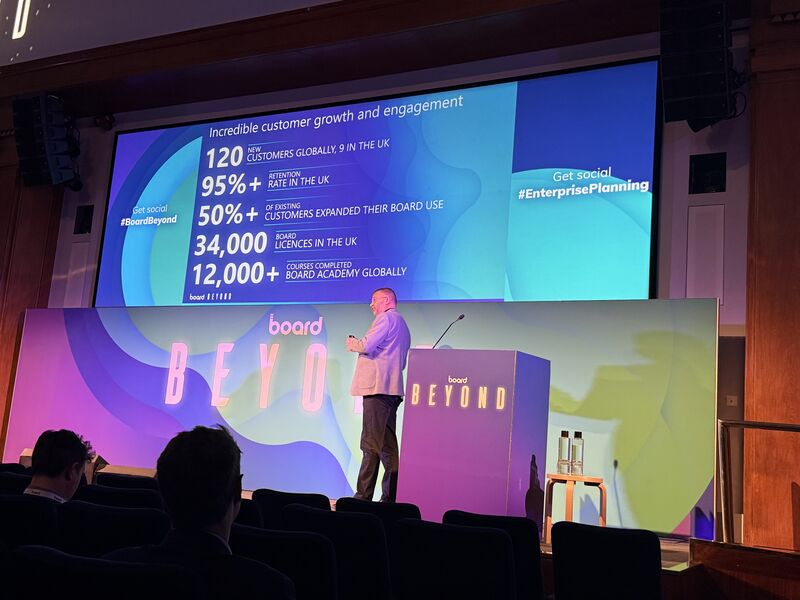
In March 2026, he took the stage at Board Beyond London for a session on continuous planning becoming “agentic.” The software vocabulary has moved from cloud and analytics to AI agents. Daniels's more durable theme remains visible beneath it. Technology earns its place when it gives someone greater control over the day, a clearer view of what changed, and enough time to respond.
A former colleague publicly described him as smart, determined, resilient, and equally comfortable getting tactical work done or navigating organizational politics. The description fits the shape of his roles. Full-stack marketing is not one brilliant campaign. It is the patient alignment of product truth, corporate narrative, demand machinery, field execution, and partners who have their own priorities.
There is something pleasingly unfashionable about that career. The companies changed. The favored acronyms changed. Two employers were acquired. Cisco's on-premise center of gravity shifted toward cloud platforms, and dashboards began promising conversations with AI. Through it all, Daniels kept returning to the same question: what does the person in front of the screen need to understand next?
Good marketing cannot answer that question by itself. It can insist that the product, the partnership, and the promise all answer it in the same language. For complicated software, that is not cosmetic work. It is how the buyer finds the door.