A good telephone call has the manners of a discreet waiter. It arrives, does its job and leaves no reason to inspect the machinery. The same is true of a text confirming an appointment or a support line that reaches the right person on the first try. The infrastructure vanishes. For Meg Powell, Chief Marketing Officer at Bandwidth, this neat disappearance is both the product's charm and the marketer's problem.
Bandwidth sells the network, software and programmable connections beneath business voice, messaging and emergency communications. The buyer may understand APIs and routing. The customer at the other end simply expects the call to be clear and the message to arrive. Powell's work is to connect those two realities without turning either into a brochure cliché.
Her answer has been to treat infrastructure as part of customer experience, not backstage equipment. A conversation can look effortless only because a long chain of technical and regulatory choices has worked properly. The marketing challenge is to make that chain visible at the moment it matters, then get out of the way.
A career assembled from useful detours
Powell did not spend twenty years polishing a single specialty. She studied communication at Florida State University, graduating in 2005, and later earned an MBA in organizational leadership from Liberty University. The pairing now looks almost suspiciously tidy: one degree about how meaning travels, another about how people and systems move together.
Her working life began in agency marketing at The Zimmerman Agency in 2007. She soon joined IGT, the gaming-technology company, where an eight-year run moved her through marketing management, field marketing and sales programs, then product marketing and development. She learned the product and the sales motion, a combination that would become more useful than any immaculate job title.
At Vision Critical, now called Alida, Powell became Director of Account Sales and Marketing. At Sharecare, she led partnership marketing and community activation. These were not random costume changes. Product work teaches what is being made. Account work teaches why somebody buys it. Partnerships teach how value changes when more than one organization is in the room.
Her 2015 publication on deeper player intelligence in the lottery industry even carried a phrase that sounds at home in her later work: “creating the feedback loop.” Years before Bandwidth described her marketing organization as metrics-based and predictable, Powell was writing about using better information to understand an audience more clearly.
Four years, three chairs, one widening remit
Powell joined Bandwidth in September 2020 as a senior director. In November 2021 she became Vice President of Revenue Marketing. The job put demand generation, marketing operations, the website and event strategy within her orbit. Bandwidth says she reworked those functions into a scalable, predictable revenue engine and strengthened collaboration across the company.
In June 2024, Powell moved into the chief marketing role. Her scope now runs across brand, solution marketing, demand generation, digital, events and field marketing. That list is less interesting as an org chart than as a statement of intent. It puts reputation, explanation, acquisition and face-to-face selling inside the same operating system.
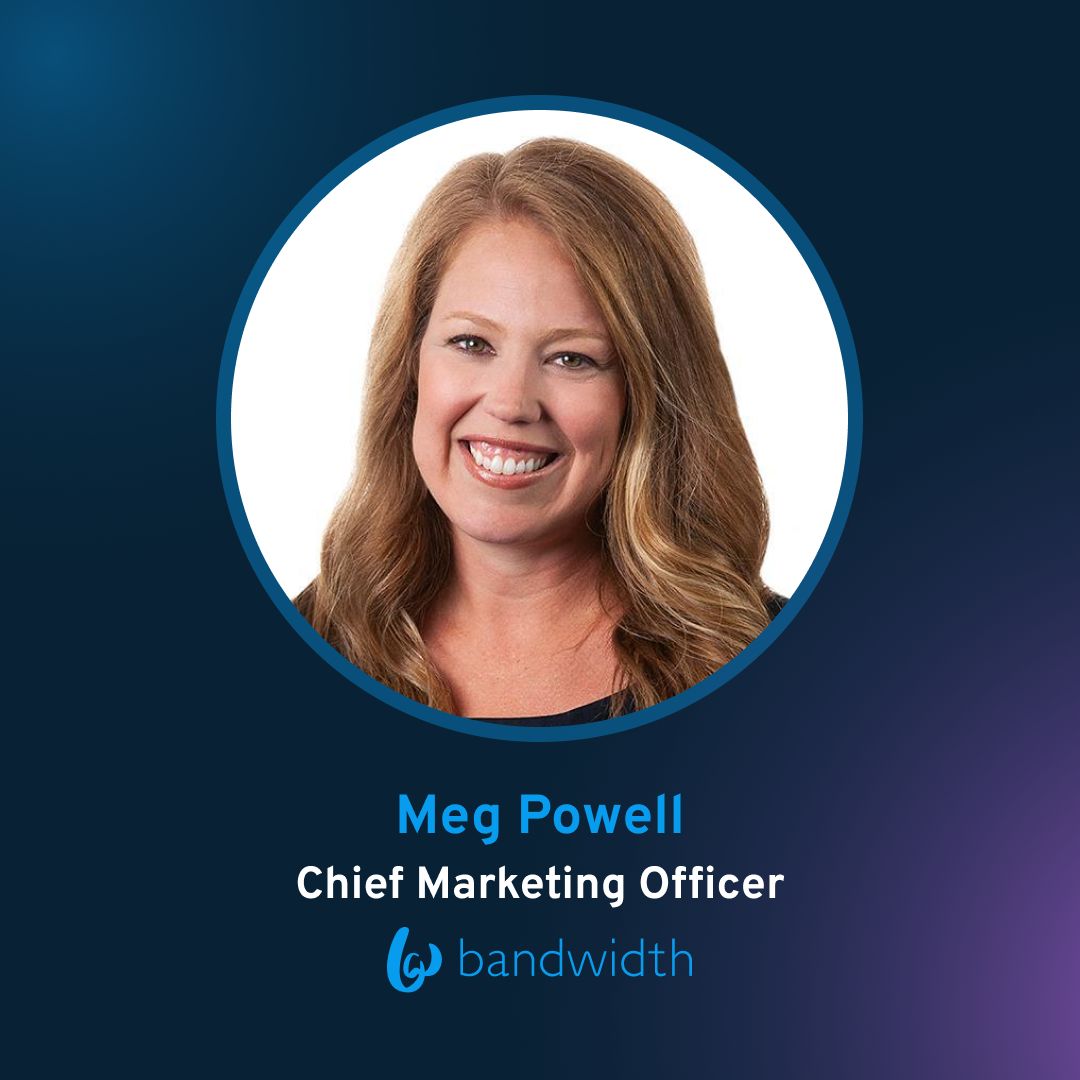
The promotion announcement praised the engine, but it spent just as much time on the mechanic. Powell was described as someone who develops her team, speaks candidly and celebrates other people's success. Former colleagues echo the theme in public recommendations. One calls her a “human dynamo.” Another remembers a leader who could dream up revenue programs and build team camaraderie along the way.
This is an important wrinkle. Measurement can make marketing sound like a factory with excellent dashboards and no windows. Powell's public reputation is for combining operational rigor with conspicuous energy. Systems give work a rhythm. People give it a reason to keep going.
A former Bandwidth colleague, Julia Washburn, gives the idea practical edges. In a public recommendation, she describes Powell learning each team member's ambitions, then finding a way to challenge that person deliberately. The recollection links coaching to performance rather than treating morale as a decorative extra. It also credits Powell with creating programs that could drive revenue and tighten the bond between sales and marketing, two departments famous for agreeing on everything except definitions, timing and credit.
Gabriel Paine, who worked with Powell at Sharecare, remembers a similar combination: quick command of new concepts, trust with clients, careful control of budgets and attention to culture. Taken together, the accounts suggest that Powell's energy has a job to do. It lowers the friction around coordination. In a function that touches product, sales, finance and leadership, enthusiasm is most useful when it helps people cross a boundary they might otherwise defend.
When the pipes become the experience
The phrase gets to the center of Powell's current argument. Enterprises once treated communications as a utility: necessary, largely interchangeable and best discussed only when the bill arrived. Cloud software changed the surface. AI is now changing the speaker. A voice on a customer-service line may belong to a person, an AI agent or an intricate handoff between the two.
Powell argues that the layer underneath still decides whether the experience deserves trust. When Bandwidth announced its 2026 work with Salesforce's Agentforce Contact Center, she framed the news around infrastructure rather than AI spectacle. Customer data and live engagement may live on one platform, but every interaction still needs to travel through a network with dependable quality, security and reach.
Her formulation is admirably blunt: brands will need more than better AI; they will need better infrastructure beneath it. This is marketing that refuses to wave away the inconvenient physical world. Models may be clever, but calls still cross networks. Messages still meet carrier rules. Telephone numbers still belong to places and regulatory systems. Even the cloud eventually has to ring somebody's phone.
In April 2026, she made the case again after Bandwidth was placed as a Leader in a new IDC category for communications engagement platforms. The category recognized a market moving toward integrated, AI-enabled engagement. Powell's emphasis was not the badge alone. It was the notion that communications had become the place where customer relationships are made or broken.
That position gives the marketing department a larger burden. If infrastructure shapes the relationship, a marketer cannot simply hand technical detail to the product team and return to adjectives. She has to understand the architecture well enough to explain the consequence: what changes for the enterprise, for the contact center and for the person waiting on the line.
A prize for the humble text message
The Texties, Bandwidth's awards for business messaging, offer a smaller stage for the same philosophy. The 2025 winners used texting for outcomes ranging from better appointment responses to student re-engagement and more reliable message delivery. Powell congratulated organizations for producing “breakthrough business outcomes” and raising standards in their industries.
The interesting word is outcomes. Delivery is a technical event. A useful response is a human one. By celebrating what happened after the message arrived, the program turned an infrastructure product into a collection of compact stories. A text message is hardly glamorous. It is also where a missed appointment can be recovered, a student can return to class or a customer can understand what happens next.
Powell's career has repeatedly occupied this seam between data and behavior. At IGT it was player intelligence and product development. At Vision Critical it was customer insight tied to account growth. At Sharecare it was activation through partners and communities. At Bandwidth it is the path from network capability to an enterprise result.
The discipline of making things legible
There is no grand personality cult here, which is fitting. Powell's work concerns systems that succeed by helping someone else have the moment. Her achievements are mostly verbs of useful administration: build, align, measure, develop, translate. They lack the peacock feathers of a product launch and have a better chance of surviving the quarter.
Still, her route to the C-suite says something cheerful about range. Agency craft did not cancel product depth. Sales experience did not disqualify brand thinking. Community activation did not sit at odds with marketing operations. Each became another way to ask the same question: how does this complicated thing become valuable to somebody?
The answer at Bandwidth is increasingly consequential. AI is making customer conversations feel new, while the networks carrying those conversations remain intentionally inconspicuous. Powell's task is to prevent “inconspicuous” from becoming “unimportant.” She must give the plumbing a plot without pretending anyone bought a ticket to admire the pipes.
That balance may be the most revealing fact about her career. The marketer earns attention for the infrastructure, then returns the attention to the customer. The machinery appears, briefly and clearly, before the call connects and vanishes again.