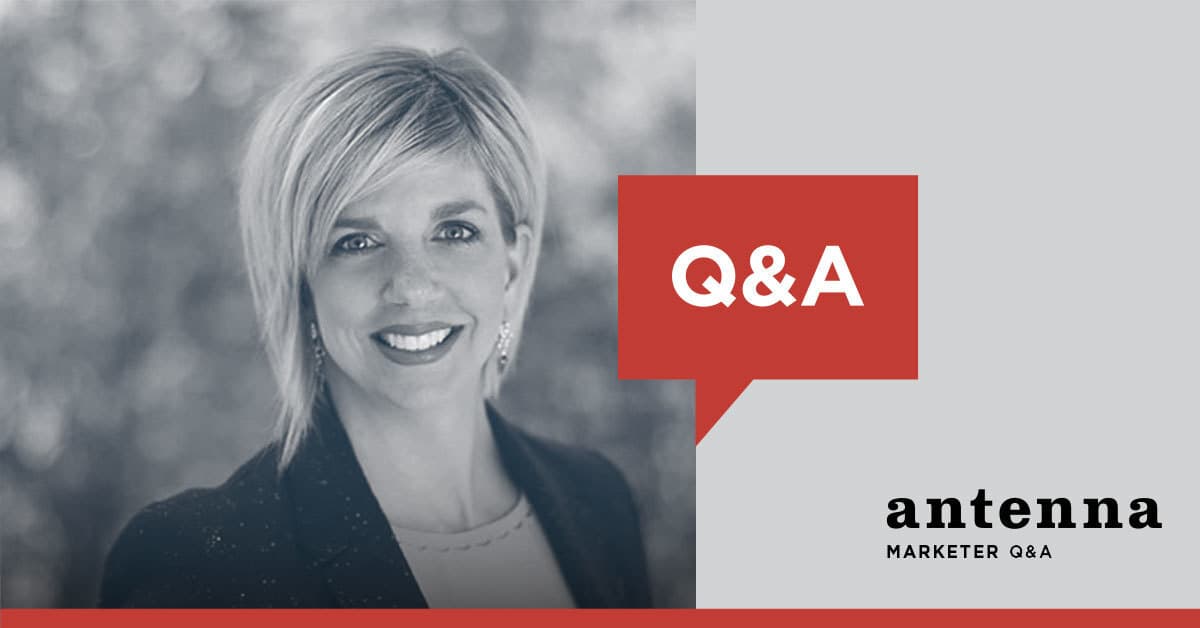
Rebecca Martin's durable marketing lesson could fit on a yellow sticky note: know thy customer. Inside and out. It is concise enough to sound obvious, which is usually where the hard work hides. Knowing a customer in enterprise software means listening across a buying committee, translating technical machinery into human consequences, and staying around after the contract is signed. It means connecting the call-center complaint to the product roadmap and the campaign dashboard to actual revenue. Martin has spent roughly three decades doing that connective work.
Today she is the chief marketing officer at Glia, a New York-headquartered banking technology company, working from Minneapolis. The role draws together two earlier chapters of her career. Total Expert put her inside financial-services marketing. Calabrio immersed her in contact-center buyers and customer-experience operations. When Martin announced the move, she called Glia the "perfect combination" of those jobs. Career changes seldom arrive with such tidy arithmetic.
The equation took years to assemble. Martin moved through field marketing at BORN, communications at Stellent, integrated marketing at Oracle, Trissential and Code42, then executive leadership at Calabrio and Total Expert. The titles reveal widening responsibility, but the more interesting development is range: communications, demand generation, customer marketing, pipeline, integration and category strategy. By the time Glia appointed its first CMO, Martin could speak both the language of the market and the language of the operating meeting.
Her early sequence also put her close to the recurring realities of enterprise technology: acquisitions, new categories and products whose value cannot be demonstrated in a thirty-second spot. Stellent was acquired by Oracle, extending her communications experience into a global software company. At Code42, she marketed data protection and security. Each stop asked for a variation on the same craft - making a complicated system legible to people with different priorities. The security leader, finance buyer and service operator may sit in the same meeting, but they do not enter through the same door.
The customer is a verb
At Calabrio, Martin described her remit in four clean parts: pipeline marketing, content strategy, customer marketing and corporate communications. Those responsibilities span the conventional border between acquiring a customer and keeping one. Martin has argued that the border itself is obsolete. In subscription businesses, presales and postsales belong to one lifecycle. Retention matters as much as acquisition because the promise made by marketing must survive contact with the product.
“Know thy customer. Inside and out.”Rebecca Martin's advice to new marketers
That view turns the contact center from a room of costs into an intelligence desk. Calls, chats, texts and service interactions reveal what customers ask for, what confuses them and what makes them leave. Martin's public writing and interviews repeatedly return to the same move: take those signals, understand the emotion beneath them, and put the insight to work. Her shorthand is to “turn data into action.” The glamour is limited. The utility is not.
The discipline extends to her own function. At Calabrio, Martin tracked engaged customers, marketing-created opportunities and the share of those opportunities that closed. Her maxim was equally plain: “You don't get what you don't measure.” Measurement, in this telling, is not a ritual for decorating a quarterly review. It is a way to discover whether the company explained its value clearly enough for someone to act.
Glia credited Martin with building an account-based marketing motion at Calabrio that fed large-enterprise pipeline. The phrase can sound like another piece of B2B furniture, but its logic fits her larger pattern. Start with a defined set of organizations. Learn the problems and people inside them. Coordinate the message across channels. Judge the work by movement in real opportunities, not by the pleasant weather of impressions. It is customer knowledge made operational, with the sales team close enough to challenge the assumptions.
A career built by adding adjacent fluencies
Unflappable, with a full desk
Martin's management style becomes clearest in small observations. During Calabrio's integration of an acquired business, her team adopted “overcommunication is a good thing” as a mantra. She spent time learning what employees were missing and filling those gaps with useful communication. It is the corporate equivalent of checking the weather before insisting everyone walk outside.
A 2019 account of her workday introduced Martin as an unflappable veteran of Minnesota technology. She named creativity, quick problem-solving, multitasking and prioritization as essential skills, then placed compassion and empathy in the same list. She also admitted that there were never enough hours to finish everything. The detail makes the executive portrait more credible: she loved the coffee, loved her team and disliked leaving a pile on the desk for tomorrow.
When work moved onto video calls, Martin noticed an unexpected correction in the social geometry. Before, employees outside Minneapolis could feel like outsiders while colleagues at headquarters shared a room and its inside jokes. Once everyone occupied an equal rectangle on screen, the global team grew closer. Martin said the more inclusive arrangement was worth keeping. Technology had not created empathy by itself. It had changed who received the room.
“Stay flexible and empathetic for your team.”Rebecca Martin on leading through uncertainty
This is a useful companion to her love of metrics. A leader can insist on outcomes while allowing the path to change. In Martin's remote team, colleagues with young children worked unusual hours; people living alone faced a different strain. The response was grace, not the abandonment of standards. Her version of operational rigor leaves space for context.
Where the machines meet the humans
At Glia, Martin markets technology in a category full of grand claims and legitimate caution. Banks and credit unions want faster service and lower operating costs, but their customers also expect security, continuity and a person when the moment calls for one. The problem suits her career-long preoccupation: arrange data, automation and human attention around the customer rather than around the org chart.
Her formal Glia brief is unusually broad: revenue marketing, content and industry strategy, customer marketing and corporate communications. The list is a map of how a category gets made. Revenue marketing turns attention into an accountable commercial motion. Industry strategy gives the message the vocabulary of bankers and credit-union leaders. Customer marketing carries real outcomes back into the market. Communications keeps the whole account coherent. If one part drifts, the promise becomes either generic or impossible to prove.
Her recent public activity emphasizes AI as capacity, not theater. In 2026 she highlighted a Heartland Credit Union story in which the institution increased service capacity, reduced abandonment and shortened handling time while creating a digital branch and more room for staff development. The telling detail was not automation for its own sake. It was what employees could do with the breathing room.
Build a chain that everyone can inspect: customer conversation → shared insight → operational decision → measured outcome. If one link exists only in a slide deck, the chain is decorative.
That preference for grounded proof also explains Martin's affection for a consumer example far from banking software. Asked about a customer journey she admired, she chose Nike By You. Personalization made online shoe shopping less impersonal and gave buyers a way to express themselves. Her point was not that every company should imitate sneakers. It was that a well-designed interaction lets a person recognize something of themselves in the experience.
Martin's own training began with political science and international relations at the University of Wisconsin-Madison, followed by an MBA in marketing from the University of St. Thomas. The pairing feels apt. Marketing at her level involves constituencies, incentives, language, coalitions and budgets. It also involves community. Her service on the Minnesota Technology Association board placed her among leaders working on talent, policy and an inclusive state technology economy.
The quiet advantage
There is no secret funnel tucked inside Martin's story. The advantage is a set of habits available to any team and difficult to sustain: listen without defensiveness, explain without fog, measure without vanity and communicate before silence becomes rumor. Treat the customer lifecycle as one story. Treat employee context as operational information. Make data travel far enough to change a decision.
These habits have carried Martin from web-content software and data security into workforce engagement, fintech and banking AI. The products changed. The central question did not: what does the person on the other side need, and how will the company know whether it helped? The answer may begin with analytics, a customer call or a half-finished PowerPoint. It ends in action.
Martin once said PowerPoint was a saviour because visual stories helped marketing explain its work to the rest of the business. One imagines the deck clean, the metrics labeled and tomorrow's pile waiting patiently at the edge of the desk. Somewhere nearby, if fortune is kind, there is decent coffee. The customer, meanwhile, remains exactly where Martin has kept them all along: inside the strategy.