A pallet jack is not yearning for a brand purpose. A facilities manager, however, would quite like the right pallet jack to arrive before Monday. This is the useful end of marketing, where the copy eventually has to meet a concrete floor. Lisa Goldson Armstrong has spent more than two decades working in that territory. In August 2024, she became senior vice president and chief marketing officer of Global Industrial Company, with responsibility for marketing, customer experience and branding. The business sells the practical anatomy of a working facility: shelving, safety equipment, cleaning supplies, motors, furniture, HVAC gear and hundreds of thousands of other industrial and maintenance products. The assortment is immense. The customer’s patience is not.
Armstrong’s assignment is therefore larger than promotion. It is translation, navigation and trust. A buyer facing a stopped line or an unsafe aisle does not want to admire the catalog. The buyer wants to find the correct object, understand it, order it and return to the actual job. Marketing in this setting is less like decorating a shop window and more like labeling every drawer in a workshop. The elegance comes from what no longer wastes time.
A career built in the engine room
The company names in Armstrong’s career form a tour of systems most people rely on without narrating at dinner. Honeywell. Pentair. Filtration Group. Resideo. Global Industrial. Controls regulate buildings. Filtration protects processes. Smart-home products manage comfort and security. MRO supplies keep businesses and public facilities moving. These are technical categories, often sold through channels, to customers who notice failure faster than novelty. They reward a marketer willing to learn how the machine works.
At Pentair, where she led global marketing and strategy for a flow and filtration business, Armstrong was working on growth initiatives tied to food yield, water availability and energy efficiency. In a 2015 interview, she described the challenge in terms that still sound current: results mattered, but so did process, shared knowledge and capability. A new initiative that depends forever on one person’s heroic memory is a stunt with a spreadsheet. Armstrong’s emphasis was on making the work sustainable inside the organization.
“Adaptability is a critical skill of being a leader.”Lisa Goldson Armstrong
She paired that conviction with a habit of continuous learning. Her public profile lists a digital technology certification from MIT in 2020, more than a decade after earning an MBA from Cornell. The chronology is the point. Seniority did not become permission to stop updating the toolkit. Armstrong spoke of keeping a pulse on markets and trends, then upskilling so her experience would remain useful. Adaptability, in her telling, was not cheerfulness in the face of reorganization. It was maintenance for the leader herself.
Four dots and no fog machine
Lunar Startups once gave Armstrong’s hidden talent a splendid description: a “Matrix-like ability to connect the dots from problem to idea to opportunity to action.” It is funny because corporate biographies rarely admit to hidden talents unless they involve jazz piano. It is revealing because the final dot is action. Plenty of organizations can identify a problem, convene an ideas session and produce an opportunity deck. The hard part is preserving the thread until somebody changes a product, a process or a customer’s experience.
Armstrong volunteered that connective ability to founders in Lunar’s network, which supports entrepreneurs historically denied equal access to capital and expertise. Her favorite Lunar memory was attending its 2019 UnDemo Day and watching the graduating cohort’s transformation, confidence and polish. The anecdote puts a human face on her language about capability. A system works when people emerge from it better equipped to act.
That service ran beside formal governance. Armstrong joined the board of professional staffing firm Salo in 2020 and has served organizations including Girl Scouts River Valleys, Meet Minneapolis and Lunar Startups. She was also a member of the President’s Council of Cornell Women and joined the Building Talent Foundation Advisory Council while at Resideo. The connective tissue is access: to advice, to networks, to training and to the confidence needed to use them.
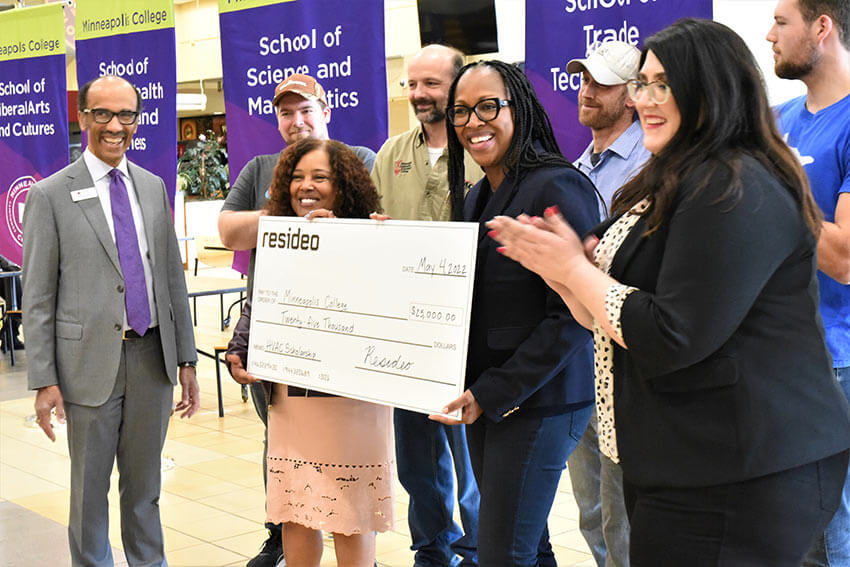
Brand is what the organization can keep
At Resideo, Armstrong became chief marketing officer and vice president of global marketing in 2020. The smart-home company had been spun out of Honeywell, which created a delicate brand puzzle. A new corporate identity needed meaning, while the Honeywell Home name still carried recognition with professionals and consumers. Armstrong’s team developed a brand council, company vision, purpose, values and brand strategy. The introduction of Resideo was designed as a multistep journey, not a ceremonial unveiling followed by frantic explanations.
The work illustrates her preference for architecture over ornament. A brand council decides how choices get made. Values give those choices a test. A strategy sequences the change. Even the old brand equity becomes a component to manage, rather than baggage to throw theatrically from the train. By 2022, Twin Cities Business had named Armstrong one of its Notable Leaders in Marketing. The recognition reflected an organization-building job as much as a communications one.
Her view of corporate responsibility was similarly operational. Writing at Resideo, Armstrong said she believed a company could do well while doing well for humanity and the planet. She separated the work into operations and products: reducing the company’s own footprint while helping customers use less energy and protect their homes. The distinction matters. A principle becomes more credible when it has two workstreams and owners.
“A CMO builds credibility by being connected to what the C-suite and board of directors are facing each quarter and asking how marketing can help.”Lisa Goldson Armstrong
Credibility has a clock
Armstrong has been unusually plain about the internal market for marketing. Executives face the recurring question of what they have done lately. Her answer was not to demand unconditional faith in the function. It was to stay close to the problems occupying the C-suite and board, then ask where marketing could help. She warned that credibility can disappear when an initiative is proposed at the wrong time. A brilliant answer to last quarter’s question is still late.
This is an operator’s view of influence. Marketing does not gain stature by insisting it is strategic. It gains stature by improving a decision the business already needs to make. Timing, financial context and customer reality are part of the brief. The CMO’s work includes choosing what not to launch, which may be the only kind of restraint more difficult than removing adjectives from a product page.
- HoneywellMarketing and strategy leadership in building and automation technologies.
- PentairGlobal marketing and strategy across flow and filtration; CMO Club Rising Star recognition in 2014.
- Filtration GroupSenior vice president for strategy, marketing and innovation.
- Resideo, 2020Chief marketing officer and vice president of global marketing; brand architecture, purpose and customer experience.
- Global Industrial, 2024Senior vice president and chief marketing officer, leading marketing, customer experience and branding.
The promise has to survive the warehouse
Global Industrial brought Armstrong back to a broad industrial portfolio, but with a particularly visible customer journey. The company’s e-commerce sites, sales relationships, distribution network and private brands all meet inside the same promise. A search result may start the transaction. Product information, availability, advice, delivery and service decide whether the promise survives it.
Soon after she arrived, the company announced a partnership with the New York Islanders and UBS Arena. It was local and literal: Global Industrial has Long Island roots, while an arena is a working facility full of surfaces, equipment and maintenance demands. Armstrong framed it as a hometown partnership that could reach local and national audiences. In 2026, she joined women associates from the company’s New Jersey distribution center at a New York Sirens professional women’s hockey game. Global Industrial sponsored the league and its on-ice crew, whose equipment maintained the playing surface. The brand, delightfully, had a job during intermission.
There is an old temptation to make B2B marketing sound grand by borrowing the language of consumer spectacle. Armstrong’s career suggests the more interesting move is the reverse: notice the drama already present in useful work. Water has to move. Air has to be filtered. A technician needs training. A warehouse has to ship. A rink must be ready before the players return. The marketer’s task is to understand those stakes, make the choice clearer and align the organization behind what it promises.
That is how industrial marketing becomes human. Not by pretending a shelving unit has feelings, but by respecting the person who needs it. Armstrong’s public aspirations have remained consistent across roles: enable sales, improve the buying experience, build marketing capability, strengthen customer relationships and create growth. The nouns are corporate. The standard is wonderfully concrete. Did the customer’s work get easier? If it did, the brand has said something worth hearing.