Dipti Kachru was supposed to become a lawyer. Political science was the plan; legal study was the destination. Then a student job at a promotional-marketing agency in India interrupted the itinerary. The country was opening to global brands, digital marketing was barely a phrase, and a small agency meant one person could shuttle from operations to strategy without asking anyone's permission. Kachru worked with names including Pepsi, American Express and Microsoft. She found consumer psychology, creative storytelling and commercial consequence sitting at the same desk. Law lost its future recruit. Marketing gained someone who liked both the argument and the evidence.
That origin story explains more than a change of major. Kachru has spent her career making immense financial businesses understandable without pretending they are simple. Her route runs through OppenheimerFunds, JPMorgan Chase, Broadridge Financial Solutions and, since 2026, State Street, where she is executive vice president and global chief marketing officer. She leads marketing and communications across the firm and sits on its Executive Committee. The remit contains the usual C-suite nouns - brand, growth, engagement - but her method starts with a less glamorous verb: listen.
Chapter one
Change was the family business
Kachru was born in India and raised in a military family. Her father was a fighter pilot in the Indian Air Force. Service life meant moving every few years, which meant another school, another group of friends, another local code to decipher. She has said the pattern made her comfortable with change and eager to enter unfamiliar environments. Adaptability, in her telling, is not a conference-stage abstraction. It is the childhood work of arriving halfway through everybody else's conversation and learning how to join it.
After five years in promotional marketing in India, she moved to the United States. A year at a direct-marketing agency led to financial services and OppenheimerFunds. Seven years of varied marketing work there were followed by roughly a decade at JPMorgan and Chase across asset management, consumer banking and wealth management. The progression looks tidy in retrospect. Living it required a willingness to keep trading fluency for a larger question.
At Chase, she encountered marketing at a scale where creative instinct had to survive contact with data. Her team studied affluent clients who had checking accounts at the bank but kept much of their money elsewhere. Income and balances described the segment without explaining it. So the work went deeper: relationships with money, aspirations, anxieties, behavior. Those insights influenced product features, client experience and the route to market, not merely the message placed on top.
“Data helps validate. The qualitative side is where you start to peel back the layers of the audience.”Dipti Kachru on customer research
Kachru became a willing over-attender of focus groups and ethnographic studies. Numbers could identify a pattern. In a room, a pause or a flicker of irritation could expose what respondents had not said. Her point is not romantic. She wants the soft signal connected back to hard evidence. Demographics provide a foundation; psychographics and behavior explain why two people who look identical in a spreadsheet may choose differently. The customer is neither a mystical muse nor a row in a database. The customer is a person leaving clues.
Chapter two
The chief translator
By the time Kachru became CMO of U.S. Wealth Management, JPMorgan had given her a large laboratory for the proposition that marketing could drive growth. She helped launch the J.P. Morgan Wealth Management brand and build a client-acquisition engine. She also watched leaders make their roles larger than the boxes drawn around them. Kristin Lemkau, then her boss and now CEO of J.P. Morgan Wealth Management, offered a durable line: if you want a bigger job, make your job bigger. For Kachru, that meant carrying the customer's voice into product and business strategy rather than waiting outside for a campaign brief.
Her other named influence is Thasunda Duckett, whom she watched use empathy and inclusion to gather teams around a purpose. Kachru describes herself as an introvert in a corporate culture that has often rewarded the visible habits of extroversion. Her case is not for quieter rooms. It is for rooms designed to collect more kinds of intelligence. A team can miss the careful observer just as easily as a brand can miss the hesitant customer.
Broadridge offered the next variation on the translator's job. When Kachru arrived as global CMO in January 2022, the company sat beneath essential parts of finance - governance, investor communications, wealth platforms, market technology - yet many audiences knew only the piece they touched. The marketing challenge was not to invent relevance. It was to reveal the connective tissue of a business already operating at enormous scale.
She led a multi-year transformation of marketing and communications, brought the function closer to sales, and helped evolve the brand. In 2024, her team launched “Be Ready,” a global campaign designed to present Broadridge as both a trusted and transformative technology partner. The formulation mattered. Trust without movement becomes an heirloom. Transformation without trust sounds like a demo. Financial institutions must carry both.
Chapter three
A grown-up relationship with AI
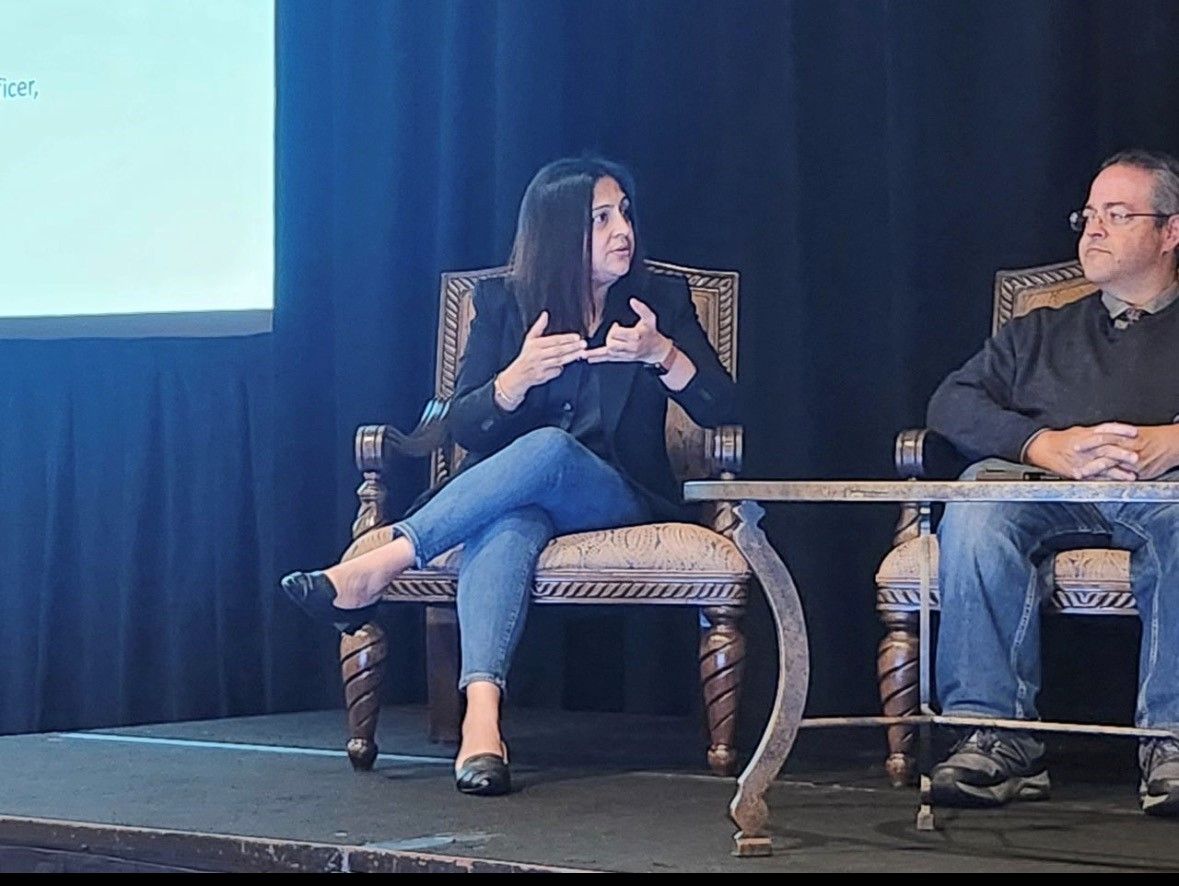
Kachru's view of artificial intelligence is bracingly free of fireworks. In a 2025 interview recorded at the ANA Masters of B2B Marketing Conference, she placed Broadridge somewhere between crawling and walking. The company had moved beyond the earliest experiments but was not pretending to run. Its strongest traction was in content creation, workflow efficiency and creative ideation. Internal technology expertise made specific pilots possible. Outside tools played a role, but controlled ecosystems and focused use cases mattered in a regulated industry.
She called the relationship between CMO and CIO “mission critical.” Modern marketing is already made of data and technology; collaboration determines whether the machinery creates value or merely produces more machinery. The useful question is not how much content a model can generate. It is where speed removes drudgery, where data remains protected, where the brand stays distinct and where a human remains responsible for the judgment.
“You can't be a CMO today without being deeply rooted in tech and data.”Dipti Kachru on the modern marketing brief
This pragmatism belongs to the same person who says her favorite life-lesson proverb is to throw one's hat over the wall. Full commitment and careful governance may sound like opposing instincts. In practice they need each other. Kachru's three self-selected strengths offer the bridge: hunger to choose a consequential goal, hustle to find a way through the closed door, humility to notice where the plan is weak. She calls herself a forever student. Even after more than two decades, she treats the CMO role as a syllabus being revised in real time.
At State Street, the new assignment is larger and newly public. She leads global marketing and communications across multiple businesses and holds a place on the senior team responsible for the firm's strategy. The company described her mandate in the language of a data-driven, client-focused approach: strengthen the brand, support growth, deepen engagement. Beneath that corporate grammar sits the problem she has practiced for years. A vast institution knows many things about markets. Its audiences need to know why those things matter to them.
Kachru has predicted that marketing will be recognized more widely as a growth driver, aided by better analytics, clearer revenue attribution and a greater role in the sales process. She also says marketers must work hard to earn that expanded promise. The word “earn” does useful work. A seat at the strategy table is not proof of impact. It is permission to be measured alongside everyone else.
There is a playful consistency to the career. A political-science student falls for persuasion. A self-described introvert builds global brands. A finance marketer insists emotion tips the scale. A champion of bold commitment worries carefully about controls. The contradictions are only cosmetic. Each is an argument for seeing the whole system: art with science, data with observation, trust with change, ambition with humility.
Financial services specializes in making ordinary life sound like plumbing. Kachru's work is to preserve the plumbing while restoring the person who turned on the tap. She listens for what the customer cannot quite articulate, teaches the institution to answer, and measures whether the answer changed anything. Then she does the marketer's oldest job, the one no dashboard has abolished: she finds the story people can carry away.