The meeting was not going well. A member of Melissa Hendricks's team had arrived confident that an event, now two days away, was buttoned up. Then came the questions. Details were missing. The plan had holes. Everyone in the room could see it.
There are several familiar ways to respond when a boss finds the loose threads in your work. Defend every choice. Collapse into agreement. Confuse a flawed plan with a flawed self. Hendricks had seen all three. This colleague chose something cleaner. He looked at her and said, I'll be back in four hours.
He returned, give or take, with the work repaired. The next meeting went better. So did the event. The phrase became a minor legend among the team: give me four hours. It was funny because it was specific, and useful because it converted criticism into a clock. No ritual humiliation. No fog of corporate resilience-speak. Just four hours and a better answer.
Adaptability is the distance between a bruised plan and a better one.The four-hour lesson
That anecdote came from Hendricks's years at Cerner, but it is an unusually good key to the rest of her career. She has worked in businesses that rarely share a shelf: Dairy Farmers of America, Cadbury Schweppes, Schering-Plough, health-technology company Cerner, and now the risk-data company Verisk. The products moved from familiar consumer categories to systems whose value may live inside an underwriting decision or a catastrophe model. Her recurring job was to make a complicated organization legible, then help a team revise fast enough to keep it so.
A career in translation
Hendricks studied speech communication and Spanish at the University of Missouri, then earned an MBA from Rockhurst University. The pairing looks almost suspiciously apt in retrospect. Communication asks how meaning travels. A second language teaches that meaning does not travel by swapping words one for one. Business school adds the rude but necessary question: did any of it work?
Before 2005, she held sales and marketing roles across dairy, packaged goods, and pharmaceuticals. Then came Cerner, where she would spend more than a decade. By 2017, as vice president of marketing strategy, her remit included corporate initiatives and global stewardship of the Cerner brand. The list beneath that sentence was considerable: earned and social media, events, industry partnerships, digital experience, market intelligence, research, and internal communications.
Cerner put her near a difficult intersection: technology, institutional buyers, and consequences that extend far beyond a campaign dashboard. She moderated and spoke on digital transformation, served in the Nashville Health Care Council Fellows program, and appeared in a professional journal alongside a hospital digital executive. Her public honors list records work ranging from conference experiences and video to an internal sales portal, an intranet redesign, a local business campaign, and a podcast series.
The variety matters more than the trophy cabinet. It suggests a marketer interested in the whole environment around a brand, including what employees see when they open an internal page and what a customer feels in a conference hall. Brand, in this view, is less a campaign than a habit with typography.
The many names problem
Verisk welcomed Hendricks to its corporate management team in 2019, saying she brought expertise in brand and modern marketing methods. The company had grown into a large public data and analytics business, but growth had produced a naming problem. More than a dozen brands sat across its portfolio. The collection reflected Verisk's history; it did not always reveal the full value of the company to a client, or give employees a common sentence about where they worked.
Hendricks championed a master-brand strategy grounded in a brand valuation study. The names were consolidated under Verisk. Account-based marketing, demand generation, event strategy, and a more data-centered marketing culture helped make the unified idea visible. Yet the most telling measure looked inward. During the broader work to translate purpose, vision, and values into employee experience, the share of U.S. employees who understood the company's vision rose from 56 percent to nearly 80 percent.
When the brand became clearer inside
U.S. employee understanding of the company vision during the brand-alignment work, as reported in 2023 award coverage.
A logo can be installed overnight. Shared understanding is slower and less obedient. It has to survive a town hall, a client call, a product roadmap, and the mildly dangerous journey through an employee's own words. The jump in understanding is evidence that the project was not simply an exercise in visual housekeeping. The company was trying to make its parts add up to something people could repeat.
There is a useful operating principle here for anyone managing a sprawling product portfolio: architecture is strategy made visible. If customers must understand the org chart before they can understand the offer, the brand has given them homework.
Red teams need Sherpas
Hendricks's writing about management is livelier than the usual leadership laminate. In one essay, she argued that overloaded calendars and constant notifications make it difficult to do the thing knowledge work is supposedly paying for: think. Her answer was not heroic inbox management. The solve is slowing down to think critically.
She described a culture built from challenge and support. Red teaming supplies the challenge. Colleagues test a proposal for vulnerabilities before it travels upward or outward. A pleasant thumbs-up has its uses, mostly social; a trusted peer who locates the soft plank in the bridge is more valuable to the work.
Support arrives through what she calls Sherpas: experienced team members who understand the terrain and can guide others. The metaphor makes succession sound less like a spreadsheet and more like a climb. Instead of a manager personally coaching every person to every summit, the manager develops guides who can multiply what they know.
The framework avoids a common management fraud: demanding independent thinkers while punishing disagreement, or promising development while the boss keeps every difficult assignment. Red teams require enough trust to question. Sherpas require enough generosity to teach. The four-hour rule requires enough self-command to separate one's ego from one's draft.
Data, with a pulse
At Verisk, Hendricks leads branding and digital marketing strategy, public relations, media, external communications, and event experiences. It is fitting work for someone who argues that modern marketing must hold data and emotion in the same hand.
In a 2023 podcast conversation, she emphasized personalization, segmentation, and targeting, but also the emotional side of marketing. Technology partners can help build a personalized customer journey; data can tell a team which audience is responding. Neither relieves the marketer of understanding why a human being might care. She also encouraged marketers to explore generative AI for automation and creative thinking, a position more curious than breathless.
That balance is especially useful in insurance analytics. The underlying subjects include extreme weather, property risk, claims, fraud, and underwriting. They are dense with models and regulation, but never merely technical. A risk score eventually touches a building, a business, or a household. Marketing has to preserve the precision without misplacing the person.
Sales and marketing roles built fluency across very different categories.
Global brand stewardship expanded into communications, digital experience, research, events, and transformation.
Joined corporate management as chief marketing officer.
Named a Top Woman in Marketing in the Data/Analytics Leader category.
Continues to frame Verisk as a data and technology partner across the insurance ecosystem.
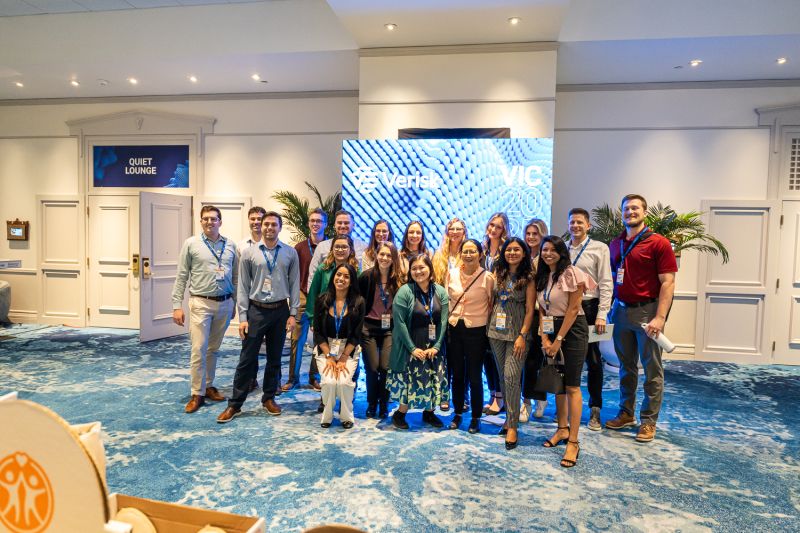
In an AM Best interview at the 2024 Verisk Insurance Conference, Hendricks described the company's aim to be a pivotal partner in the insurance ecosystem, using data and technology to drive insight and impact. A year later, she reflected on another conference that brought together more than 800 clients and partners. She highlighted the conversations, the emerging-professionals gathering, the solutions gallery, and the people who made the event work.
It is a small detail, but consistent with the rest. The executive responsible for the master brand keeps returning to the team behind it. The story is never only the polished stage. It is also the critique before the stage, the colleague who knows the trail, the four hours spent fixing what did not hold up, and the people in the room who can finally say what the company means.
Careers are tidied into timelines after the fact. Hendricks's crossed several industries and two cities of professional gravity, Kansas City and Jersey City. The continuous thread is not a sector. It is the craft of translation and the temperament to revise. Her most portable idea may also be her least glamorous: when the work is wrong, do not make the meeting longer. Ask good questions. Take the time. Come back better.