The meeting is called coaching. Much of the work happens before anybody meets. A supervisor gathers an agent’s numbers, checks a quality score, hunts for a useful conversation and decides what deserves attention. By the time the employee arrives, the expensive part may already be over. AmplifAI has built its business around that peculiar allocation of effort: managers preparing to improve performance instead of spending time improving it.
- Connect the data supervisors otherwise assemble by hand.
- Turn performance gaps into specific coaching actions.
- Check whether the coaching changed the numbers.
The method worked. The workload did not.
Founder Sean Minter traces the idea to 2008, when he was brought into the business-process outsourcer PRC. Thousands of agents worked across dozens of sites. His account describes a discovery familiar to anyone who has managed a large team: the useful opportunity lay in the middle of the performance distribution, among capable employees who were neither stars nor emergencies.
Minter’s teams collected performance data manually and studied what successful agents did differently. Supervisors coached those behaviors. Results improved, he says. But every extra team meant more analysis, preparation, follow-up and recognition. The method demanded an expanding army of people. What changed his thinking was the cost of repeating a successful intervention across a much larger workforce.

The scorecard gets a to-do list
AmplifAI begins with systems a contact center already owns. Phone platforms, customer relationship software, quality tools and workforce systems contain different pieces of the same employee’s working day. Data integration brings these together with recordings, transcripts, chats, emails and survey feedback. The point is to see performance without requiring a supervisor to reconstruct it from several incompatible views.
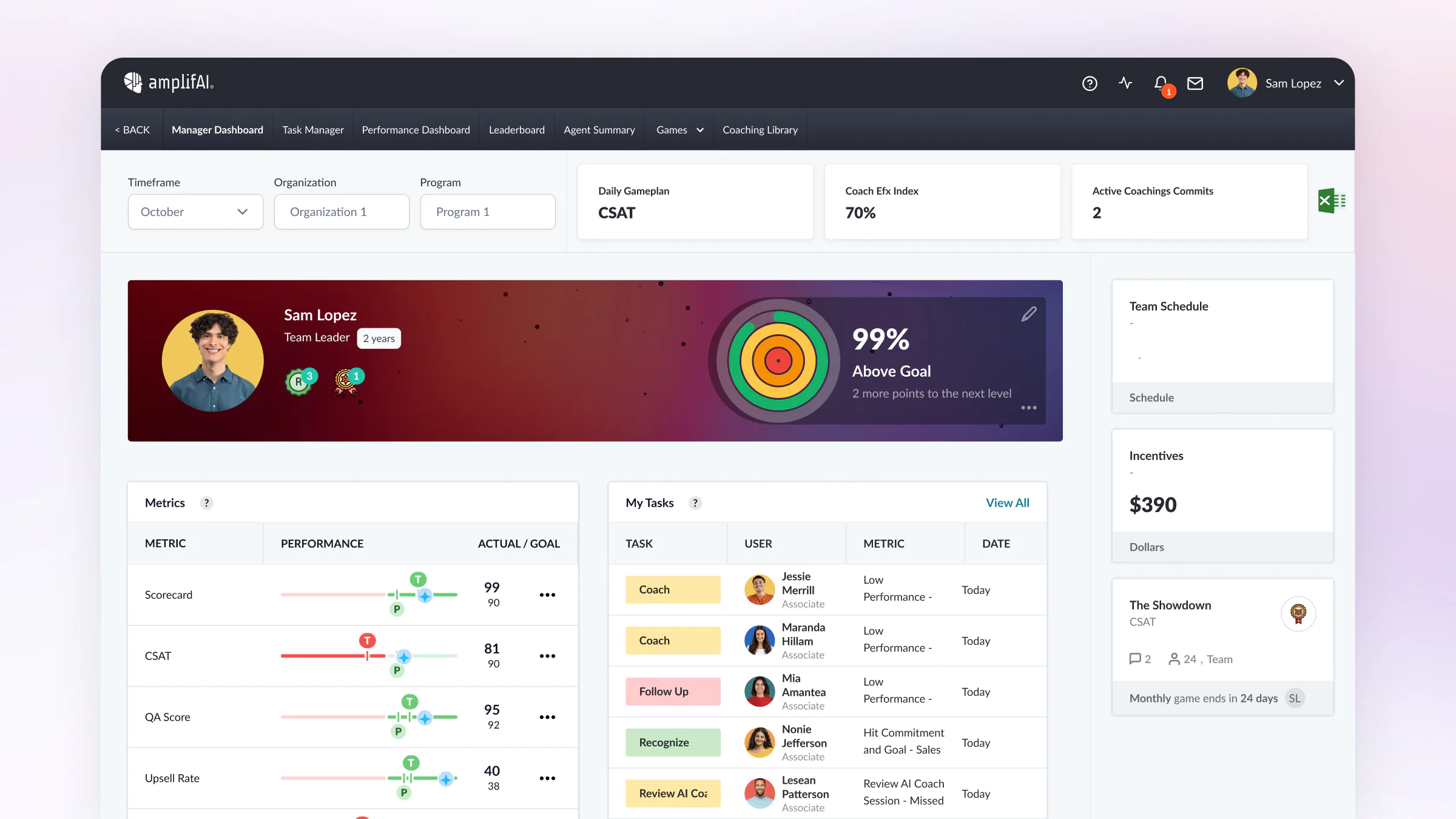
Then comes the recommendation. A leader gets guidance about whom to coach and which behavior to address. Quality findings can become coaching tasks; a commitment can become a follow-up; improvement can trigger recognition. Performance dashboards, automated quality assurance, customer analytics and gamification sit on that connected foundation. A customer can use it to run a more consistent coaching routine across internal teams and outsourced partners.
- 01ConnectMetrics + conversations
- 02IdentifyThe behavior to change
- 03CoachAct + follow up
- 04MeasureCheck the result
The coach gets a score, too
The company’s more interesting question concerns the supervisor. A completed coaching session proves that a meeting occurred. It does not prove the agent learned anything. AmplifAI’s Coaching Effectiveness Index connects coaching with subsequent performance movement. Leaders can examine which coaches improve their teams and which need support themselves. The coach becomes part of the system being measured.
“Our view of AI is that it isn’t here to replace people.”Sean Minter, in the company’s 2021 financing article
Thrasio provides a concrete example of the operating change. In a published AmplifAI case study, the multi-brand retailer adopted the platform in Q2 2022 while rebuilding its coaching program. Consolidated agent data replaced report gathering. Leadership development accompanied the software. The case reports average monthly coachings per agent rising from 1.5 to 10.7, while first-reply time fell from 4.43 hours to 1.23 hours.
Vendor-published customer results. A before-and-after comparison, not a forecast.
Those are customer observations reported by the vendor, rather than proof that software alone caused every improvement. That distinction makes the example more useful. The implementation changed a management habit as well as a screen. Recovered preparation time became more frequent, more individual conversations. A buyer hoping to copy the result needs to budget attention for that organizational work.
A customer problem can be a policy problem
The buyers are contact centers and BPOs handling sales, service and collections, including healthcare, finance, retail and technology operations. AmplifAI reports more than 10,000 teams using its platform. Its public materials feature The Home Depot, Cox Communications and GoDaddy. Supervisors are central users, but quality analysts, CX leaders and agents also receive views and actions suited to their roles.
This places AmplifAI in a crowded neighborhood. Observe.AI, Cresta and Level AI address overlapping conversation-intelligence and quality needs; broader suites include NICE, Verint and Calabrio. AmplifAI’s distinguishing emphasis is the connection from measured behavior to coaching, follow-up and effectiveness. Its partners also include vendors whose products overlap with its own. Enterprise software permits surprisingly cordial competition.
Customer analytics broadens the investigation. A disappointing interaction might reflect an agent’s behavior, but it might also reveal a confusing product or an unhelpful policy. Connecting conversational themes with operational data gives other departments a reason to pay attention. Coaching the agent more intensely will accomplish little if the organization keeps supplying the same broken process.
The commercial model is enterprise SaaS. The partner program describes monthly licensing; the BPO offering uses per-user pricing adapted to outsourced operations. Procurement is therefore a quotation exercise tied to the deployment. For an operator, the economic question is whether integration and recurring licenses buy enough usable supervisor capacity and performance improvement to justify the expense.
Now the chatbot needs a review
The financing history reflects the expansion. AmplifAI announced $18.5 million in 2021, comprising $12.5 million in equity and $6 million in venture debt. In September 2025 it announced a $33.7 million Series B and credit facility led by CVS Health Ventures. The combined figures matter: borrowing capacity and equity investment are different kinds of fuel.
The current product also evaluates AI-agent interactions alongside human work. Automated quality, compliance flags and governance extend the performance framework to a workforce that now includes software. In 2026, AmplifAI announced the CCW Automation Solution of the Year award. Its next problem follows naturally from its first: a conversation still needs a standard even when no employee is speaking.
The lesson readers can borrow is small enough to try without a procurement committee. Pick one performance gap, identify the behavior behind it, coach that behavior, and revisit the result. It requires trustworthy data, a sensible benchmark and managers who actually use the time recovered. Otherwise, the organization has simply acquired a faster way to prepare for a conversation it never holds.