There is a pleasing indecency to Swapnil Jain’s account of becoming a founder: he says envy helped. In 2015, he was a young engineer at Twitter in San Francisco, watching friends from IIT Delhi start companies in India. Twitter had gone public. The work was good, the colleagues formidable, the corporate life increasingly polished. Jain felt the itch of other people getting on with the adventure. “It was not driven by an idea,” he later said. “It was about doing it as well.” Most origin stories improve with age. This one has retained its original awkwardness, which is why it is useful.
He moved to India with Twitter and helped set up the company’s first engineering office there. Eight months later, he left. The romantic version of entrepreneurship would now provide a garage, a revelation and an obliging market. Jain instead found himself without a job, without a co-founder and without a viable idea. Two friends who had been exploring companies with him stepped away after four months. He had energy, savings and the slightly terrible luxury of too many directions.
A founder in search of a problem
Jain tested eight ideas over roughly two years. Insurance in India lasted three months before regulation made the attraction fade. Logistics looked too operational. Consumer software was set aside. He wanted a software-first business, and he understood that selling to American companies offered the economics he sought. B2B became the boundary. The process was less a lightning strike than a series of politely closed doors.
Then he began studying business processes. Through his network, he gained access to contact centers in India and Manila. Manila alone had an enormous concentration of agents, headsets and fluorescent-lit operations. Jain sat on the floors and watched. Customer calls were recorded with the familiar promise of quality and training, but people still listened to a tiny sample, completed forms by hand and passed fragments of information to supervisors. Coaching, compliance and operational analysis all depended on humans reviewing speech one conversation at a time.
The contrast was almost comic. Twitter could distribute a thought around the planet in seconds; a large customer-service operation might still need a person to replay a call and tick a box. Deep learning had recently improved machines’ ability to process speech. Here was a vast industry with more recorded language than it could reasonably understand.
“I would write 20 emails and see if someone responds.”Swapnil Jain, on early customer research
There was still no product. Jain made mockups and screenshots, assembled a deck and approached executives with the confidence of someone whose company existed a little more fully in PowerPoint than in code. The pose was practical. Large enterprises rarely pause to advise three people with an interesting hunch. Presenting a plausible future earned him conversations; those conversations made the future less imaginary.
Rejection, then a product that failed
Observe.AI began in August 2017. An earlier application to Y Combinator had been rejected. After raising an initial seed round, the founders applied again and joined the accelerator’s Winter 2018 batch. The sequence contains a tidy startup moral about persistence, but the untidy part came next. The first real product, released around mid-2018, did not land.
The first product took about a year to build. When customers did not embrace it, the company needed roughly another year to make something that worked for the market.
Jain has called that release a failure without applying cosmetic language. It took another year, and roughly two and a half years from the company’s start, to reach a stronger product. Early customers arrived through a contact-center partner, which brought in 20 to 30 smaller accounts. That channel soon proved mismatched with the founders’ enterprise ambitions. By late 2019, Observe.AI was building a direct sales operation of its own.
The platform’s premise was simple to describe and difficult to execute: understand every conversation rather than a small sample, then turn the result into useful work. That meant transcription, quality monitoring, compliance checks, coaching and analysis. It also meant fitting around the contact-center systems enterprises already used. The company was not tearing out the switchboard. It was trying to make the words passing through it intelligible.
Money followed the improving fit. A $26 million Series A arrived in 2019. In 2022, SoftBank Vision Fund 2 led a $125 million Series C, bringing disclosed funding to about $213 million. The company reported 150 percent annual recurring revenue growth in the year before that round, while the volume of customer interactions it analyzed tripled. Funding headlines invite a founder to speak in unicorns. Jain offered a less zoologically glamorous target: a “Centaur,” meaning a company with more than $100 million in revenue. Revenue, unlike mythology, pays the wages.
When the software learned to speak back
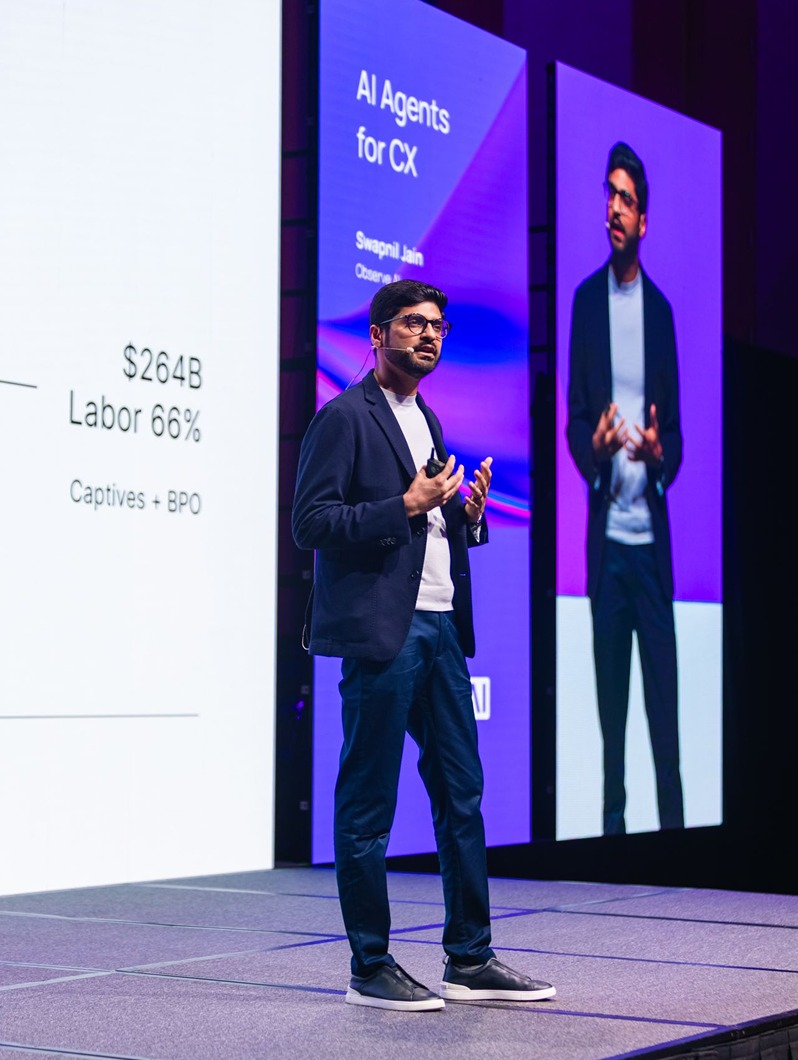
Observe.AI’s original territory was understanding conversations after or during the event. Generative AI altered the boundary. A system could now participate in the conversation, identify intent, answer and take action. Jain described the first deployment in which VoiceAI held a two-way exchange as a turning point. The recorded voice had become an active one.
The company’s platform expanded into three related jobs. Automation agents handle customer interactions across voice and chat. Companion agents assist frontline employees before, during and after a call. Operations agents evaluate quality, compliance and performance. Together they express Jain’s current thesis: the future of customer service contains both AI agents and human frontline agents, assigned according to the work rather than a slogan about total automation.
His own examples reveal the trade. In collections, Observe.AI’s early tools helped human representatives improve results by perhaps 10 to 15 percent, according to Jain. A later VoiceAI deployment handled outbound collections calls end to end and collected three times as much for the same number of calls. Yet when automation removes routine requests, the conversations passed to people become more complicated. The human needs context, judgment and a graceful handoff, preferably without juggling the eight to twelve applications Jain says an agent may face on a screen.
“Start with guardrails. AI needs structure, especially in regulated environments.”Swapnil Jain
That caution is not decorative in businesses where a missed disclosure or an improvised answer can create a regulatory problem. Jain speaks about safety, transparency and compliance as design requirements. He also argues for beginning with a workflow audit: find the tasks technology can perform reliably, then expand. It is a builder’s answer to an excitable market. The machine should be judged by the work it completes and by whether it knows when to summon a person.
The second founding
The arrival of AI agents also forced an uncomfortable verdict on the company Jain had already built. Observe.AI initially tried to add the new capabilities to its existing product, team and technical stack. Jain says the incremental approach consumed six quarters and did not work. So the company started over inside itself: a small team, a new stack, a separate floor, fewer approvals and a direct line to the CEO. The arrangement was designed to feel like a seed-stage company housed inside a nine-year-old one.
This is where the engineer remains visible beneath the chief executive. A former Twitter manager remembered Jain as someone who could build complex software from the ground up and embodied a “ship it” spirit. Jain still says his favorite hours are spent with product and engineering teams, discussing what users actually do rather than what buyers say they do. One recent discovery was that supervisors had quietly begun using AI summaries to write coaching notes, a behavior no executive sales conversation had surfaced.
The rebuilt system became Observe.AI 2.0. Jain later said it produced two consecutive record quarters, with bookings in one quarter rising 60 percent from the previous one. In July 2026, the company announced a multi-year collaboration with AWS intended to bring its agents into large enterprise environments with the reliability and controls those deployments demand. In September, it launched Performance Agents, software meant to connect specific frontline behaviors with outcomes and coaching.
The trajectory from Vidisha to San Francisco can be made to look inevitable if enough dates are placed in a row. It was not. Jain grew up focused on academics in a small city in Madhya Pradesh, left for Rajasthan to prepare for the IIT entrance exam, studied computer science in Delhi and endured eight interview rounds before Twitter hired him. At each stage, systems grew larger: a digital notice board at college, Twitter’s infrastructure, a global network of customer conversations.
The recurring habit is less glamorous than vision. Look closely at how people work. Admit when the product misses. Write another 20 emails. Jain’s company now sells machines that listen at scale, but its origin depended on a founder doing the listening himself. There is a moral in that for the age of artificial intelligence, though it is almost embarrassingly human: before a system can act on the world, someone has to pay attention to it.