The least glamorous record in a company database may also be the most expensive. “Beth Pfefferle” becomes “B. Pfefferle.” A household moves. A guest books under a work email, joins a loyalty program with a personal one and calls the front desk from a third phone number. Now one human appears to be three customers. The marketing system sends the wrong offer; the service agent misses the history; the analytics model confidently counts fiction.
Redpoint Global has spent two decades in that untidy gap between what a company has collected and what it can safely use. Founded in 2006 and based in Wellesley, Massachusetts, the private software company sells tools that ingest, clean, match, unify and activate customer information. Its buyers are not only marketers. They are the data, IT, analytics and customer-experience teams that get called when the “single customer view” turns out to contain several versions of the customer.
The company’s current language is “data readiness.” That is both a product category and a useful correction to the AI conversation. A model can be sophisticated and still make a dim decision if the underlying address is stale, the consent flag is wrong or two family members have been collapsed into one. Redpoint’s wager is simple: prepare the record before celebrating what the model can do with it.
The first thing to fail is the plumbing
Customer-data projects are usually sold from the top down: beautiful journeys, timely offers, loyal customers. The breakdown happens from the bottom up. Data arrives in different formats and at different speeds. Names and addresses resist easy matching. Departments define a “customer” differently. Consent must follow the person across channels. By the time a team discovers these conflicts, it may already have bought the campaign layer that depends on them.
Redpoint’s Data Readiness Hub attacks this earlier layer. It connects structured and unstructured sources, validates and standardizes fields, resolves identities, builds a continuously updated “golden record,” and makes the result available for analytics, service, AI or marketing. Its Smart Engagement tools then segment audiences, orchestrate journeys and make real-time decisions. The customer data platform combines those foundations and activation capabilities. Enterprises can run the software as SaaS, in a private cloud, in hybrid form or on premises.
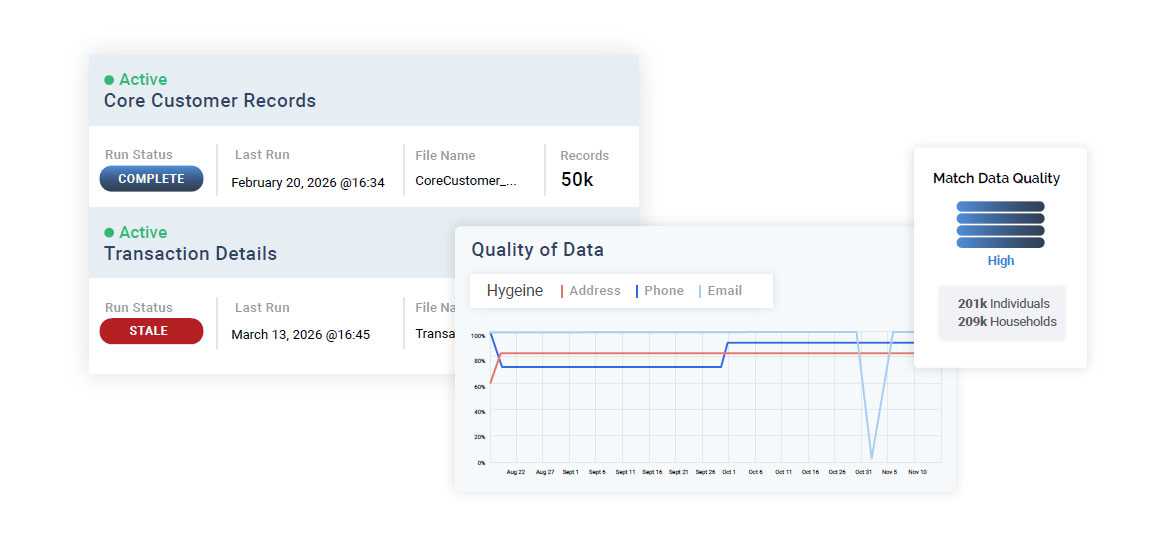
That deployment range matters. Redpoint competes in a market crowded with large suites, independent CDPs and newer “composable” products that activate data from a warehouse. Its answer is an “open garden”: work with the cloud, warehouse, CRM and channels a company already owns. It supports environments built around AWS, Azure, Google Cloud and Snowflake. The point is not to win custody of every byte. It is to make the bytes agree.
“We didn’t have to change a single reservation platform to get all our data into our common database.”Andrew Heltzel, Xanterra marketing and CRM director
A hundred data sources walk into a resort
The clearest example comes from Xanterra Travel Collection, whose brands span national-park lodges, resorts, cruises, rail journeys and cycling tours. Its inventory uncovered more than 100 sources of customer information, each with its own habits. A traveler could cruise with Windstar, visit Glacier National Park and later browse an Austin Adventures trip without the organization recognizing the same person across brands. It could not reliably calculate total spend.
What failed first was not the email creative. It was the identity layer. Xanterra considered the usual expensive remedy: standardize the systems and data-entry processes across the enterprise. After evaluating alternatives, its decision-makers chose Redpoint because the platform could take in the existing mess while leaving reservation infrastructure intact. That constraint changed the choice. It traded a sweeping systems replacement for a common database, adapters and data-management rules.
Redpoint cleaned, standardized and enriched the profiles with more than 300 appended attributes. Xanterra’s analysis surfaced seven core segments, including one called “sensible explorers.” It then mapped digital and analog moments - email, call center, front desk, pre-arrival - against a guest’s stage and needs. Two brands discovered overlapping travelers and could cross-sell adjacent itineraries. Automated, multi-wave campaigns took work off local marketing teams.
The company reported triple-digit improvements in many Xanterra campaigns, with one reaching 839 percent. Another Redpoint travel case, published later without naming the customer, reported an 80 percent reduction in data-preparation time and a tenfold revenue increase. A global financial-services deployment cut complex queries from half a day to minutes and improved marketing-program speed by 96 percent across information for 25 million customers. These are vendor case studies, not controlled experiments, but they put measurable edges on an otherwise woolly promise.
The product followed the buyer downstairs
Redpoint began in marketing software and spent years describing an end-to-end route from data to engagement. In 2025 it launched the Data Readiness Hub and moved the center of gravity toward enterprise data quality. The company said customers had reported a threefold conversion lift from improved matching, a 20 percent increase in average basket size and up to 80 percent less preparation time. The more revealing move was rhetorical: data was no longer merely available. It needed to be complete, accurate, timely, actionable, trusted and compliant.
In June 2026, Redpoint pushed the idea further with Identity Studio, a native application sold through Snowflake Marketplace. The matching work happens inside the customer’s Snowflake environment. Data teams can tune deterministic and probabilistic rules, inspect why records merged, compare two rule sets on live data before promoting a change, and preserve identity keys as fresh information arrives. For regulated companies, explainability and keeping personally identifiable information in place may be more persuasive than another promise of effortless personalization.
Two months later, Redpoint released open-source MCP servers under the Apache 2.0 license. They let developers connect AI agents, using the model provider of their choice, to Redpoint’s data-readiness and interaction products. The move is small but coherent: if customer data is going to become conversational, the permissions and identity beneath the conversation cannot be vague.
The price is a conversation, not a menu
Redpoint sells enterprise software through negotiated, quote-based contracts. It does not publish a current software price, which means a buyer needs to budget beyond license fees: source discovery, implementation, identity rules, governance, security review, partner services, training and ongoing ownership all count. A public 2021 training sheet listed a two-day basics workshop at $7,000 and a custom or advanced workshop at $14,000 plus travel. Those are historical training charges, not a proxy for today’s subscription.
The company has raised several publicly reported rounds: $6.5 million in 2012, $5.2 million in 2014, $12 million in 2016 and $13.5 million led by Camden Partners in 2019. A $1 million option or warrant financing was recorded in May 2025. No reliable public valuation is available. LinkedIn places the team in the 51-to-200 range. This is a specialist of roughly a hundred-plus people competing beside software conglomerates.
The four moves worth stealing
Redpoint’s own implementation guidance is admirably uncinematic. Start with an inventory and baseline: sources, event streams, schemas, duplicates and consent gaps. Publish a minimum standard for canonical models, reference data, identity and activation. Configure and automate rules. Then pilot two or three high-priority sources and one channel before scaling. That sequence is useful even if Redpoint never appears in the purchase order.
There are conditions. The approach depends on access to source systems, an accountable data owner and agreement about matching, survivorship and consent. A tool cannot decide whether a shared household account should be treated as one customer or two; that is a business and policy choice. Real-time promises are also wasted when upstream feeds arrive weekly. A small company with a clean CRM and three simple sources may be buying an aircraft carrier for a pond. And an organization determined to replace its entire suite may value a bundled cloud more than Redpoint’s interoperability.
For the right buyer, however, Redpoint occupies a sensible place. It sits below the glitter of campaign creative and above raw storage, doing the reconciliation that makes both useful. Its public customer roster crosses AAA, American Express, Cigna, DSW, Express Scripts, Freedom Mortgage, Houston Methodist, Jet2.com, Kingfisher, Talbots, Vanguard, VSP Vision Care and 1-800 Contacts. Those are businesses where identity mistakes can become wasted media, awkward service, unreliable analysis or compliance exposure.
Redpoint’s mission is to help organizations unlock the potential of their data for better customer experiences. Its values include delighting customers, respect for the individual and the delightfully blunt “Think straight, talk straight.” The best version of the company follows that last instruction. Do not begin with a magical AI outcome. Begin with the dull, consequential question: are these two rows the same person?