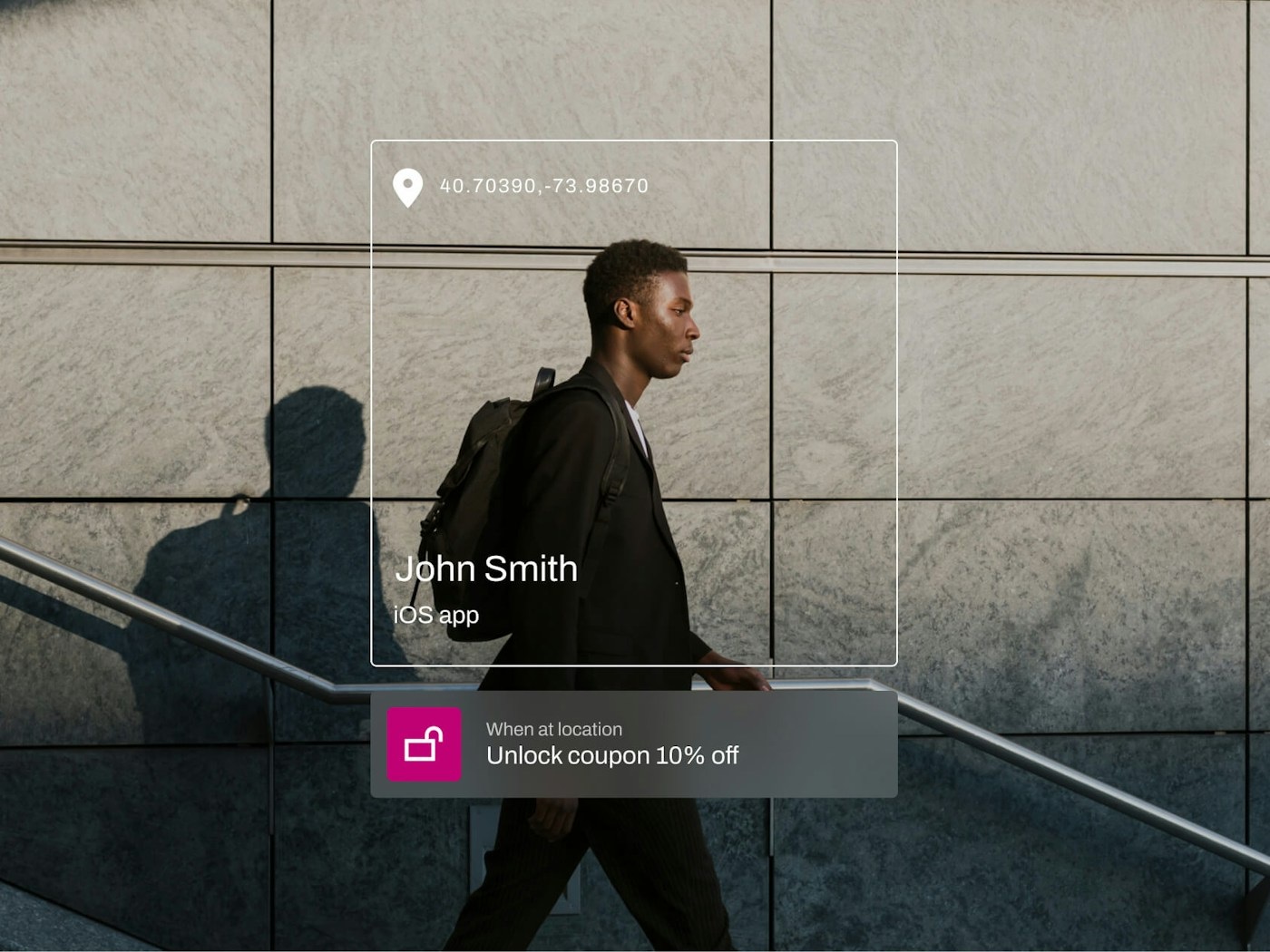
In December 2018, Burger King asked people to go to McDonald’s. Get close enough to one of the rival’s restaurants, open the Burger King app, and a Whopper could be yours for one cent. The app would then send you to Burger King. It was a joke with directions. Beneath it sat a less visible achievement: several pieces of software agreeing, quickly, about where someone was and what should happen next.
- The job: collect customer signals, connect identities, and send usable audiences to other tools.
- The distinction: combine warehouse history with behavior happening now.
- The catch: teams still need reliable events, identity rules, and someone accountable for the result.
A burger needs a plumbing diagram
The Whopper Detour stack included mParticle, alongside tools for engagement, location, and attribution. The company’s role was customer data infrastructure: helping information travel between systems so an idea could become an experience. The cheekiness belonged to Burger King. The coordination was shared work.
Rokt’s case study reports more than 1.5 million app downloads during the nine-day campaign and coupon redemption 40 times the previous digital-promotion record. Those are results for the campaign and its integrated stack. They cannot tell us how many downloads mParticle alone caused. They do show why a restaurant chain might care deeply about software that most diners will never see.
Vendor-reported campaign result.
The useful lesson is smaller than the stunt. A signal acquired value because somebody had already decided what to do with it. Collecting location data without an offer, a trigger, and a destination would have produced a very well-documented walk.
The customer has more than one clock
mParticle sells a customer data platform, or CDP, to consumer businesses with complicated digital lives. Publicly named customers include HBO Max, Marks & Spencer, JetBlue, and SoFi. Their systems may recognize a customer through an app, a browser, a loyalty account, or a transaction record. The platform collects events through SDKs and APIs, connects identities, applies governance rules, and forwards information to marketing and advertising destinations.
Its hybrid architecture addresses two different questions. A warehouse can tell you who spent heavily over the past year. A streaming system can tell you who just added something to a basket. A marketer may need both answers before making an offer.
mParticle’s Composable Audiences query data in warehouses including Snowflake, BigQuery, Redshift, and Databricks. Hybrid Audiences can combine that warehouse membership with live behavior. A high-value customer browsing now can qualify for different treatment from an equally valuable customer who has not visited in months.
There is a clock hidden inside that promise. Composable audiences refresh on a schedule. Fresh warehouse tables do not update an audience until its next run. Hybrid matching also needs usable identifiers. Connecting historical context to a live event cannot repair history that was never updated.
Then the infrastructure met its users
Michael Katz, Andrew Katz, and Jason Lynn co-founded mParticle; the company’s own releases date its founding to 2013. It developed expertise in the awkward work between applications: identity, mobile collection, integrations, and governance. Its public SDK repositories make that developer foundation unusually tangible.
Yet getting infrastructure installed was only part of the problem. In his essay introducing the Performance Engine, Lynn describes customers struggling with the complexity and organizational changes required to use a CDP. Buyers had to fit the platform into their business context. The pipes could work while the business still struggled to get value.

That diagnosis explains the June 2026 Performance Engine launch. Its Audience Agent lets marketers describe an outcome conversationally, then proposes an audience using the brand’s data and context. The marketer reviews, refines, and saves the definition. The launch explicitly says nothing activates on its own.
“The agent does the heavy reasoning. The marketer keeps the judgment.”Sam Dozor, Rokt CTO · June 2026
The accompanying tools address different bottlenecks. Match Boost improves recognition of existing audiences by advertising platforms. Audience Expansion finds additional prospects within a brand’s first-party data. Household Reach extends eligible targeting across households. Predictive Audiences scores likely outcomes such as churn and lifetime value.
Why Rokt wanted the connection
In January 2025, Rokt announced a $300 million investment and merger with mParticle. Rokt’s ecommerce decisioning business already operated around purchase moments. mParticle brought the customer-data foundation beneath those decisions. The deal joined a mechanism for understanding customers to a business organized around acting when they buy.
Earlier, mParticle raised a $150 million Series E led by Permira in October 2021. For buyers, however, the relevant cost is their own contract and implementation. Current public pricing sends prospects to sales. Warehouse audience queries can also consume billable warehouse compute.
The commercial logic is increasingly about reachable audiences. In the Performance Engine announcement, Hardee’s reported a 117% increase in Google Ads match rates after enabling Match Boost. A match rate measures how much of an audience an advertising destination can recognize. It is useful evidence about reach, but it is not a revenue forecast. A brand still needs an offer that works and a way to test whether the resulting sales were incremental.
Buy the decision you need to improve
The buying alternatives include Segment and Tealium, marketing-cloud CDPs, and warehouse-centered activation tools such as Hightouch. mParticle’s case rests on combining streaming, identity, governance, and warehouse audiences. That combination matters when several systems must react coherently. A team with simple, occasional campaigns may have less need for it.
Implementation deserves the same scrutiny as the demo. Engineers must connect collection points and establish warehouse models; marketing needs to know which behavior warrants a response. mParticle’s governance controls can restrict what travels downstream, but the company buying the software still chooses its rules. If those teams disagree about what a purchase or an active customer means, faster delivery can spread that disagreement remarkably efficiently.
There is also a product boundary to remember: mParticle began sunsetting Analytics on October 1, 2026. Its present story emphasizes audience activation and performance. Older descriptions of the suite need that correction.
The part readers can copy requires no procurement: choose one customer decision, define its triggering event, agree on the identity rule, assign an owner, and measure the outcome. Burger King had a precise answer to what should happen next. A CDP becomes useful when its customer does, too.