The customer had bought a car somewhere else. For the dealership that lost him, this ought to have been the end of the story. Instead, the emails changed. Out went the vehicle offers. In came maintenance advice and invitations to the service department. Months later, the customer returned - with the competitor’s car.
This is one of the more revealing examples in Fullpath’s account of its Urban Science integration. The buyer’s name is disguised, and the story is the vendor’s own. But the mechanism is wonderfully concrete: discover that somebody has purchased, stop treating him as an immediate sales prospect, and offer something he now needs. A database has acquired a little tact.
- Fullpath joins dealership customer records, then puts them to work in email, ads, websites and sales workflows.
- Its distinctive expertise is automotive context: actual vehicles, ownership history, trade-in equity and service relationships.
- Cox Automotive acquired the business in June 2026, adding access to a broader automotive data ecosystem.
- The lesson travels: change the message when the customer’s circumstances change.
The sale that refused to end
In the published example, a shopper submitted a lead to a Toyota dealership on May 24, 2025. On June 2, Urban Science data showed he had purchased at a competing Toyota store. Fullpath changed his status and shifted the outreach toward service. In September, he began opening those emails. On October 1, he submitted a service lead and came in for an appointment that day.
The integration supplies daily sales and defection information. Fullpath says a detected purchase moves the shopper out of the in-market audience for 12 months. The store can preserve a relationship while redirecting its acquisition budget. The important event is the change of state. Sending more of the old offer would have been an efficient way to advertise yesterday’s opportunity.
For a reader outside automotive retail, this is the transferable idea. A customer who has stopped needing one thing may have started needing another. You need a dependable signal, a useful second offer and a system capable of connecting them. Persistence without that information is merely repetition with a budget.
First, teach the systems to remember the same person
A dealership has several ways of knowing a customer. Its customer relationship management system records leads and conversations. Its dealer management system contains operational and transaction history. The website sees browsing. Advertising platforms record campaign interactions. Each may hold a useful piece of the relationship.
Fullpath’s Customer Data Platform combines those pieces and resolves disconnected profiles into a shared shopper record. Its integration documentation describes daily CRM imports of customer, lead, sold, service and appointment data, with DMS connections adding further customer and financial information. This is the plumbing behind the more photogenic AI promises.
The business sells that infrastructure and the tools that act on it to dealerships and dealer groups. Fullpath currently reports more than 2,000 dealers across North America. Its Group CDP extends visibility across multiple stores. The underlying question gets harder in a group: is the visitor at one location the same person already talking to another?
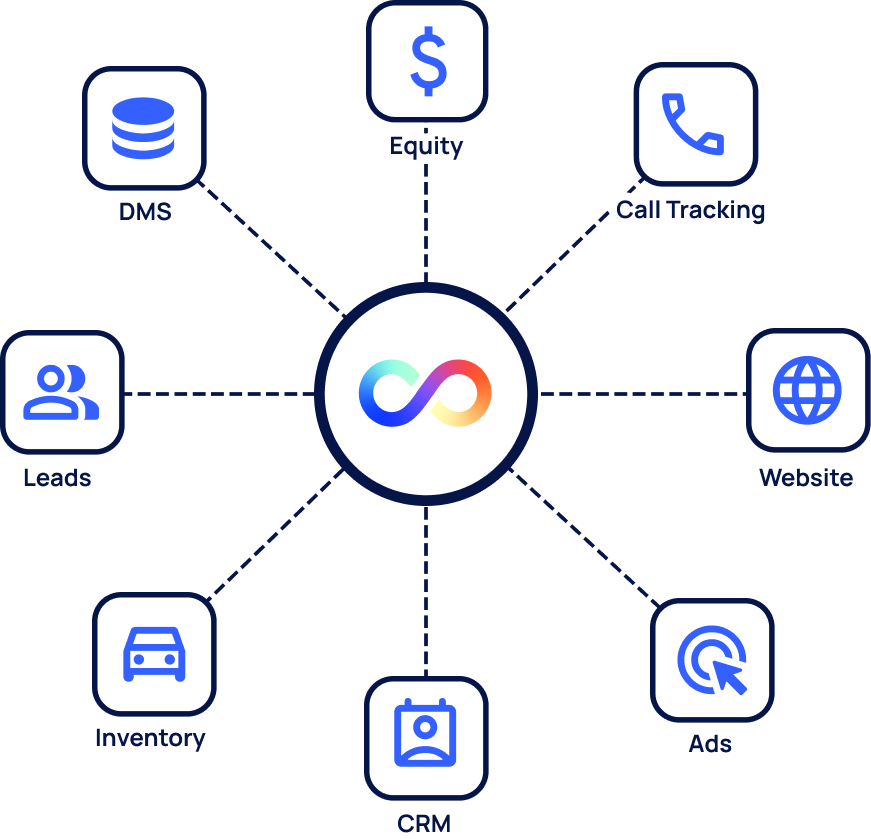
Audience Activation turns the joined record into personalized email and SMS. Digital Advertising automates paid campaigns and budget allocation. Website Engagement personalizes the site. VINs-Acceleration concentrates on particular vehicles. A VIN, the vehicle identification number, makes the marketing object pleasingly specific: this car, on this lot, needing a buyer.
Equity adds another automotive detail. It combines ownership and financing information with Kelley Blue Book valuation data to identify trade-in opportunities. The offer depends on the customer’s position and the vehicle’s estimated value. A generic email tool can send a message; this requires knowing what the message ought to contain.
The embarrassing richness of the lost-lead drawer
Newbold BMW’s case study puts numbers on the argument. After launching Audience Activation in February 2024, the dealership’s campaign period through August included 193,369 emails. Fullpath reports that outreach reached 4,805 leads previously marked lost; 1,374 became engaged shoppers, and 20 of those shoppers purchased.
purchases from shoppers whose leads had previously been marked lost.
That result invites a sensible distinction. “Lost” is an administrative label. It describes what the sales process currently believes. It cannot, by itself, describe every future intention of the person underneath it. The case study suggests value in continuing relevant contact; it does not establish that every dormant database contains the same opportunity.
“That’s the real advantage of this tool.”Joe Barhoumi, Newbold Toyota BMW, discussing message and timing
The Sales Stories dashboard documentation uses the language of influenced sales. It reconstructs marketing and shopper engagements along the path to a purchase. That is useful operational evidence. A customer receiving an email before buying does not prove the email caused the purchase. A buyer evaluating Fullpath should ask how attribution is calculated and compare completed sales or appointments with a credible baseline.
The first market was too big
Fullpath’s beginnings contain an ordinary entrepreneurial temptation: sell useful software to almost everybody. In a 2024 interview with Globes, co-founder Aharon Horwitz recalled an early ambition to provide data and marketing automation to small and medium businesses. By 2015, the initial funding had run down, payroll was a problem and entry into the American market had not worked.
Horwitz, Eliav Moshe and Yishai Goldstein decided to continue and narrow the target to automotive. Horwitz described visiting dealerships across the United States to sell the idea. The failure came before the present product suite: the broad market entry had not supplied a viable business. The change of mind was a choice of customer.

The later name change tells the next chapter. AutoLeadStar became Fullpath as the product expanded beyond capturing leads. The company’s account describes learning by observing dealers’ daily work. Its new logo included a Möbius strip: a customer journey with no convenient finishing line. A rebrand is sometimes expensive stationery. Here, the explanation also described a change in scope.
Pay for the machine, then pay for the audience
Fullpath’s model is business software and marketing services sold to dealers, with a demo-led sales process. A published advertising price sheet lists Search Only at $1,100 and Search/Social/Display at $1,900. The VIN service has a $1,100 minimum for 10 vehicles. The sheet explicitly excludes advertising budget. These are document-listed module prices, not a complete current platform quotation; the sheet does not specify their billing interval.
The cost calculation therefore needs separate lines for the service, the media and the dealership’s work. Connecting systems, checking record quality and deciding what staff should do with surfaced opportunities are part of implementation. A buyer can copy the discipline even without buying the product: join the records, select one trigger, assign responsibility and measure the finished transaction.
There are practical limits. Dynamic Payments documentation says price values must exist in the inventory feed; Fullpath cannot create or modify them. Equity estimates depend partly on mileage and service information, falling back to averages when data is missing. Automation can distribute an offer quickly, but the dealership still has to supply reliable inputs.
Cox buys the connection
The financing announcement in November 2022 disclosed a $40 million growth round led by Riverwood Capital and nearly 1,000 dealership customers in the United States and Canada. In April 2026, Cox Automotive announced an agreement to acquire 100% of Fullpath. Fullpath’s news and integration documentation record the completed acquisition in June.
That puts Fullpath alongside VinSolutions, Dealer.com, Autotrader and Kelley Blue Book. Some overlap with traditional CRM and marketing suppliers becomes a matter of coordination inside the same parent. Outside that portfolio, buyers can assemble agencies, email tools and dealership CRMs, or choose a broader retail platform. Fullpath’s pitch centers on the shared data layer connecting those jobs.
September 2026 documentation describes KBB and Autotrader activity and Cox Consumer Intelligence buying signals inside Fullpath. Marketplace vehicle views can be matched to shopper profiles; account settings control the KBB and Autotrader data connection. Ownership has begun to produce a specific product consequence.
Meanwhile, the Agentic CRM, announced in January, is still described as beta in August help documentation. It includes automated lead follow-up and a Task Builder that prioritizes a representative’s work. Omni lets staff ask questions of dealership data, assemble prospect lists and draft messages. Fullpath is moving further into the salesperson’s working day.
The ambition is large; the useful test remains small. Does the system recognize the customer accurately? Does it notice a meaningful change? Does somebody act on it? The lost Toyota sale that became a service appointment offers a good place to begin. The customer had moved on. The dealership finally caught up.