Zeta Global sells an appealing fantasy to a particular kind of executive: the chief marketing officer who would like to stop holding six vendor meetings before lunch. Somewhere in the company sits a customer database. Somewhere else, an email tool. Paid media lives with an agency, identity resolution has its own contract, and analytics produces a handsome explanation of last month. Zeta's pitch is to put those pieces in one machine - know the customer, predict the next move, send the message, buy the ad and measure what happened.
That machine produced $1.305 billion in revenue in 2025, up 29.7 percent from the year before. By the second quarter of 2026, Zeta said it had delivered 20 consecutive quarters of beating its forecast and then raising the next one. The company is large enough to count 197 customers spending at least $1 million a year, yet unfamiliar enough that many people experience its work without noticing the name. A sneaker offer, a hotel ad, a mobile plan or an email subject line may have passed through Zeta's software while the consumer saw only the brand.
+29.7% year over year
at year-end 2025
super-scaled customers
The useful third of a messy deal
The origin is more interesting than the usual founders-see-future story. David A. Steinberg and former Pepsi and Apple chief John Sculley started XL Marketing in 2007 as a customer-acquisition business. It helped companies find buyers. Then the customers asked the obvious follow-up: can you help us keep them?
That request pulled the company toward customer relationship management. XL bought a small business called Zeta Interactive. Steinberg later said they broke it apart quickly and sold roughly two-thirds. What remained was the platform, which became one of the company's most important products. XL took the Zeta Interactive name in 2014 and became Zeta Global two years later. The change was not cosmetic. A services-led acquisition shop had found its route into software.
“We sold off two-thirds of the business. We kept and ran the platform.”David A. Steinberg, describing the Zeta Interactive acquisition in 2017
There is a copyable lesson here, and it is not “buy companies.” It is to let the customer's adjacent problem redraw the boundary of the product. It is also to treat an acquisition as a collection of capabilities, not a sacred object. Zeta discarded what did not fit and kept the part that could compound.
One record, many expensive buttons
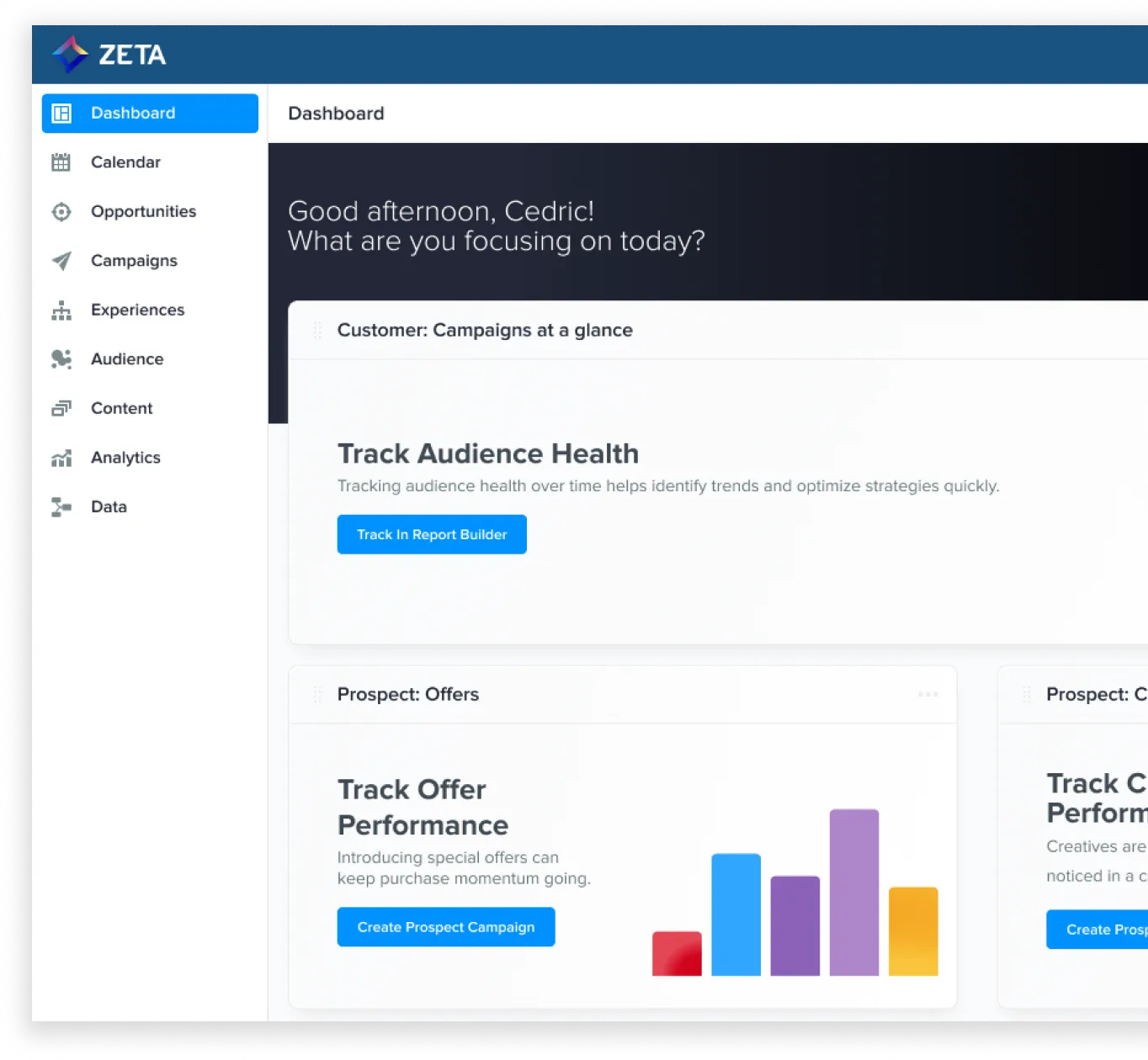
Zeta's system is easier to understand as three layers. Identity and data decide who a person probably is across devices and channels. Intelligence estimates intent, likely value and the next useful action. Activation does something with that answer - an email, text, display ad, connected-TV spot, social campaign or in-store intervention. Analytics closes the loop by tying activity to an outcome.
The Zeta loop - from signal to sale and back again
The identity layer is the distinction Zeta emphasizes. It says its U.S. graph includes more than 245 million profiles and draws on trillions of signals. That can help an enterprise connect anonymous browsing with known customers, build audiences and measure across channels without treating every cookie or device as a new person. The product spans acquisition through retention, where many vendors specialize in only one side.
Athena is the new front door. Launched broadly in March 2026 and supported by OpenAI models, the conversational agent lets a marketer ask which audience is growing, what return a campaign might produce or where a budget should move. Zeta says workflows that took weeks can happen in hours. Athena can assemble dashboards, recommend next actions and move toward execution rather than stopping at a chatbot's tidy paragraph.
The business is software, media and sleeves rolled up
Zeta is not a pure self-serve subscription app. It earns money when enterprises use its platform directly and when the platform works through third parties. Revenue can reflect software, data, messaging volume, campaign activity, paid media and managed services. Its cost of revenue includes payments to publishers, media owners, data providers and other partners. A customer can buy a module, but the economic engine improves when that customer adds channels and moves more of the lifecycle onto Zeta.
The concentration is revealing. In 2025, 87 percent of revenue came from “super-scaled” customers generating at least $1 million apiece. Consumer and retail supplied 24 percent of sales; travel, insurance, telecom and financial services were also substantial. These are businesses with millions of records, frequent customer interactions and enough wasted spend to make consolidation meaningful.
Revenue climbed as existing customers bought more
Of the $298.9 million increase in 2025 revenue, $190.9 million came from existing customers. That is the platform thesis showing up in the accounts: land with a use case, then expand. New customers contributed $108 million, including about $84.2 million associated with acquisitions.
The shopping list became the strategy
Zeta has assembled much of its reach by buying infrastructure. The purchases included eBay Enterprise's CRM unit, Acxiom's email services business, machine-learning startup Boomtrain, Disqus, and advertising assets from the bankrupt Sizmek. The Sizmek DSP and data-management assets cost $36 million in 2019 - a bargain-bin route into programmatic media, but also a reminder that adtech plumbing can lose value quickly when supply and customers flee.
The appetite remains. In late 2025, Zeta completed the purchase of Marigold's enterprise software business for consideration of up to $325 million. The acquired operation brought recognizable messaging products and revenue that was more than 90 percent subscription-based in its prior fiscal year. In July 2026, Zeta replaced a $550 million credit facility with a $1 billion facility, including an undrawn $750 million revolver. The company plainly wants room for another deal.
The OpenAI-Palantir graduation attempt
In 2026, Zeta began describing itself as an intelligent AI infrastructure company, a larger suit than “marketing cloud.” OpenAI supplies models behind Athena's conversational layer. Palantir is the more consequential architecture bet: Zeta plans to rework its Data Cloud on Foundry, putting customer intelligence beside governed operational data. The companies also plan to sell together to eligible Palantir customers. Steinberg has said the partnership could eventually generate more than $100 million in annual revenue for Zeta, though that remains a forecast, not a result.
The move is logical. A marketing agent cannot make a useful decision if it sees only last week's clicks. It needs inventory, margin, availability, customer history and permission. Palantir's ontology is meant to provide governed context; Zeta provides customer signals and the channels that act. If the integration works, a question such as “Which lapsed customers should receive this offer?” can account for what the company can actually deliver.
Proof, with an asterisk the size of an enterprise
Public case studies show the shape of the payoff. Aerosoles reported a five-times return on ad spend and a 23 percent lower cost per acquisition after using Zeta to reach high-intent shoppers beyond search and social. Hibbett said Zeta's Data Cloud uncovered 30 percent more targetable customers; combined with Movable Ink, the program produced more than 40 percent higher revenue and engagement. A Zeta-commissioned Forrester study modeled 295 percent technology ROI for a composite enterprise, $3.2 million in annual savings and payback inside six months.
Those numbers are evidence, not a coupon. Commissioned models blend interviews and assumptions; case studies select customers willing to be studied. The useful question is not whether every buyer gets 295 percent. It is whether the buyer has the conditions that created the result: significant media spend, many customer records, duplicated tools, executive ownership and a baseline against which improvement can be measured.
Copy this
Start with one costly customer workflow, connect the data required to improve it, and expand only after the result is measurable.
Copy this too
Buy capabilities against a thesis. Keep the platform pieces that compound; dispose of the parts that merely add revenue.
It breaks when
Consent is vague, identities are messy, teams guard their channels, or nobody owns implementation after the contract is signed.
Skip it when
Your stack is simple, your audience is small, or the savings from consolidation cannot outrun enterprise software and change-management costs.
Privacy is the structural tension. The same identity graph that makes Zeta useful also raises the cost of governance and the risk of regulatory or platform change. Its own filings warn that limits on online data collection, email standards and security failures could hurt the business. A deterministic customer record is powerful only when permission, provenance and correction processes are real.
Competition is equally untidy. Adobe, Salesforce and Oracle sell broad marketing clouds. Braze specializes in engagement. LiveRamp and Acxiom work in data and identity. The Trade Desk dominates many programmatic conversations. A determined enterprise can assemble a best-of-breed stack and preserve leverage over each supplier. Zeta wins when integration produces more value than specialization - and loses when a customer would rather own the seams.
That makes Zeta less a universal marketing answer than a very specific organizational wager. The buyer believes one identity layer can improve many decisions, one platform can reduce enough friction, and an agent can compress analysis into action without loosening control. For a national retailer, insurer, airline or telecom company, that may be a sensible bet. For a small team sending a weekly newsletter, it is a limousine for a grocery run.
The company's most honest piece of history remains the old acquisition it dismantled. Zeta did not become a platform because somebody wrote “platform” on a roadmap. It became one because customers asked for the next job, and management kept the piece of software that could do it. Everything since - the data graph, the buying spree, Athena, OpenAI and Palantir - is a larger version of that same move: keep connecting the next expensive decision until the collection behaves like a system.