A phone rings while someone is doing the work a customer hired them to do. Answer it, and the work stops. Ignore it, and a possible new customer meets voicemail. Roojoom has built a product around that small, familiar collision. The interesting part is where it came from: a company accustomed to guiding enterprise customers through complicated service journeys now wants to guide the conversation at a small business’s front door.
- Enterprise Roojoom chooses actions and content toward defined customer goals.
- PickMyCall handles missed calls, captures leads, and supports follow-up.
- Its voice redesign shows why conversational timing belongs on the buyer’s checklist.
The route came before the voice
Roojoom began in 2013 with founders Yuval Shemesh, Rami Ricanati, and Or Meirov. Its early product arranged web material into guided tutorials. By 2017, it was announcing a Customer Journey Management platform for enterprises. The ambition had widened: help people proceed through a relationship with a business, rather than simply proceed through content.
There is a pleasing clue in the name. Roojoom says it refers to stacks of stones used to mark a trail. A stone does not walk the path for you. It tells you where to go next. In software, that distinction becomes quite practical: an introduction, a troubleshooting question, a reminder, or a handoff to someone who can help.

A map is an optimistic document
A customer journey map can look wonderfully orderly. Customers are less obliging. They leave halfway through, return on another device, telephone instead, or need help before they are ready to buy. Each department may know something useful about them. The difficulty is arranging those pieces into a coherent next step.
Roojoom’s enterprise platform lets operators define goals and available messages or actions. Its AI selects what to present based on predicted impact. Journey progress persists across sessions and channels, including digital self-service and agent assistance. Web experiences can be generated from templates. This is machinery for executing a journey, with the customer’s changing position informing the route.
The work spans engagement, service, and product adoption. A marketing team might pursue retention. A support team might guide a broadband fault toward resolution. A software company might help an individual user reach a personal value goal, with an internal product champion setting goals and tracking progress. The destination gives otherwise scattered interactions their purpose.
- 01 Define the goal
- 02 Choose the action
- 03 Remember progress
- 04 Continue the journey
Its published customer history includes AT&T, Comcast, Sky, and Bouygues Telecom. The latter offers a particularly tangible example. My Bbox assistant, developed using Roojoom, guides customers through technical troubleshooting in self-service. It won gold for Best Data & Personalization Strategy at the 2020 CX Paris Awards. The attraction is easy to understand: an ailing connection can receive attention outside a call center’s timetable.
Roojoom sits among enterprise journey-orchestration vendors, with alternatives including Adobe Journey Optimizer and CSG Xponent. Its stated emphasis is goal-based selection, remembered progress, and automatically generated experiences. Those are useful buying criteria, rather than proof of superiority. The right comparison starts with the journeys a business actually needs to run.
The phone brings the enterprise home
PickMyCall narrows the setting considerably. Its audience includes contractors, consultants, shops, and other small service businesses. The receptionist answers missed calls, collects lead information, and supplies summaries. Scheduling and follow-up give the conversation somewhere to go. For an owner working with their hands, the proposed benefit is attention recovered without abandoning the next caller.
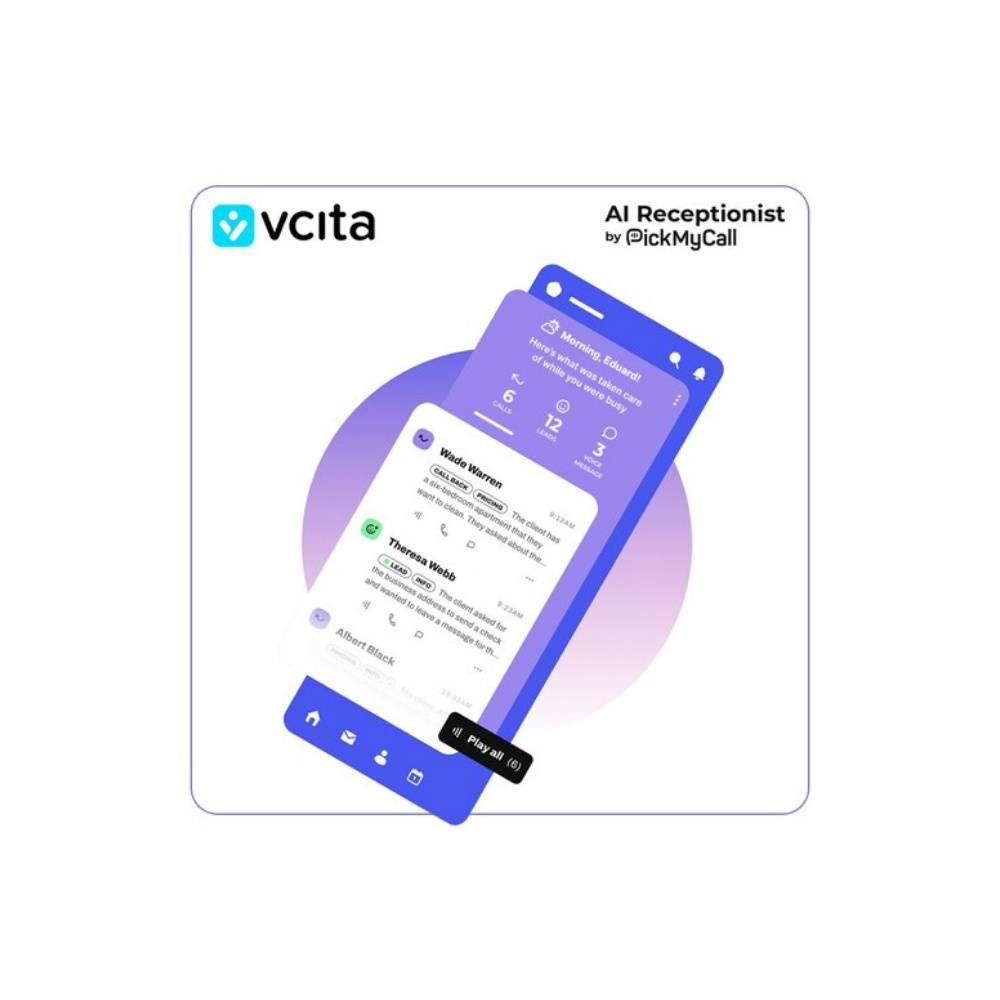
Distribution matters here. In November 2025, vcita announced an integrated receptionist powered by PickMyCall. The connection brings business information and call records into the management software an owner already uses. On its current product page, vcita describes booking links sent to callers, with recordings, transcripts, and summaries saved to the CRM.
“Small businesses shouldn’t have to choose between doing the work and catching every call.”Itzik Levy, vcita CEO, partnership announcement
The commercial model has two doors: direct subscriptions and software partners. The US App Store lists PickMyCall Pro at $49.99 a month after a seven-day trial. Partner packages carry their own terms. An owner’s useful calculation is the value of recovered opportunities against the subscription and the time spent reviewing calls.
The pause that changed the machine
The revealing failure was a delay. In its December 2025 engineering account, Roojoom described an earlier architecture that converted speech to text, passed it to a language model, then converted the response back to speech. Each stage added waiting. Callers could talk over the assistant or feel unheard. Requests for better name recognition and call stability strengthened the case for a change.
Roojoom switched to Amazon Nova Sonic for native speech-to-speech. The company reported average latency falling from roughly 4.5 seconds to 800 milliseconds and a functioning prototype built within days. These are company-reported figures. Still, the lesson is concrete: a correct answer has to arrive in time to remain part of the conversation.
Average latency reported by Roojoom, December 2025. Approximate figures; bars share the same scale.
Copy the destination, then test the route
The transferable idea is to specify an outcome before choosing the automation. Resolve the fault. Capture the inquiry. Help the user reach a useful feature. Then connect the information and actions needed to finish. Roojoom’s products make more sense when examined this way than when treated as another collection of AI features.
A practical trial would follow one interaction all the way through: call after hours, ask about a service, request a booking, then inspect the record left behind. Did the information remain accurate? Could the owner follow up without reconstructing the conversation? These are less glamorous questions than whether a voice sounds human, and considerably closer to what the business is paying for.
There are conditions attached. A receptionist drawing on stale hours or incorrect service information inherits those errors. A journey that needs backend access requires integration. A complicated or sensitive conversation may need a person. Buyers should test their own callers, booking process, and escalation route. The cairn points onward; someone must still make sure there is a passable path.