The family business is an unusually demanding first customer. It knows whether the work has improved. It may also know your childhood nickname. For Cherryanne Lee Angoy, returning to the Philippines meant bringing a career in technology into reach of a familiar, stubborn problem: making construction projects run more efficiently. The question was close enough to belong to her family and broad enough to belong to other builders. She started AIMHI to address it.
The resulting company has a name that joins artificial intelligence with human intelligence. Its founder’s career gives that combination some substance. Angoy had worked inside a large American technology organization, helped build a Philippine commerce startup, and taken leadership roles in family businesses. She understood organizations from several directions. Construction supplied a fresh test of how much that understanding could accomplish.
The business waiting at home
Angoy studied Management Accounting at Ateneo de Davao University. It is a useful educational detail for someone who would later concern herself with construction margins: finishing a project and earning from it are separate achievements. A completed building can look perfectly convincing while the financial result tells a less cheerful story. Accounting teaches a person to ask for the second story.
Her professional life took her to the United States. She spent 16 years in the broader US technology industry, including a career at Verizon that she has described as lasting 13 years. In her own account, she received at least eight promotions. She credits male and female mentors, recognition for performance, and a workplace where she felt respected as an Asian woman in leadership.
She returned to the Philippines in 2017. That year also appears in her education record: her eCornell Digital Marketing certification was issued in November. Technology, sales, marketing and operations were already part of her working vocabulary. Coming home gave those skills a different setting, with local businesses and family enterprises taking the place of an established American corporate structure.
StreetBy was an early expression of that change. As a co-founder and chief strategy officer, Angoy spoke about the application as a way to introduce local businesses to customers in Davao. Its services included restaurant ordering, hotel bookings, tickets, deliveries and laundry. The range was decidedly everyday. It dealt with things people wanted to arrange without spending the day arranging them.
Construction brought another collection of everyday complications. Angoy held leadership roles at SECKKA, including the construction business SECKKA Empire Builders. The family’s enterprises had roots in the work of Samuel Uy Angoy and Ester Lee Angoy and extended across several business activities. Her interest in technology therefore had somewhere concrete to be tested. A contractor’s working day would supply questions a software presentation might overlook.
In December 2023, she explained that AIMHI had begun as a way to improve efficiency in her family’s construction company. She then saw a wider purpose for it. Small and medium contractors needed an accessible route into digital management. That origin matters: the first problem arrived through the business itself, with the inconvenience already attached.
A third application, with corrections
AIMHI’s company timeline places its founding in May 2021, with Angoy as CEO and Monica Llamas-Turrecha as CTO. Attorney Ma. Janice Tejano completes the founding team with legal and governance expertise. Their disciplines suggest the range of work involved. A construction platform needs to make business sense, behave sensibly on a screen, and handle its legal responsibilities.
In February 2022, AIMHI entered UPGRADE Innolab’s incubation program at UP Mindanao. The word incubation can sound rather comfortable. Angoy’s account of seeking government support supplies the less comfortable details: questions, requirements, revisions and the discovery that an experienced leadership team could still have a great deal to learn.
The first two applications to the DOST startup grant program were unsuccessful. The third was approved. Angoy described the founding team’s frustration with feedback and last-minute requirements. They had venting sessions, she wrote, which ended with plans to improve documents, answers and next steps. Even frustration was expected to produce something useful before the meeting ended.
“Being rejected was such a humbling experience!”
Cherryanne Lee Angoy, on AIMHI’s grant applications
By February 2023, AIMHI had secured a combined ₱4.3 million in grants from DOST-PCIEERD and Accenture. The DOST-PCIEERD component was ₱3.8 million. The funding supported a company working on forecasting and risk analysis for construction. Those figures describe assistance to a venture developing its technology; they are distinct from a contractor’s eventual results using it.
There is a recognizable progression here: experience, a problem, a team, then help. The grant applications interrupted any tidy version of that progression. They required the founders to revisit their work. Angoy’s willingness to describe that process makes the company’s development more intelligible than a list of recognitions alone.
Strict, apparently
In March 2023, Angoy wrote a leadership essay titled “Strikta si Maam.” She recalled hearing women described as strict while male counterparts could be loud and assertive and receive approval for it. She also described employees trying to go above a woman leader’s head when she held them accountable. Her examples were about ordinary workplace behavior, where assumptions become visible in a passing remark.
The essay drew on the contrast between her experience at Verizon and what she encountered after returning home. She wanted performance and competence to determine opportunities. She called for women to share their experiences and offer advice to younger leaders. She also asked fathers to consider the attitudes toward women in leadership that they taught their sons.
That is a wider audience than a company’s management team. Angoy was addressing the people who shape expectations before a young person enters an office. The essay carries some humor: she says the strict label makes her laugh. Yet the practical concern beneath it is authority. A leader cannot do much with a responsibility that everyone else feels free to overrule.
Her account adds a personal dimension to AIMHI’s women-led founding team. It puts business leadership beside the social habits through which people judge it. In a company concerned with accountability on construction projects, her attention to who gets to enforce accountability has particular resonance.
The phone still has a job to do
On June 16, 2026, Angoy formally launched AIMHI Mobile at Benilde’s Peter D. Garrucho Jr. Innovations Institute. Government, academic and construction industry participants gathered for a forum on digital transformation. The product’s mobile and offline capability brought the discussion down to a straightforward condition: construction sites do not always have dependable internet.
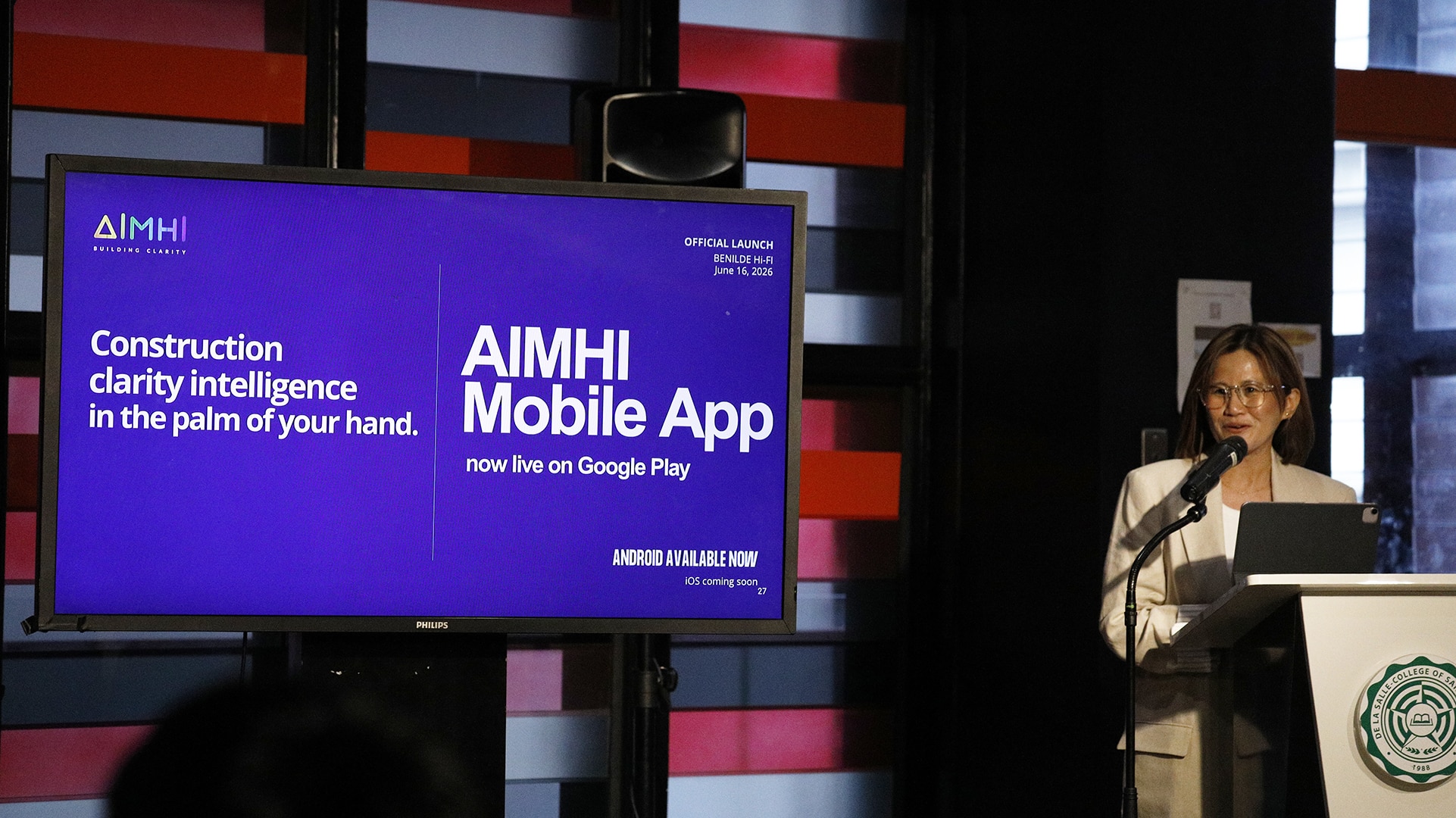
The app allows site teams to record information offline and sync it when connectivity returns. Project tracking, attendance and inventory are among the areas it supports. The platform also uses AI to flag potential delays, budget overruns and material shortages. A team can keep making a record of its work even when the phone cannot reach the network.
- 01Record on siteCapture work data offline.
- 02Connection returnsSync the recorded information.
- 03Review togetherUse project records and alerts.
That sequence is modest enough to understand without a demonstration. It also places a constraint on the ambition of construction technology: the record has to survive the circumstances of the work. A sophisticated analysis is of limited use if the information needed for it never leaves the site. Offline recording addresses the beginning of that chain.
At the launch, Angoy discussed limited project visibility and costs that can surprise contractors even when work finishes on schedule. Participants could explore the platform at demonstration stations. The event made room for questions about access and workforce readiness, issues that matter to smaller firms deciding whether another piece of software will fit into their day.
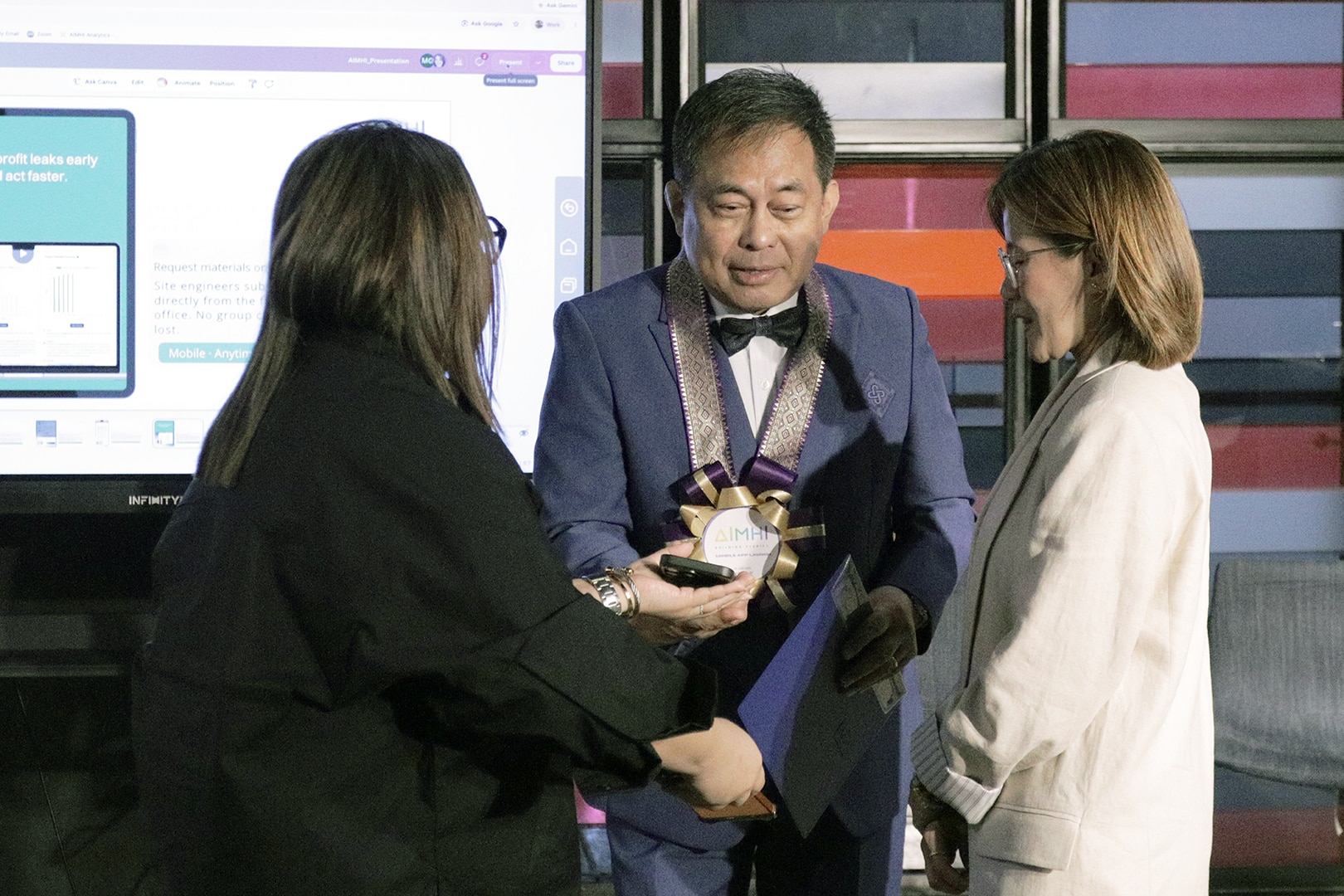
Angoy acknowledged her co-founders, team and partners in her closing remarks. She finished with a short rallying call: “Mabuhay ang Filipino innovation!” It suited a launch whose central proposition was local practicality. The technology was being presented in terms of the budgets, connections and working conditions of the people expected to use it.
A company needs somewhere to grow
Building in Mindanao also means finding people to build with. In 2024, Angoy described difficulty recruiting local developers within AIMHI’s budget. Candidates’ expectations could exceed what the startup could offer. Her response included academic referrals, a stronger online presence and industry connections. The ambition to grow local technology work has a recruitment process attached to it.
She has worked on the other side of the learning process, too. At UPGRADE’s 2020 LIHOK Startup Roadshow, she taught business modeling and helped mentor teams on market feasibility and pitch preparation. UPGRADE now lists her on its board of trustees. At a Davao Oriental State University startup event, she shared her own entrepreneurial journey with participants.
Recognition has widened the company’s public reach. AIMHI received the E3 Chairman Recognition Award in Kuala Lumpur in December 2023. In 2024, Angoy and Tejano accepted its Startup of the Year recognition at the Davao Startup Champion Awards. These occasions brought a company rooted in a family business into regional and international rooms.
In July 2026, AIMHI advanced from the Mindanao sub-national Presidential Filipinnovation competition in Ozamiz. By September, AIMHI Construction Clarity Intelligence appeared among the 16 national finalists. The route from Tagum to a national innovation competition is now part of the company’s record, alongside the less photogenic work of hiring and revising applications.
Angoy’s aspiration reaches beyond a single company: she and her fellow founders want to strengthen Mindanao’s place in artificial intelligence. Her career makes that ambition feel connected to an address. She brought experience home, found a problem in a business she knew, and kept working until other builders could encounter the proposed solution.
The family business remains a useful place to end. It gives the story a scale people can recognize. There are people doing work, decisions that affect the result, and a need to understand what happened. Angoy has built a company around making that understanding easier. Even a grand idea needs somewhere to clock in.