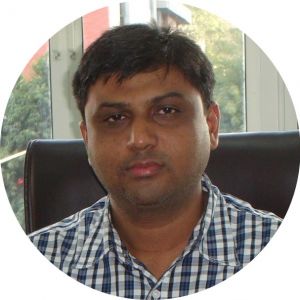
The long game, run in plain English.
Oakland, CASahin Mansuri runs Perception System out of a building at 490 43rd Street and a second floor in Ahmedabad that has been there a little longer. He has been doing this since 2001. The year is worth saying out loud because most software companies don't survive their first hiring round, and his has survived four recessions, the death of Flash, the rise and re-rise of PHP, the iPhone, the cloud, and whatever it is that we're calling artificial intelligence this quarter.
The company has about 95 people on payroll, a client list that includes Harvard, the Indian Institutes of Management, Sanofi, Servier and the Saudi Heart Association, and an annual revenue figure that hovers around nine million dollars. It is not enormous. It is not trying to be. That is the point.
Mansuri's stated philosophy is two words long: simplification and transparency. He puts those words in his bio on every platform that lets him write a bio. He repeats them in his bylined columns for Entrepreneur India. He says them often enough that you start to suspect they are not buzzwords but a contract he has signed with himself, the kind of contract that determines how a Tuesday morning email gets answered.
What Perception System actually does, on the ground, is build the kind of software that nobody writes glossy magazine features about. Magento storefronts. React Native apps. WordPress sites for hospital networks. Custom CRMs for distributors. Recruitment portals. Restaurant management dashboards. The connective tissue of small-and-medium-sized commerce, in twenty-odd verticals, for clients who need a Tuesday deliverable more than they need a manifesto.
It is unfashionable work in the era of generative everything, and Mansuri appears to be entirely fine with that. Perception System has quietly added AI, blockchain and devops automation to its services menu over the years, the way a diner adds avocado toast - because customers want it - while keeping the meatloaf on the page because regulars order it.
The SetupMansuri earned his Master of Computer Applications from Gujarat University in 2001. That same year, with the dot-com bust still smoking, he started Perception System as a one-man operation in Ahmedabad. There was no co-founder, no seed round, no incubator. The lore on his own profile is that he served clients out of a small office and slowly hired people who could be trusted to talk to those clients without him in the room.
The American leg came later. Today, the firm files paperwork as Perception System USA Inc., headquartered at the Oakland address but with Mansuri himself living in San Jose. The Indian arm is the engineering muscle - the developers, QA leads, project managers and DevOps engineers who do the work while California is asleep. It is the classic 24-hour software studio model, and Mansuri has been running it long enough that he can speak fluently about timezone fatigue, billing cycles in two currencies, and the precise email tone required to keep a client in Riyadh and a developer in Gujarat aligned on a Friday.
He is not a public figure in the Founder Mode sense of the term. He doesn't speak at TechCrunch Disrupt. He doesn't seem to keep a podcast. His Twitter is the company's, not his, and it has the URL @perceptionweb, a relic from when the word "web" still felt like a thing one had to specify. His LinkedIn URL still carries the alphanumeric tail that LinkedIn used to assign to new accounts in the late 2000s. He has not, in other words, optimized himself for being googleable. He has optimized for the work.
The verticals he keeps re-entering
The WritingEvery so often Mansuri writes a column for Entrepreneur India. The 2019 piece, "This Transformation in the Digital World is Changing the Way Business is Done," is the kind of essay you'd expect from someone whose job is to sit between a retailer and an API: pragmatic, vendor-agnostic, light on hype, heavier on the unglamorous reality that supermarkets now want voice-driven kiosks and don't quite know what to ask for. The column reads like a manager talking to other managers. It is not trying to make you build a unicorn. It is trying to make you ship something that works.
That voice - call it the technopreneur tone, since that's the word he uses about himself - is consistent across every public surface where Mansuri has left a sentence behind. The about.me page. The Entrepreneur byline. The LinkedIn summary. The company's "About Us" page. He keeps saying the same things in slightly different orders: simplification, transparency, expertise, team, compliance, lean. They are not slogans. They are filing categories.
The RosterRead his client list and you can tell what kind of company Perception System is by the company it keeps. Sanofi and Servier are global pharma, which means audited builds and compliance documentation. Harvard means academia, which means slow procurement and exacting brand controls. The Saudi Heart Association means non-profit healthcare in a non-English-speaking market, which means localization and patience. IIM means Indian higher education, which means a clientele that can argue PHP versions at a level most CTOs can't.
A studio that has serviced all four does not skate by on charm. It has documentation. It has SLAs. It has the unglamorous middle of the business well-tended. That is the version of Mansuri that the public record actually supports - not visionary, not influencer, but operator, in the old-fashioned sense of the word: the person who runs the operation, day after day, without confusing himself with the product.
What he chooses not to be
Mansuri has not turned Perception System into a venture-backed firm. There is no listed funding round on Crunchbase, no Series A, no Latest Raised At. He has not split the company into a flashy AI subsidiary and a boring services arm. He has not rebranded every three years. He has not, as far as the public record shows, fired the marketing department and replaced them with a TikTok account.
What he has done, instead, is hold the same WordPress domain, the same LinkedIn handle, the same email signature, and the same business model for over twenty years. In a country where the average tech founder pivots faster than their VCs can update their portfolio decks, that is its own kind of statement. Whether it's principle or stubbornness depends on how you feel about principle and stubbornness, which is mostly a personality test for the reader.
The StackPerception System's own toolset reads like a tour of working software in 2026: Gmail and Google Workspace for the office, Slack for the team, WordPress on WP Engine for the site, Bootstrap for layout, reCAPTCHA for forms, Node.js and Microsoft SQL Server somewhere in the backend, React Native for the mobile work, plus Snowflake and Databricks for the analytics conversations, and "AI" for the ones that start with "can you build us a chatbot." It's not a fashionable stack. It's a working one.
You don't survive twenty-four years in IT services by being early. You survive by being on time.
The AspirationMansuri's stated long-term goal, when he writes it down anywhere, is to build a "fully compliant, financially lean and profitable corporation" rooted in expertise and team development. That is not the language of a man chasing a billion-dollar exit. It is the language of a man who has watched dozens of his peers' shops fold and decided, deliberately, to keep his open.
He is, in the end, the kind of founder a journalist has to work to write about, because the work itself is undramatic. The drama is in the duration. Twenty-four years of shipping. Sixty countries of invoicing. Two cities of payroll. One stubborn rule about clear language.
A career, measured in clients.
Small facts, stuck to the wall.
The iPhone
Perception System was founded in 2001. The iPhone arrived in 2007. The company is six years older than smartphones as we know them.
@perceptionweb
The company's Twitter handle still says "web" - a holdover from when calling something a "web company" still narrowed it down.
SJC ↔ AMD
San Jose and Ahmedabad, twelve and a half time zones apart. He runs a 24-hour studio by being awake for half of them.
PHP, still
His company has been writing PHP since 2001, through every "PHP is dead" cycle, including the current one.
Bootstrapped
No disclosed funding rounds. No "stealth" period. Just twenty-four years of invoicing.
~60 countries
The client roster has more passports than most embassies process in a quiet week.