Three people can keep a company’s working memory in their heads. Add a few dozen more, and memory starts needing a system. Muhammad Akif Malhi gave that change a number in July 2024: Techling, the software business he founded in 2020, had grown from a team of three to more than 50. In the same account, he said five clients had become more than 20. Behind those neat figures sits a less tidy occupation: being responsible for the people who turn someone else’s idea into working software.
Malhi is Techling’s founder and CEO. He also speaks the language of software architecture, design, project management, and security. These are fields in which a charming presentation has a short shelf life. Eventually, somebody must open the application. The button must do something. The system must survive an ordinary working day, which is often more demanding than a carefully prepared demonstration.
His public story has several settings: a growing software company, a university computer lab, a stream of technical articles, and a startup conference. The thread connecting them is the movement from doing technical work to helping other people do it. A larger team makes that movement consequential. A classroom makes it visible.
Three chairs, then more than 50
In his July 5, 2024 reflection, Malhi described the ups and downs of running an IT services company. He reported a seven-figure business, 300 percent year-on-year revenue growth, and the addition of AI to Techling’s services. These were his own figures. They belong to that moment in the company’s history, rather than serving as a running counter of its size today.
Founder-reported milestones, published July 5, 2024.
The people count is the useful opening. Three colleagues can overhear most of the conversations that matter. More than 50 cannot. For any founder making that transition, communication becomes part of the product: who understands the request, who has the authority to change it, and who knows what the customer expects on Friday. A calendar acquires the capacity to look like a work of abstract art.
Malhi’s announcement also looked outward. He offered guidance to other tech startup founders, describing AI and business strategies as tools he could help them use. The invitation adds a second audience to his work. Alongside the customers buying software are founders trying to work out how to build a business around it.
There is a familiar temptation to tell a founder’s story as a series of larger numbers. This one becomes more interesting when the numbers lead to people: a team taking on more work, clients placing more requests, and other entrepreneurs asking for advice. The scale of the business changes the scale of the conversations.
Back in a room full of monitors
On December 20, 2023, Malhi joined Shoaib Ijaz at National Textile University in Faisalabad for a workshop on developing industry-ready final-year projects. The Society of Software Engineers organized the session. Its purpose was practical: helping students create projects that meet expectations beyond the university.
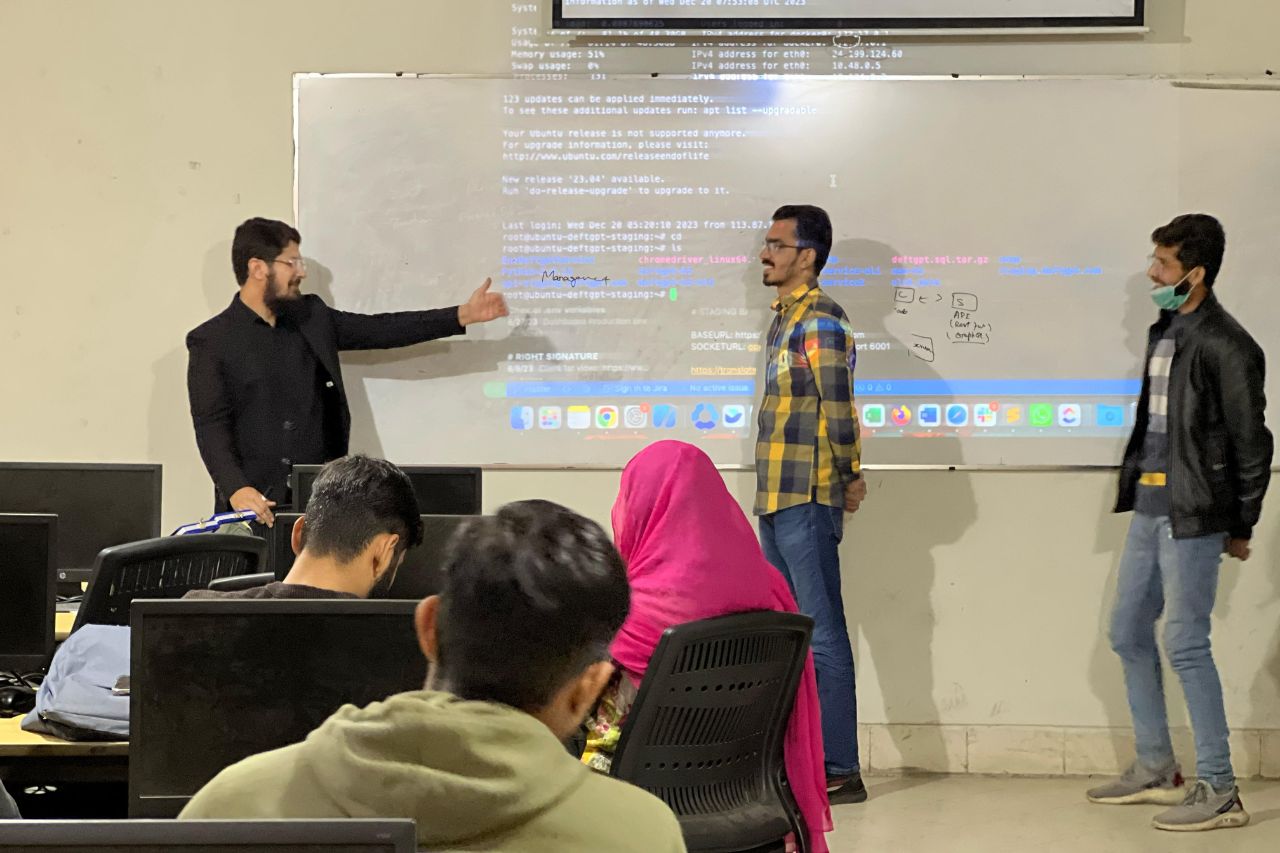
The event photograph offers a pleasingly literal illustration of the subject. Malhi stands beside a whiteboard and a projected terminal, extending a hand toward the screen. Students sit at desktop computers. There is code to look at, rather than a stage arranged to suggest that code exists somewhere nearby. Even the wall has been recruited into the debugging process.
For Malhi, the setting had a personal connection. His education entry lists National Textile University from 2011 to 2015. It also records an activity outside technical coursework: vice president of the Character Building Society. Years later, he was back as an industry guest, bringing a company-builder’s perspective to students approaching their own professional beginnings.
A final-year project occupies an awkward border. It must satisfy academic requirements and may also become a student’s first substantial answer to an employer asking what they can build. The workshop’s emphasis on industry readiness addressed that border directly. Malhi’s participation places student guidance within his public career, alongside commercial leadership.
The skills beneath the title
A CEO title compresses a great deal of work into three letters. Malhi’s biography expands it through four technical areas: solution architecture, software design, project management, and security. Together, they cover how a system is arranged, how it behaves, how its development is coordinated, and how it is protected. That combination explains the technical emphasis of his public identity.
His public certifications provide more specific names. They include MongoDB, ECMAScript 6, securing React applications, building a Vue interface, and scaling Node.js applications. The visible entries cluster around 2018 and 2019. Rather than a single fashionable label, they describe an interest in the components from which web applications are assembled.
The distinction matters when considering a services founder. A customer may arrive with a desired outcome; a developer needs requirements, dependencies, and decisions. Technical leadership lives in the translation between those vocabularies. Malhi presents himself as someone working across both. His biography emphasizes hands-on leadership as well as strategic responsibilities.
He describes himself as organized, energetic, and compassionate. Those are his chosen terms, and their combination is revealing as self-description. Organization concerns the work. Energy concerns the pace. Compassion concerns the people experiencing both. A software company needs all three conversations, especially when its staff can no longer fit into one convenient huddle.
An engineer’s reading list keeps moving
Malhi’s LinkedIn writing in 2025 ranged across emerging technology. In June he published on edge AI and explainable AI. July brought AutoML, multimodal generative AI, and immersive applications using AR, VR, and XR. On August 8, he published “Custom Software for the Quantum Era.” The subjects show what he chose to put before his professional audience.
The range invites a distinction between curiosity and a finished commercial offering. An article about quantum software establishes an interest in the topic. Its place beside pieces on AI and immersive interfaces shows an editorial habit of looking ahead. Readers can follow that habit without turning every article title into a claim about a product his company has shipped.
His public discussion of AI agents also moves closer to the developer’s toolbox. A post assembled agent-building resources and prompted questions about choosing tools and integrating them into existing systems. That is a useful shift in emphasis: software has to join the systems a business already uses, with all their inconvenient history attached.
Techling’s technical publishing carries his name in another capacity. Articles on agentic coding and research workflows credit Hadiqa Mazhar as writer and Malhi as fact checker. A January 2026 article on digital transformation leadership uses the same division of credit. Authorship and review are different contributions; here, both are made visible.
“One thing I've learned is the power of embracing change.”
Muhammad Akif Malhi, May 2024
In that May reflection, Malhi named changing methodologies, technologies, and business strategies, then credited his team. It is a modestly useful statement because it includes several kinds of adaptation. Learning a new tool is one task. Adjusting the way people work together is another. Running a technical business puts both on the agenda.
The dates give that activity a useful shape. A university education in 2011-2015 precedes the founding of Techling in 2020. Student guidance appears in 2023, a company-growth reflection follows in 2024, and technical articles and a conference visit appear in 2025. Seen together, these moments show the different audiences his public work reaches. Students need a route into professional practice. Founders need help making decisions. Technical readers want ideas they can investigate for themselves. Each conversation begins with a different question.
The conversation travels
On October 29, 2025, Malhi shared highlights from TechCrunch Disrupt. His update discussed AI, machine learning, generative AI, and agents, and described helping ambitious startups through software development, automation, consulting, and digital transformation. The accompanying photograph places him among the conference’s attendees, wearing a visitor badge.

A conference offers many opportunities to discuss the future. A software business still has to deliver something in the present. Malhi’s conference message connects the two by addressing startup needs. The emphasis is on what the technology can help a business do, an extension of the founder guidance he had already offered publicly.
Techling states a mission to empower 100 businesses over five years through technology. That is a company ambition, with the practical measure attached to businesses served. Malhi’s own public invitations sit comfortably beside it: help founders, explore technical possibilities, and keep the work connected to an outcome someone can use.
The classroom photograph remains the clearest closing image. A founder with a growing company stands beside a projected terminal, talking to students at their monitors. The business numbers provide scale. The university visit provides a human scene. Between them is the work of passing an idea from one person to another, until somebody can make it run.