Most software looks innocent in a demonstration. The buttons behave. The sample data is tidy. Nobody has forgotten a password, changed an API, or asked the system to reconcile two records that disagree about reality. Then the applause ends, the software goes to work, and Tuesday happens.
Muhammad Akif Malhi has arranged his public career around Tuesday. He is the founder and CEO of Techling, an Austin-headquartered software company he started in 2020. Its current language is thick with artificial intelligence, cloud systems, data platforms, and application engineering. Yet beneath that modern catalogue sits an older concern: can the thing be run, understood, repaired, and trusted?
Malhi describes his own toolkit without much ornamental foliage. Solution architecture. Software design. Project management. Security. These are disciplines that become visible when ambition meets consequence. Architecture decides which promises can coexist. Management notices that a technically correct system can still arrive too late. Security insists that convenience has a door and somebody ought to know who holds the key.
“As CEO of Techling, I’m driven by a mission to leverage technology and collaboration for meaningful global impact.”Muhammad Akif Malhi
An engineer learns the second half
Before the CEO title, there was National Textile University. Malhi studied there from 2011 to 2015 and served as vice president of the Character Building Society. The combination is almost too tidy for a future services founder: one education in systems, another in the less programmable matter of people.
His later training kept close to the keyboard. Over 2018 and 2019, he collected coursework and certifications in Node.js, MongoDB, React security, ECMAScript 6, and Vue.js. It is a period-piece stack in the affectionate sense. Those were the tools of a web moving from pages toward applications, and of developers learning that “full stack” could mean the whole ladder or simply a larger collection of ways to fall off it.
This matters because Malhi’s role at Techling is presented as hands-on technical leadership. The founder’s job in a services company is not only to pick a direction. It is to translate between rooms. A buyer speaks in costs, delays, and missed opportunities. An engineer speaks in dependencies, tradeoffs, and failure modes. A project manager speaks in dates that everyone swears are reasonable. The work is to make those languages produce one honest plan.
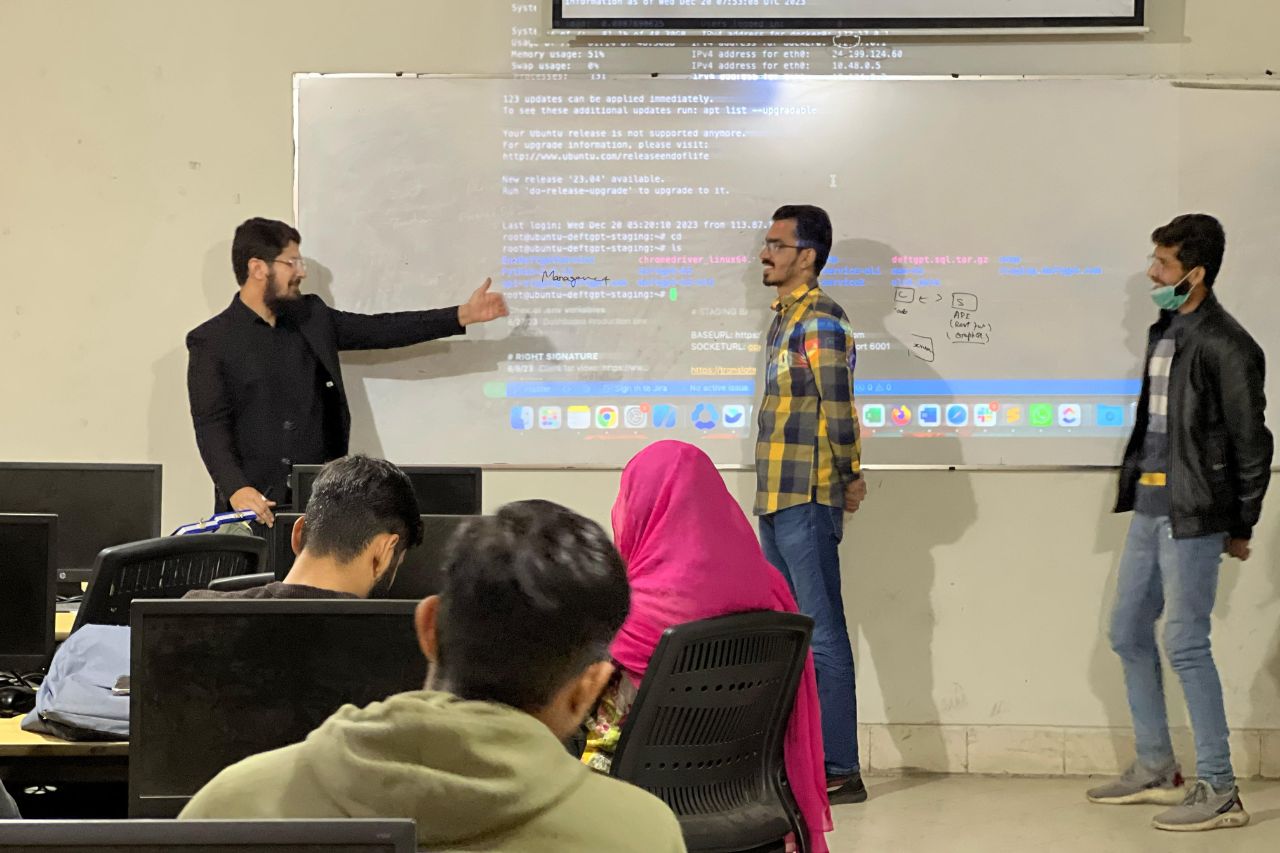
Eight years after finishing university, Malhi returned to that campus as an industry speaker. In December 2023, he and Shoaib Ijaz led a workshop for final-year students on making software projects industry-ready. The photographs show a classroom, code projected over a whiteboard, and the pleasantly uncinematic furniture of actual technical work.
The topic reveals more than a ceremonial alumni visit would. A final-year project is usually built to prove that its creator can make something work. A commercial product has to keep working while customers, requirements, data, and personnel change around it. The first earns a grade. The second earns a maintenance queue.
The company as translation machine
Techling’s company page places its founding in 2020. It now describes a business working across application development, AI, data engineering, cloud modernization, and advisory services. The headquarters is in Austin, while its employment footprint and public activity connect it strongly to Pakistan. This is a familiar modern arrangement, but familiarity does not make it simple. Distributed delivery turns clarity from a virtue into infrastructure.
Look closely at the company’s current service descriptions and a pattern emerges. Discovery begins with requirements, technical constraints, integrations, risks, and success measures. AI proofs of concept are narrow and testable. Automated agents receive roles, limits, escalation paths, and monitoring. Fixed-price work gets scope and change controls. Dedicated teams get continuity and ownership.
The nouns change, but the operating instinct remains the same: expose uncertainty early. Every project contains surprises. A competent process does not promise their extinction. It decides where they will be noticed and who will make the next decision.
That approach is useful in AI because the technology invites a peculiar kind of optimism. A model produces an elegant answer once, and the room begins imagining an employee who never sleeps. Production asks less romantic questions. Which data may it see? Which actions may it take? What happens when confidence is low? Who reviews the exception? How quickly can the decision be reconstructed?
Techling’s language around autonomous systems answers with boundaries. Roles are definite. Decision-making has limits. Orchestration and escalation are part of the design. The vocabulary is managerial as much as technical, which is precisely the point. An automated action inside a business is still an action inside a business. It inherits policy, accountability, and somebody’s anxious calendar invitation.
Start with a narrow use case that can be tested against real data.
Define what the system may decide and when a person steps in.
Make performance and failure visible after launch.
Leave behind software a team can operate and improve.
A public persona made from verbs
Malhi’s official biography calls him passionate, organized, and people-centered. Corporate biographies tend to hand out agreeable adjectives like hotel towels, but his public activities give these particular words some structure. The classroom workshop points toward mentorship. His technical certifications show a period of deliberate skill-building. His recent writing moves through quantum-era software and immersive AR, VR, and XR applications. On Techling’s blog, his name appears as the founder and CEO checking technical material on agentic systems and digital transformation.
In 2025, he also appeared among business representatives in a Pakistan technology delegation tied to the US-Pak tech corridor and TechCrunch Disrupt. The trip fits the geography of the company he runs: American clients and headquarters, Pakistani technical talent, and a founder translating between markets as well as disciplines.
There is no need to turn this into mythology. The public record is compact. It does not offer a childhood epiphany, a garage, or a napkin preserved behind glass. What it offers is more useful: a sequence. Technical education. Continued developer training. A company founded in 2020. A return to the classroom. A widening conversation about how new computing ideas become operational systems.
The prototype proves that something can work. The company is built around everything required for it to keep working.The operating idea
The stealable part
Founders studying Malhi’s path can borrow the structure without copying the services menu. Begin with translation. Turn the customer’s desired outcome into explicit constraints. Make the proof small enough to teach you something. Decide how failure will surface. Design the handoff while the system is still young. Treat maintenance as part of the product rather than the administrative afterlife of innovation.
They can also borrow the loop between learning and teaching. Malhi’s return to National Textile University placed an industry operator in front of students still discovering how many meanings the word “done” can have. The encounter benefits both sides. Students see the hidden requirements of professional work. Practitioners are reminded that expertise should be explainable without a proposal deck.
There is another lesson in the breadth of Techling’s work. A services firm may offer application engineering, data pipelines, cloud modernization, and AI without pretending they are separate planets. In practice, they often arrive as one untidy problem. The intelligent feature needs clean data. The clean data needs a dependable pipeline. The pipeline needs infrastructure. The infrastructure needs monitoring. The user, showing little respect for the organization chart, expects all of it to feel like one product.
For the founder, breadth creates a test of judgment. Saying yes is easy when every capability has a page on the website. Choosing the order is harder. Malhi’s public emphasis on discovery and product strategy supplies an answer: sequence the work by feasibility and business value. It is an engineer’s way of declining to confuse motion with progress.
The same discipline appears in his recent subjects. Quantum computing and immersive interfaces are technologies with large imaginative shadows. Writing about them from a custom software perspective moves the conversation toward compatibility, architecture, and use. The future is invited into the room, then politely asked for its requirements.
The aspiration in Malhi’s biography is “meaningful global impact,” an enormous phrase that becomes more credible when reduced to daily decisions. Impact is an architecture that does not collapse under growth. It is a security review that catches the easy mistake. It is a project plan honest enough to survive contact with a client. It is an automated system that knows when to ask for help.
Techling’s headline promises software built for scale, intelligence, and impact. Malhi’s more interesting contribution may be the implied fourth term: endurance. Scale attracts attention. Intelligence makes for a lively demonstration. Impact belongs in the case study. Endurance is what remains after everyone closes the laptop and returns the next morning.
Tuesday arrives without malice. The data is messy, the integration has opinions, and somebody has changed the requirement. Somewhere between Austin and Pakistan, a team opens the logs. The software has begun telling the truth about itself. Now the real work can start.