Consider the popcorn tin. It is a cheerful object, generally innocent of enterprise architecture. But send several tins to several people, and the website must negotiate an unexpectedly adult world: different addresses, delivery choices, and a buyer who would rather finish the gift than become its shipping coordinator. For Garrett Popcorn, Codal used its ShipperHQ partnership to handle those complications. The tin was the visible product. The choreography behind it was the assignment.
- Codal designs digital experiences and builds the systems behind them.
- Its revealing projects involve pharmacy operations, professional buyers, and complicated commerce.
- The useful lesson: trace the troublesome transaction before commissioning the attractive screen.
That makes a useful introduction to a company whose description can otherwise disappear into the consultancy vocabulary. Strategy, experience design, product engineering: respectable words, each broad enough to shelter an entire sales department. Codal becomes easier to understand when the brief gets specific. Someone needs to buy something. Several pieces of software must agree about what happens next.
01 / The website grew up
Codal began in 2009 as CMScentral, building websites with Joomla. In 2013, it adopted its present name. Co-founders Keval Baxi, the chief executive, and Matthew Gierut, the chief operating officer, now lead a business operating across the United States, Britain, Canada, and India. A modest website brief has acquired some considerably less modest plumbing.
The progression matters. A website can become a storefront, then an account portal, then the place where a company’s inventory, customer records, and operational rules collide. Codal’s market is that expanding middle ground: businesses with existing systems, real users, and requirements that exceed a standard theme. Its work spans commerce and custom enterprise applications, including healthcare, manufacturing, and financial services.

02 / A pharmacy asks for room to move
Cost Plus Drugs provides the sharper example. Its existing platform worked, but growth exposed a constraint: the company wanted more freedom to introduce features and bring separate experiences together. The trigger was a need for control and adaptability. A functional system can still make the next business decision unnecessarily difficult.
Codal began by mapping pharmacy workflows, then reworked the backend. The engagement covered ordering and fulfillment data, prescription audits, family accounts, and automatic refills. Users and active prescriptions also had to move across. These are changes whose value appears in the ordinary business of getting an order processed, rather than in the glamour of a launch screenshot.
One consequential decision was replacing licensed authentication with a custom alternative. Codal projects annual savings in the millions from that change. “Projects” deserves its place in the sentence: a forecast is a different thing from a realized saving. The engineering question is still useful. Which recurring dependencies earn their cost, and which constrain the business?
action
rules
data
A good interface depends on what happens between these steps.
03 / The dentist has permissions
Bisco, a dental-materials business, presents another version of the same puzzle. Its older commerce setup lacked important B2B functions and depended on costly, rigid custom development. A professional buyer needed more than a basket. The site needed to establish eligibility, reveal the right prices, and accommodate purchasing within an organization.
Codal migrated Bisco to BigCommerce B2B. A custom registration flow checked National Provider Identifier numbers; company accounts introduced multiple users and administrative permissions. Nosto supported search and merchandising. The work continued after launch, with experiments on mobile search and product information. The NYX award entry describes roughly $34,000 in modeled incremental monthly revenue from those refinements. Again, the qualifier matters.
“They need systems that talk to each other, data they can trust”Joe Comins, Codal’s director of eCommerce strategy
Codal’s May 2026 announcement of a Connected Commerce Award connects this engagement to the integration of commerce, ERP, and CRM systems. That is a useful distinction from a narrower storefront redesign: the account experience and the company’s operational data belong in the same conversation. Other agencies can do this work. Buyers should ask to see comparable integrations.
04 / Traffic arrives. Then what?
At Origin USA, the problem lay farther along the shopping journey. Visitors were arriving but leaving before purchasing. Codal combined conversion testing with technical SEO, working on product pages, navigation, structured data, and speed. Over twelve months, its team ran more than thirty experiments. A proposed improvement had to survive measurement.
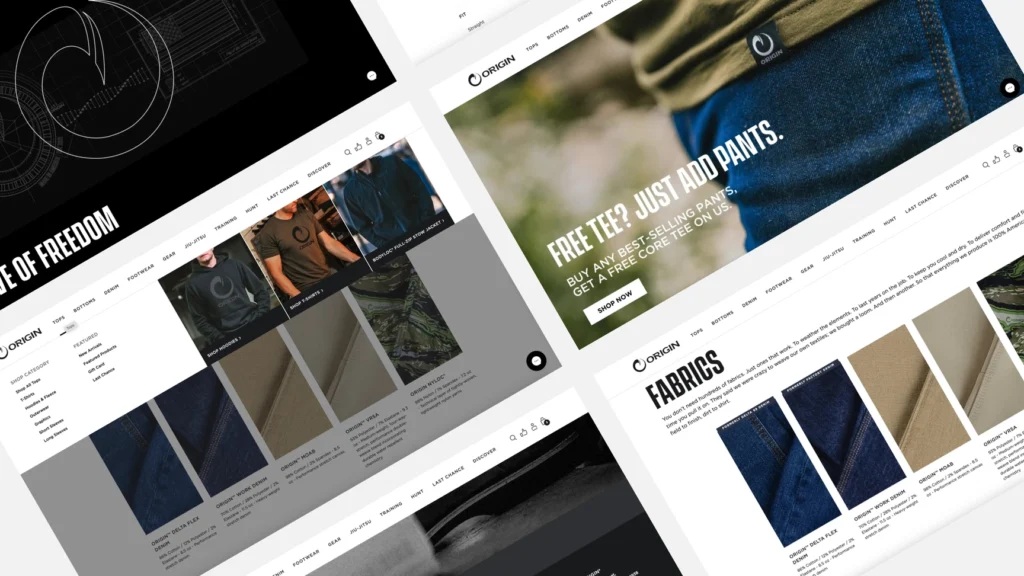
The published outcomes include increases of 46% in add-to-cart rates and 28% in checkout completion. Those figures describe this engagement, rather than a promise to the next client. They do explain why continuing optimization is part of Codal’s business model. Launching the store begins a new set of questions about how people actually use it.
05 / Buy the diagnosis, too
Codal sells consulting, design, implementation, and ongoing managed services. Its Sanity partner listing places projects in budget bands of $50,000-$100,000 and above $100,000. Scope determines the bill. A sensible buyer budgets for discovery, migration, integration, testing, and maintenance, then compares the total with the cost of leaving the operational problem in place.
The partner network includes Shopify, BigCommerce, AWS, and content platforms. Those relationships help explain its platform expertise; they do not remove the need to inspect delivery experience. For a small, straightforward store, standard platform features may be sufficient. Extensive custom work becomes more plausible when unusual business rules or disconnected systems impose a measurable burden.
06 / Borrow the question before the software
Codal’s June 2026 article on AI makes a restrained argument: begin with customer friction. Strategist Lori Cantwell discusses uncertainty about delivery, compatibility, and returns, alongside the maintenance and governance that AI introduces. New capability alone does not establish customer value. That thinking fits the popcorn tin rather well.
The copyable habit is to follow one transaction, identify where confidence or information breaks down, and test a specific remedy. It requires dependable data and access to the people who own the workflow. Without those, even an accomplished engineering team is guessing. Codal’s projects are most interesting at that meeting point: a small inconvenience on a screen, and a business willing to examine everything behind it.