A shared spreadsheet can be a remarkably durable piece of enterprise software. At Canadian Mortgages Inc., the accounting team used one to manage payments. People updated it, passed it around and kept the process moving. Teqfocus’s 2022 case study describes the missing dashboards and disconnected systems around it. The spreadsheet was doing a job the surrounding software had left unfinished.
- Teqfocus connects customer applications, cloud data and business workflows.
- Its sweet spot is enterprise work where records, permissions and approvals matter.
- Its AI offers include workflow monitoring, client-owned infrastructure and tools inside Slack.
- The lesson to borrow: measure one troublesome handoff before buying another interface.
Teqfocus integrated CMI’s back-office web application with Salesforce and added workflow controls. The company estimated savings of three to five hours per employee each week. That is a vendor-reported result, but the mechanism is wonderfully ordinary: fewer manual transfers, clearer approvals, less effort spent keeping systems in agreement.
The interesting question is how much of an enterprise runs this way. Somewhere between an application that records an event and a person who must act on it, there is often a small administrative republic. It has its own spreadsheets, email threads and unwritten rules. Teqfocus works in that territory.
A business built in the gaps
Founded by Andy Singh in 2012, Teqfocus is a technology consultancy and delivery firm. Its work spans Salesforce, data engineering, cloud migration, custom applications and continuing support. The homepage describes serving more than 300 enterprises. Its present industry emphasis is healthcare and life sciences, insurance, financial services and technology.
These businesses buy software to coordinate people. A service team needs the customer’s history. An insurer needs documents it can process and decisions it can explain. A care coordinator needs a patient record that survives the journey between systems. The common problem is less glamorous than the industry labels suggest: the information exists, but useful access to it arrives late.
Teqfocus’s pitch brings data foundations, analytics, applications and AI into one delivery relationship. The attraction is accountability across the connections. When a workflow crosses Salesforce and a data platform, the buyer wants someone who can repair both ends. That is the firm’s stated position in a market crowded with consultants who can offer one part of the job.

Follow the document, follow the trouble
Armour Group supplies another example. Teqfocus’s insurance case describes manual document processing that produced delays, errors and compliance problems. Its headline claims 95% faster processing after an AI-driven solution. Treat that as a company-published case result, rather than a universal forecast. The more transferable detail is the starting point: documents moving through an operation too slowly.
At Adobe Population Health, the case-study overview describes fragmented patient data, inefficient care coordination and limited visibility into health risks. Teqfocus says its tailored Salesforce solution improved coordination, engagement and risk identification while automating workflows. The page’s headline reports a 20% cost reduction. Here, too, the result belongs to the particular case.
Those examples explain the market fit better than a catalogue of technologies. In both, the work concerns information that somebody must use, and a process that somebody must own. Buying a model does not decide where a document goes next. A workflow has to answer that question.
An editorial map of the work - not a measured customer funnel.
The AI agent gets a supervisor
In 2025, Teqfocus announced Salesforce Summit Consulting Partner status. Its announcement tied that development to Agentforce and Data Cloud, alongside AWS, Snowflake and Databricks. The technology mix matters because agents need access to business context. The partner badge is one signal of delivery capability; a buyer still has to examine the proposed team and scope.
“AI adoption isn’t just about technology; it’s about execution.”
Andy Singh / 2025 Salesforce Summit announcement
By its Dreamforce 2026 materials, the company was advertising tools for the period after deployment as well as the build itself. Agently AI is presented as an independent layer for testing agents, observing their workflows, finding failures and coordinating improvements. Its starting point is Salesforce Agentforce.
The distinction between an agent and a workflow is useful. An agent may answer correctly while the overall process misses an approval or hands a case to the wrong person. Agently’s product description links agent inventories, preproduction tests and production monitoring to human-approved fixes. Its refund example is explicitly illustrative, so the numbers in that demonstration should stay in the demonstration.
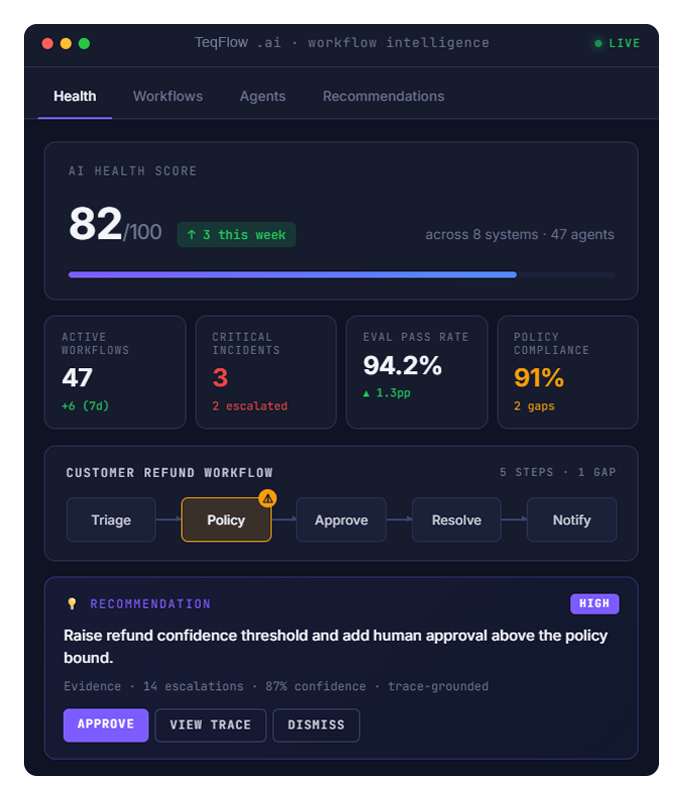
The attraction is legibility. If a process goes wrong, someone needs to see what happened, who owns the correction and whether it worked. The screen offers a product view of that ambition. It does not, by itself, establish how well a particular deployment performs.
The bill arrives before the magic
Teqfocus’s business model is enterprise services with several ways to buy. Its AWS Marketplace listing covers migrations, modernization, DevOps and cloud operations through custom private offers. Advice, implementation and monitoring are purchasable work. The budget follows the requirements.
For AI Harness Engineering, Teqfocus publishes more explicit ranges. An assessment is advertised at $30,000-$50,000; the core build at $100,000-$200,000. A governance and memory layer has a separate $75,000-$150,000 range. Optional evolution services are listed at $8,000-$15,000 per month. These are offer prices, not the disclosed cost of a completed customer project.
AI Harness Engineering · 2-3 weeks · architecture blueprint
The harness is infrastructure the client owns. It sits between applications and model providers, handling routing and shared controls such as access restrictions, redaction and audit trails. Ownership changes the procurement question: the buyer must consider who will operate and maintain what is handed over.
A pilot that lives where people already work
Another offer puts Claude-based skills inside Slack, grounded in Salesforce, Gong and Snowflake. Teqfocus advertises account research, drafting, call summaries, pipeline triage and reconciliation. Its recommended entry is a fixed-fee, two-week pilot for 20 representative users and three selected skills, ending in a usage report. An annual deployment is advertised at $100,000-$300,000.
The design makes a sensible hypothesis: an employee may use help more often if it appears inside an existing work habit. Teqfocus publishes adoption and conversion claims, but a prospective customer can test the proposition more directly. Did people use the skills? Did the time saved survive review and correction? Did the connected records supply the right context?
A pilot provides an opportunity to change the buying decision on evidence. The day-14 report is meant to determine whether the offer deserves a wider contract. This is a useful commercial structure to copy: define the decision before the experiment, while enthusiasm is still cheap.
Who should invite them into the room?
Teqfocus fits a company with a troublesome process spread across enterprise systems and a team prepared to change it. Its data practice builds pipelines and governance; its product engineering practice handles custom applications and incremental modernization. The firm’s proposed advantage is coordinating those capabilities with the customer-facing workflow.
Alternatives include an internal platform team, a specialist Salesforce consultancy or a larger systems integrator. This is a comparison of approaches. A narrow configuration job may need a narrow specialist. A capable internal team may prefer to retain the work. The case for Teqfocus grows when the difficulty spans several platforms and the buyer wants a common delivery owner.
There are practical conditions, too. An agent cannot repair a policy nobody has agreed on. A connected record cannot resolve conflicting definitions without a business decision. If permissions block essential data, ownership is unclear or employees have no reason to change their routine, the proposed technology needs organizational work around it.
The reader can begin with an inexpensive exercise: choose one request and follow it from arrival to completion. Mark every re-entry, wait and approval. Establish a baseline, assign an owner and decide what improvement would justify expansion. That is the useful idea running through Teqfocus’s offerings. Give the machinery a job whose completion a person can recognize.
Keep following the work
Explore the services, read the customer stories or hear the conversations behind them.