In May 2020, Tim Tyannikov had something to say about an audit. This is a difficult opening for a glamorous technology story. An audit offers few opportunities for confetti. Yet his brief comment gets close to the work that has occupied much of his career: other people entrust a software company with things that matter, and the company has to deserve the arrangement.
One Inc, the insurance technology business he co-founded, had completed independent SOC 1 Type 2 and SOC 2 Type 2 audits. Tyannikov was its chief operating officer. Discussing the personal and financial data customers placed in the company’s care, he said, “we don’t take that responsibility lightly.” The phrase is modest enough to pass unnoticed. The responsibilities behind it are considerably larger.
Today, Tyannikov is CEO of Argo 34 and is based in Granite Bay, California. His earlier career includes insurance technology leadership, enterprise architecture and programming instruction. Alongside that work, he serves on nonprofit boards. Put those activities together and a subject emerges who has spent time both making systems and helping people acquire the knowledge to use and lead them.
A promise with paperwork
One Inc’s 2020 audit announcement concerned financial reporting controls and data security. Its first SOC 2 audit had taken place in 2018; the following year’s work expanded to cover both SOC 1 and SOC 2. Type 2 reports examine controls over a period of time. The distinction matters: a system has to keep behaving properly after the date on a presentation slide.
That provides a useful entry into an operator’s career. A software demonstration can show what happens when everything follows the intended path. An operating organization must also deal with repeated use, changing requirements and the records left behind. Tyannikov’s comment attached a personal expression of responsibility to that institutional work.
In insurance payments, the transaction is part of a larger relationship. Premiums come in; claims payments go out. Records must connect the money to the insurance business around it. A payment experience may look brief on a screen, while the underlying organization has rather more to remember. The software’s public face gets the button. Its less visible machinery gets the consequences.
What has to keep working
after the button is pressed?
“we don’t take that responsibility lightly.”
Tim Tyannikov · on customer data, 2020
Before the payment button
Tyannikov’s earlier insurance work placed him inside that machinery. At Cost-U-Less Insurance Center, he served as CTO and CIO. His executive biography credits the enterprise systems he built with helping the company triple in size. He also managed an IT department supporting more than 600 employees. The figures describe different aspects of the same job: enabling an organization to grow, and serving the people already depending on its technology.
His career history also includes technology leadership at ClearSide General Insurance Services and GreenPath Insurance Company. Immediately before co-founding One Inc, he worked as an architect at Active Networks, building enterprise systems for recreation registration, facility management, reservations and multilingual telephone interaction.
The variety is instructive. Registration, reservations and insurance each bring their own vocabulary, but the work involves coordinating records and actions across an organization. For someone at the receiving end, the system is simply supposed to work. The architect has to understand the larger arrangement that makes such a reasonable request surprisingly demanding.
Tyannikov also ran a software development company whose projects included customer relationship management, forms management, restaurant point-of-sale software and document generation and management for Standard Register. These are practical applications with identifiable users and jobs to complete. Taken together, they give his technical history a grounded character: software operating in the places where businesses conduct their daily work.
The suite with a very literal name
In 2012, Tyannikov and Christopher Ewing co-founded One Inc. Their partnership joined engineering experience with insurance business experience. The name was economical; the product catalog was less restrained. By the Spring 2016 release, the company’s software encompassed policy administration, rating, billing, claims, agency management, payments and portals. There was plenty to fit under the word “One.”
Tyannikov, then COO, described the release as progress toward an integrated platform for insurers. The release itself makes the ambition tangible. Digital signatures connected to applications. Payment handling connected to reporting. Policy functions connected to third-party systems. The task was to make those pieces useful together.
Some improvements were small enough to sound unremarkable in isolation: less manual entry, more detailed transaction tracking, duplicate payment warnings. For the employee doing the same task repeatedly, such changes can be the substance of a software upgrade. A product announcement lists features. A working day supplies the reasons anyone wanted them.
In 2017, Tyannikov spoke about frequent upgrades and reducing the risk and cost of adopting them. He called continuous improvement the objective. The phrasing suits the practical nature of this work: software changes while the organization using it carries on. Delivery has to accommodate that continuing activity, rather than assuming everyone can pause for the developer’s convenience.
- 2012Co-founds One Inc with Christopher Ewing.
- 2016Speaks as COO on an integrated insurance software release.
- 2020Discusses customer data responsibility after SOC audit completion.
- 2021Identified as CTO and founder in his executive biography.
- TodayLeads Argo 34; also serves on nonprofit boards.
The programmer at the front of the room
There is another entry in Tyannikov’s career that deserves space beside the executive titles. He taught courses helping people prepare for certification in programming languages. His biography reports that former students went on to become architects, CIOs and CTOs. Teaching belongs in the story because it changes the audience for his technical knowledge: from an organization commissioning a system to a person learning how to build one.
A classroom also changes what counts as a successful explanation. The instructor may understand the problem perfectly and still leave the student bewildered. Knowledge has to travel. That is a useful way to consider this part of Tyannikov’s work, without assigning him a teaching philosophy he has never publicly claimed.
Training appears in his life outside software, too. Born and raised in Uzbekistan in a pastor’s family, he has years of experience in teen ministry. Organizing and training church leaders is an interest explicitly identified in his ministry biography. The two activities concern different subjects, but both put him in settings where other people are learning.
It would be easy to make the church background explain every subsequent professional choice. His actual biography offers a more interesting arrangement: engineering, teaching and ministry coexist. Each merits attention on its own terms. The childhood in Uzbekistan supplies a place of origin; the classrooms and leadership training supply activities he has carried into adult life.
Another kind of board meeting
In a photograph of Strategic Renewal’s board, Tyannikov stands at the far left of the front row, wearing a jacket over a blue shirt. The group has assembled indoors, with several colleagues behind him. It is an ordinary board photograph, and that ordinariness is useful. Here is an executive in another organization, with another purpose and another set of people.
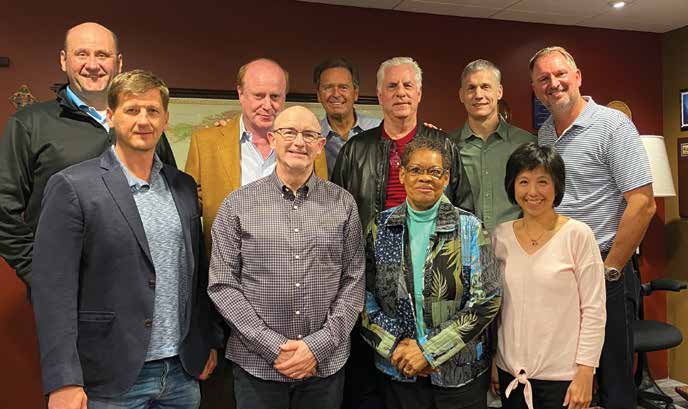
That February meeting devoted its morning to prayer and its afternoon to the ministry’s progress. Strategic Renewal’s work centers on supporting pastors and developing disciples. Tyannikov’s board membership places his interest in church leadership within an ongoing organization, alongside people responsible for its direction.
His service extends to Embrace a Street Child Kenya. A January 2025 ministry update lists him on its board and identifies him as a member of Bryte Church in the Sacramento area. The organization’s team connects people in Kenya with supporters elsewhere. This is a separate part of his public work, with a geographic reach beyond his California base.
The board roles give the profile a wider cast without requiring a grand claim about personal virtue. They are concrete commitments to named organizations. In a career often described through software and insurance, they also make room for leadership work whose purpose is not expressed in a product catalog.
The next set of systems
At Argo 34, the remit is broad again. The company describes custom software development, outsourcing and venture partnerships, with clients in insurance, nonprofits and emerging technology. It also offers digital marketing and fractional chief marketing officer services. Its published approach emphasizes working closely with clients and adapting development methods to the project.
The insurance and nonprofit interests fit alongside sectors already visible in Tyannikov’s career. The company’s venture offering adds financial and strategic support for entrepreneurs. This is the business he now leads, combining the construction of software with services intended to help an organization develop and grow around it.
Argo 34’s AI offering brings another set of tools into the picture: model fine-tuning and training, workflow automation, virtual agents, predictive analysis, language processing and visual analysis. It also describes local model deployment, allowing a client to retain control over technology assets and sensitive data.
The details bring the story back to its opening concern. New capabilities enter organizations that already have responsibilities, records and people doing the work. Their usefulness depends on how they fit those conditions. A model, like an earlier insurance system, arrives with a job to do and an organization that must continue after its arrival.
Tyannikov’s career has included the system builder, the operations executive, the teacher and the board member. Those roles have different duties, but they share a practical circumstance: someone else will depend on what happens next. The launch can have its announcement. There is still a working day to get through.