In 2007, a student tried a technical question on Greg Davidson. What did he think of Microsoft’s new .NET Framework 3.0? Arthur Shih, a computer systems engineering graduate in the audience, remembered the reply years later. Davidson supplied a detailed technical explanation. The questioner had evidently picked someone who knew his subject rather better than a speaker’s job title might suggest.
For Shih, the encounter helped answer a question of his own: where should he work? He wanted a company where technical people could become leaders. He joined Datacom, moved through engineering and operations, and eventually helped establish its business in the United States. A question about a software framework had become an unusually effective recruitment advertisement. No tote bag required.
The episode is a useful way into Davidson’s story. His present title, Group Chief Executive Officer, suggests distance from the machinery. His career has repeatedly brought him back to it. The interesting thread runs through the work of building things, then through the much less tidy business of making those things useful to other people.
Before the chief executive’s chair
Davidson began his IT career in 1990 with Terrabyte Interactive, an early New Zealand web pioneer. His education included a Bachelor of Science majoring in computer science at the University of Canterbury. In 1997 he joined Datacom as general manager of internet services. By 2000 he was responsible for its Auckland software development business; the following year his responsibilities extended to the Wellington team and systems and integration.
It was a career assembled across different kinds of computing work. Internet services, software development and integration each put a different problem in front of the person running them. Getting a website online is one task. Making an organisation’s systems cooperate is another. A manager who moves between them gets acquainted with the awkward spaces where an attractive proposal meets the working day.
His account of his earlier life has a similarly practical starting point. Both his parents were teachers. He grew up in Hawke’s Bay and Palmerston North before attending high school in the Hutt Valley. He has described starting with Lego as a small child, then discovering computers and the freedom to build what he could imagine. He calls himself a “lapsed software engineer”. The lapse appears to have left a considerable residue.
That childhood detail need not carry a grand theory of leadership. It is simply revealing that, when asked about the interest that has sustained him, he reaches for the act of making something. Computers offered a larger box of parts. Management eventually offered a different one, containing people, customers, contracts and decisions that cannot be debugged quite so neatly.
Across the Tasman, without losing the plot
Davidson became chief executive of Datacom’s New Zealand business in 2007. Responsibility for its Australian systems business followed in June 2016. His appointment as the next group chief executive was announced in November 2017, and he took up that role in 2018, succeeding Jonathan Ladd. These were successive enlargements of responsibility inside a business he already knew.
The appointment placed an internal operator at the head of a company working across national borders. Then-chairman Craig Boyce credited Davidson with helping align the New Zealand and Australian systems businesses around customers’ needs. The succession also involved an existing working relationship with Ladd. Davidson was taking charge of an organisation whose habits and people had formed part of his own professional life for two decades.
In a 2016 interview, his explanation of Datacom’s vendor relationships was more interesting than a list of partner badges. The company needed specialist knowledge of its partners’ technologies while retaining the freedom to recommend what suited a customer. Microsoft and Amazon Web Services were among those partners. The arrangement required expertise and independence at the same time, a combination that can make a sales conversation rather less comfortable.
Davidson also stressed the wider professional skills that sit beside technical competence. Knowing a product is useful; understanding the customer’s problem determines whether that knowledge will help. His discussion of accreditation connected it to staff learning. The badges mattered, but so did the capability accumulated while earning them. Anyone who has sat through a meeting devoted entirely to badges may appreciate the distinction.
By 2018, the organisational problem was explicit. Datacom was merging Systems and Solutions and bringing its Australian state businesses into a more unified structure. Davidson wanted expertise to travel across locations while preserving local leadership and culture. The work required changes to the business itself, including its executive responsibilities, rather than a fresh description of the same arrangement.
There is a recurring management difficulty here: proximity helps you understand a customer, while scale helps you bring the right expertise to that customer. Too much separation makes knowledge hard to share. Too much centralisation can make the local relationship feel remote. Davidson’s restructuring addressed that practical tension. Geography should help a service business meet people, rather than determine which skills they are allowed to receive.
The people who make the machinery work
The student in the opening anecdote was part of a wider relationship with emerging talent. In 2015, Datacom awarded its Imagine Cup Scholarship to University of Auckland student Rhea Babbar. The prize included a paid six-month internship in the Microsoft Solutions team in Auckland. Her team’s aFOODable app connected donors, charities and supermarkets. Davidson welcomed the competition’s ability to turn students’ ideas into practical technology.
An internship is a small, concrete bridge between an idea and a working career. It lets a student encounter the constraints that make professional work different from a competition entry, while giving an employer a chance to learn from someone arriving with fresh questions. Davidson’s public involvement in the scholarship sits comfortably beside the older graduate’s memory of a leader willing to answer a technical challenge.
Davidson also took a regular part in Datacom’s culture work. As its visible executive sponsor, he participated weekly in refining the intent behind company values and behaviours. That is a specific management activity, rather less photogenic than announcing a strategy. It matters because words about culture eventually have to describe what colleagues actually do together.
Neither an internship nor a weekly discussion guarantees a flourishing organisation. They do show where leadership can become observable. A student gets time inside a team. Executives spend time deciding what a value means. The mechanics are modest enough to be overlooked, which may be one reason they deserve attention in a career usually described through larger job titles.
Fifty service lines, five doors
Long experience brings its own administrative luggage. Looking back on 2024, Davidson described a Datacom that had grown to more than 50 service lines. Its Beyond transformation strategy organised the business around five core areas: Professional Services, Managed Operations, Infrastructure Products, Product Solutions Group and SaaS products. A customer should have an easier time working out where to begin.
The aim connected organisational simplicity with changing demand. Customers were looking for help with automation, AI, cloud applications and the use of existing technology. Davidson placed people alongside infrastructure and locally developed products in his account of the response. The company’s history could supply experience, but it also created complexity that needed attention.
Fifty service lines can represent fifty useful capabilities. They can also resemble a restaurant menu that requires an index. Grouping them into five areas is an attempt to make accumulated expertise legible. The old builder’s problem has acquired an organisational form: the pieces exist, but someone still needs to arrange them so another person can use them.
Service lines grouped into core business areas
AI arrives with a facilities bill
By the end of 2025, Davidson was describing AI-assisted modernisation of older applications for an Australian state government and a New Zealand port. He said engineers supervised agents performing coding, analysis and testing, and that some project phases had shortened from months to days. These are company-reported results, attached to particular work rather than a promise about every software project.
His account also made room for a less solemn application: a conversational tool for the Melbourne International Comedy Festival, helping attendees interpret their entertainment preferences. An industry that spends much of its time talking about productivity had found a use for choosing a laugh. The example makes a useful companion to the government work. Specific problems can be consequential, enjoyable, or both.
In July 2026, Davidson pushed the discussion further down into the foundations. Computing capacity, connectivity, energy and skilled people all featured in his argument about New Zealand’s AI opportunity. Datacom had acquired T4’s Auckland facility, bringing its New Zealand network to five data centres and its direct investment in that network above NZ$200 million.
The position he described allowed room for international platforms alongside meaningful local capability. That is a practical question of control, continuity and choice. A business can buy access to a powerful system and still need to decide where its data will sit, who will operate the infrastructure, and what happens when a dependency becomes difficult to obtain.
At the Aotearoa AI Summit in Wellington on 8 September 2026, Davidson brought the argument back to testing. He compared evaluating an AI agent with the discipline applied to conventional software. “An agent you cannot evaluate is a demo.” It is a short sentence with an inconvenient implication for anyone hoping to declare a project finished immediately after its most impressive demonstration.
Evaluation creates work of its own. Someone must decide what success means, which failures matter and when a human should intervene. His keynote put those questions beside cost controls, resilience and infrastructure. The builder is still present in the executive: acquiring a component begins a job that includes fitting it, checking it and understanding its behaviour in use.
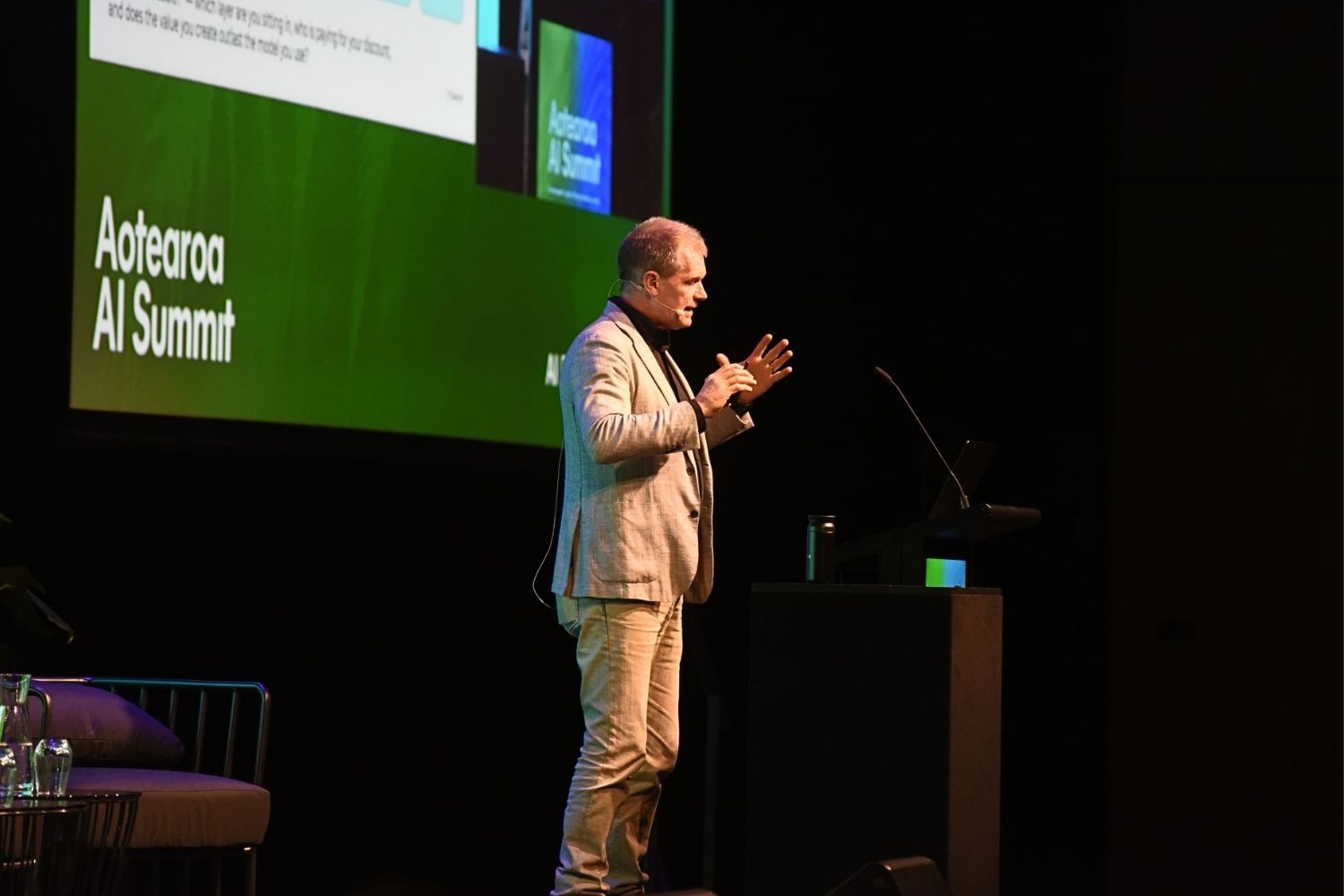
“An agent you cannot evaluate is a demo.”
Greg Davidson · Aotearoa AI Summit, 2026
The cost of building ahead
The FY26 results supply a more demanding backdrop to that argument. Datacom reported NZ$1.58 billion in revenue for the year ended 31 March 2026, up from NZ$1.48 billion. Net profit after tax fell from NZ$37 million to NZ$20 million. The company increased strategic capital investment, including infrastructure upgrades and the Auckland data centre acquisition.
Davidson presented the choices as investment in resilience and future growth amid difficult trading conditions. The figures keep the account honest: a larger revenue total and a smaller profit total can occupy the same year. Building capacity involves choices about timing and money, as well as confidence about what customers will need.
His story has reached a stage where imagination needs buildings, power and a balance sheet. The software engineer who once answered a student’s question at length is now arguing over the conditions that let a country use new technology well. The questions have grown. His attention keeps returning to the pieces, the people who join them, and whether the finished thing will work when somebody needs it.
FY25: NZ$1.48bn
FY25: NZ$37m