The future of artificial intelligence, in Akinobu Shimada's telling, begins somewhere unfashionable. Not with a sentient chatbot or a blinking rack of processors, but with the data underneath: where it lives, whether it can be reached, and whether anyone ought to trust it when it arrives. This is infrastructure, the part of technology most people notice only when it fails. Shimada has spent a career noticing it before then.
He entered Hitachi in April 1989, newly graduated in mechanical engineering from the institution then called Musashi Institute of Technology, now Tokyo City University. The Berlin Wall was still standing. The World Wide Web had not yet been proposed in public. A gigabyte of storage was an expensive industrial fact, not the crumbs under a phone's sofa cushion. Shimada joined the company at the level where digital ambition met physical constraint.
Thirty-seven years later, on April 1, 2026, he became chief executive of Hitachi Vantara while continuing as president of its Japanese company. His route to the office was neither sudden nor ornamental. It wound through business strategy, technical strategy, product planning, hardware, software and the long institutional memory of enterprise storage. If the modern technology executive is often marketed as a prophet, Shimada looks more like a custodian with an engineer's notebook.
The basement becomes the main stage
Storage once seemed like the basement of computing: necessary, humming, rarely invited into the photograph. AI has changed the seating plan. Models are hungry for vast, varied collections of information. They need data at the right moment, in a usable shape, with access controlled and provenance understood. The dazzling answer at the top of the system is hostage to every dull decision made below it.
Shimada's public argument is that the AI race has been framed too narrowly. Organizations can buy advanced computing and still find that their information is fragmented, inaccessible or poorly organized. He has pointed to company research showing the imbalance neatly: 35 percent of surveyed organizations prioritized managing data growth, while only 10 percent focused on AI-ready foundations. The gap is not abstract. It is where promising demonstrations go to acquire disappointing quarterly reviews.
What sits beneath a dependable AI answer
It is an appealingly mechanical way to regard an apparently magical technology. Inputs matter. Tolerances matter. Failure modes matter. His degree did not make him an AI executive by prophecy; it gave him a language for systems. The result is a worldview in which trust is not the soft halo around a product. It is an engineered property, tested when a hospital, financial institution or piece of critical infrastructure needs its data and cannot accept an eloquent excuse.
A career measured in crossings
Shimada's apprenticeship was also geographic. In 2014 he went to the United States as senior vice president of corporate strategy and planning at Hitachi Data Systems, the predecessor at the center of today's Hitachi Vantara. He returned to Japan in 2016 as deputy leader of the IT Products Division. In 2020, he crossed the Pacific again to become chief product planning officer at Hitachi Vantara LLC. By 2021 he was leading the IT Products Division.
Four turns in one long apprenticeship
- Joins Hitachi after studying mechanical engineering.
- Leads corporate strategy and planning in the United States.
- Becomes president of the newly launched Hitachi Vantara in Japan.
- Takes the global CEO role while retaining the Japan presidency.
Those crossings matter because his present assignment is itself a bridge. Hitachi Vantara's plan joins Japan's engineering and manufacturing discipline with the speed, market contact and service delivery of a global operation. It is a marriage of temperaments, and therefore more complicated than combining org charts. One side prizes the defect prevented; the other rewards the opportunity seized before breakfast. Shimada has lived inside both clocks.
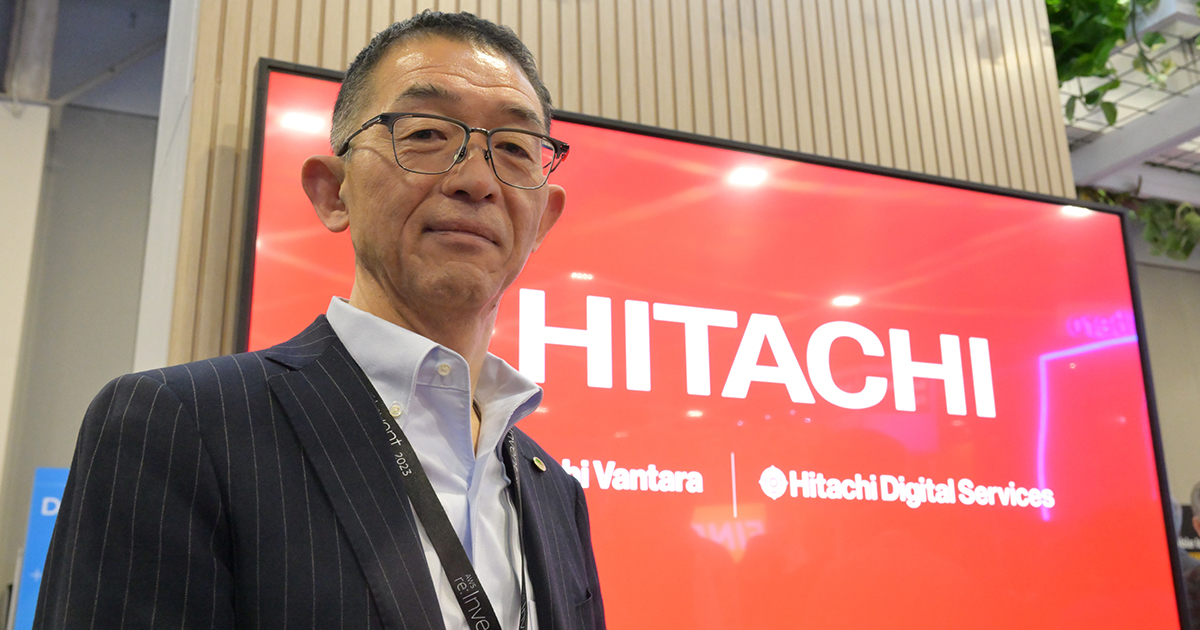
At re:Invent in 2023, months before the reorganized Japanese company began operating, he described the opportunity in almost combative terms. Japanese technology companies had often struggled to turn domestic strength into global scale. The proposed answer was not to discard what Japan did well, but to connect it more tightly to the customers, partners and pace of overseas markets. Storage would remain the core, but the business around it would become more porous: on-premises and cloud, hardware and software, Japan and the world.
The proof is in Oklahoma
One of the clearest illustrations of this philosophy is not in a strategy deck. It is in Norman, Oklahoma, where Hitachi Vantara manufactures highly customized storage systems. The operation applied AI, automation and end-to-end orchestration to its own supply chain. Inventory fell by 50 percent. Order-to-ship lead time fell by 77 percent. In 2026 the World Economic Forum added the site to its Global Lighthouse Network.
Shimada called the factory “Customer Zero,” a tidy phrase for a demanding idea: use your own operation as the first unforgiving customer. There is a useful modesty in this. A company selling infrastructure cannot merely admire its technology in captivity. The equipment has to survive production schedules, missing parts, shifting demand and the thousand small indignities by which the physical world edits a digital plan.
The Norman figures also rescue his language of trust from the clouds. Trust may be difficult to place on a balance sheet, but lead time and inventory are not. Reliability becomes interesting when it changes working capital. Resilience earns attention when it prevents a missed delivery. The engineer's virtue is to make the abstract submit to measurement.
Clarity, with cherry blossoms
Shimada's early months as CEO offered small glimpses of the person inside the corporate vocabulary. At the start of Japan's fiscal year, he photographed cherry trees in bloom outside the office and wrote about renewal, learning and beginning together. The image was gentle; the calendar was not. He was taking global responsibility as companies raced from AI experiments toward operating systems they would actually have to live with.
He then traveled through Korea, Singapore and India, meeting customers, partners and employees. What stayed with him was the speed of the transition from exploration to execution. A later week at the Santa Clara headquarters was packed with an all-hands meeting, kickoff sessions, a board meeting, leadership conversations and video recordings. From that traffic he extracted one word: clarity. Be precise about where the company leads, he argued, and remain consistent long enough for the position to mean something.
This is not the vocabulary of a chief executive pursuing novelty for sport. His stated focus is long-term value creation. He returns often to collaboration, thanking engineers when he receives recognition and describing partners as participants rather than distribution. He has used the Japanese word kizuna, connection or lasting bonds, for a program bringing Hitachi engineers together across regions and disciplines. Infrastructure may be made of machinery, but institutions are held together by repeated acts of translation.
In July, CRN placed Shimada among its Top 25 IT Innovators for 2026. He directed the credit toward Hitachi Vantara's engineers. The reflex fits his career. Product planning is the art of turning many people's specialized knowledge into one coherent bet. The CEO title enlarges the room, not the underlying problem.
The promise beneath the promise
Every technology cycle produces a gap between what is demonstrated and what can be depended upon. AI's gap is unusually theatrical because the demonstrations speak. They write poems, summarize contracts and sound certain while being wrong. Shimada's company works lower in the stack, where confidence must be designed without conversation: the data protected, the workload available, the system recoverable, the energy use defensible.
His ambition is to build what he calls the world's most trusted data infrastructure. It is a grand sentence from a notably ungrand career. There was no garage, no overnight fortune, no ceremonial pivot from an unrelated industry. There was a mechanical-engineering degree, a job begun in 1989, a sequence of widening responsibilities and several crossings of the Pacific. The drama is cumulative.
That may be exactly the point. Enterprise trust is accumulated too. It grows through products that work, recoveries that succeed, partnerships that last and promises repeated accurately enough to become reputation. In an industry bewitched by sudden intelligence, Shimada represents an older and still necessary idea: before a machine can surprise us, someone has to make sure it will be there in the morning.