An old enterprise joke says that your data has two states: lost, or being copied. Starburst has spent nine years making the second state optional. Its software lets an analyst ask one SQL question across a data lake, a warehouse, an operational database, another cloud and the old system nobody dares unplug. The records can stay where they are. The query does the traveling.
That sounds like plumbing because it is. Yet it is expensive plumbing. Starburst says it passed $100 million in annual recurring revenue during 2025, grew nearly 40 percent and built a $20 million AI annual run rate. A single financial institution signed an eight-figure annual contract. Ten of the world's 15 largest banks use the platform. The company has raised $414 million and was valued at $3.35 billion in 2022.
The business rests on a mildly rebellious premise: the standard cure for scattered data - copy it all into one central system - can become its own disease. Every duplicate needs a pipeline, a schedule, a security policy and somebody to explain why yesterday's dashboard disagrees with today's database. Starburst sells an alternative: federation first, migration only when it earns its keep.
The warehouse, without the moving vans
The engine underneath Starburst is Trino, the open-source distributed SQL project born at Facebook in 2012 under the name Presto. Co-founder and chief technology officer Martin Traverso helped create it. CEO Justin Borgman arrived with scars from an earlier company, Hadapt, which put SQL on Hadoop and was acquired by Teradata. Starburst's unusually deep founder bench joined open-source query expertise with the unglamorous requirements of big companies: identity, permissions, audit trails, connectors, uptime and someone to call at 2 a.m.
Borgman's mind changed while he was inside Teradata, the company that had spent roughly four decades promoting the enterprise data warehouse as a single source of truth. He noticed that even its customers had not managed to put all their data in one place. If the pioneer could not finish centralization, he reasoned, perhaps centralization was the wrong finish line. Meeting the creators of Presto supplied the missing mechanism: a massively parallel engine detached from storage.
One question, several stubborn systems
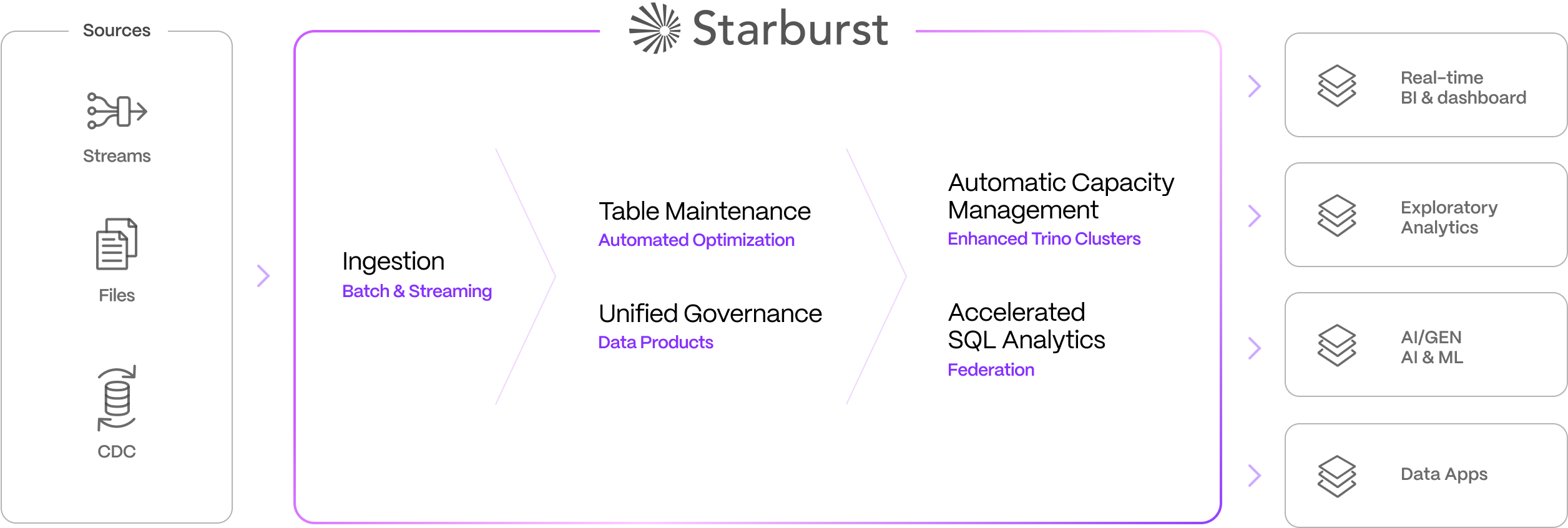
Starburst Enterprise is the self-managed version for companies that need to run inside their own cloud, data center or Kubernetes estate. Starburst Galaxy is the managed service. Both add enterprise machinery around Trino: more than 50 connectors, workload management, fine-grained access controls, query optimization and support. Galaxy also handles ingestion and Apache Iceberg tables, the open format that has become common ground in modern data lakes.
What failed first was the waiting
Starburst's best customer stories begin with a specific annoyance, not an abstract digital transformation. At Trainline, cloud-native SQL jobs hit timeouts after roughly 20 to 25 minutes, pushing analysts toward PySpark for bigger scans. At Arity, a Spark-heavy system took hours and cost too much to scale. Priceline's users could query cleaned warehouse tables but not raw historical files without a developer stepping in. Comcast had years of data spread across Hadoop, Teradata, Oracle, the cloud and systems older than some of its engineers.
The first failure, then, was usually the operating model around the database: brittle ETL, delayed access, duplicated storage, specialist queues and a governance rule rebuilt in every destination. The database did not collapse. People simply waited too long or paid too much to ask the next question.
“We are not starting over. It's not a costly migration.”Bryan Aller, Comcast director of software development and engineering
What changed Comcast's mind was wonderfully practical: live demos and measurable performance. Its team saw complex SQL queries run 10 to 20 times faster, while existing systems remained useful. That made federation easier to sell internally than a grand migration. The broader data-mesh strategy followed the working query fabric, not the other way around.
The numbers vary because the starting mess varies. Arity reports 10 times faster processing and a 66 percent cost reduction. Kovi reports 85 percent faster ad hoc queries and 75 percent lower S3 request costs. Trainline says its first-year costs fell 20 to 30 percent while 300 to 400 people gained direct access. Zalando reports cutting infrastructure costs in half. These are vendor-published case studies, but they share a useful pattern: remove a particular bottleneck, keep the data format open, then measure the whole workflow rather than one benchmark query.
The bill is visible. The total cost is not.
Galaxy now publishes a refreshingly legible starting price. Pro costs from 50 cents per compute credit, Enterprise from 75 cents and Mission-Critical from one dollar. A two-worker cluster consumes 12 credits an hour. At the Pro floor, that is $6 an hour for Starburst compute. The free tier permits three clusters, and the 30-day trial includes $500 in credits. AIDA's model tokens are billed separately.
2-worker cluster × 12 credits per hour × $0.50 per credit. Annual commitments may be discounted; cloud, region, support tier, data transfer and workload shape change the real bill.
The more important cost sits outside that multiplication. What pipelines disappear? How much duplicate storage can be avoided? Does a cross-cloud join create network charges? Can the connector push filtering into the source, or will it drag a giant table across the wire? Starburst wins when avoided movement, faster work and shared governance outweigh its compute fee. It loses when federation simply turns network distance into a new tax.
A $414 million acceleration
Starburst was already profitable when it raised a $22 million Series A in 2019. Then came a $42 million Series B in June 2020, a $100 million Series C seven months later and a $250 million Series D in February 2022. In 27 months, a bootstrapped software shop became a heavily financed unicorn.
The money funded three expansions. First, it turned a powerful open-source engine into a supported enterprise product. Second, it built Galaxy so customers could buy Trino as a service rather than hire a platform team to babysit it. Third, it moved beyond query execution into lakehouse operations, governance and AI. The 2022 acquisition of Israeli accelerator Varada added the indexing and caching technology now associated with Warp Speed. Starburst said the combined system could run some AWS queries up to seven times faster and cut cloud compute by up to 40 percent.
The company now occupies an interesting market position. Snowflake and Databricks want to be a central home for data and workloads. Dremio emphasizes lakehouse analytics. Denodo sells virtualization. Cloud providers offer Athena, BigQuery, Redshift and Synapse. A capable engineering team can run open-source Trino itself. Starburst's answer is coexistence: keep the warehouse, lake and databases, but place one governed query layer across them. The enemy is not another logo. It is forced movement and the lock-in that can follow.
AI makes the plumbing visible
AIDA, announced in April 2026, is Starburst's attempt to climb from infrastructure into the interface. It accepts natural-language questions, samples live data, consults metadata and returns an answer shaped for the user's role. Enterprise customers can choose models from OpenAI, Anthropic or AWS Bedrock. Later additions connect business context and external tools through MCP-style interfaces. Guardrails can reject oversize prompts and restrict topics while the platform's row, column and identity rules remain underneath.
The move is coherent. An agent needs more than a clever model; it needs to know which “revenue” definition finance trusts, whether the user may see a customer record, and where the freshest table lives. Starburst already sells that connective tissue. But an AI assistant also raises the stakes. A slow analyst query wastes time. An agent acting on a bad definition can waste money. The company's differentiation will depend less on fluent answers than on whether context and policy survive every hop.
The part worth copying
Other founders cannot copy a decade of distributed-systems expertise, but they can copy Starburst's sequence. Start with an open-source engine that solves a sharp technical problem. Commercialize the pain surrounding it: deployment, security, connectors, performance and support. Let the product coexist with expensive incumbents so the first purchase does not require a political revolution. Prove one ugly workload. Only then sell the architecture.
Data leaders can copy the customer playbook too. Choose a workload currently punished by timeouts, duplication or infrastructure cost. Run it against data in place. Track elapsed time, compute, data-transfer charges, engineer hours and the number of people who can work without opening a ticket. If the pilot wins, expand the governance layer. If it does not, you have learned something before moving the estate.
Good conditions
- Data is split across clouds and systems
- Migration is risky, slow or politically hard
- SQL access and shared policy matter
- Large scans justify distributed compute
Walk away when
- Small data already lives in one place
- Network distance dominates query time
- Connectors cannot push filters down
- The team wants zero platform ownership
Starburst will not make a chaotic data estate tidy by itself. Federation can hide sprawl without fixing ownership, quality or semantics. Distributed joins still obey physics. A small company with one warehouse and predictable dashboards may be better served by the tool it already has. A team unwilling to govern data products will merely produce faster confusion.
But for a multinational bank, retailer or telecom with decades of systems, “put everything in one place” is less a plan than a recurring invoice. Starburst found a large business in saying no to that reflex. Its most useful product may not be the query engine or the AI assistant. It may be permission to leave the moving vans parked.
Keep exploring
Customer results are self-reported through Starburst case studies and depend on workload, architecture, cloud pricing, configuration and baseline. Published prices are starting rates as of September 2026.