Ask a technology chief about a favourite book and you might expect a manual for winning, preferably with a number in the title. Arvind Krishna chose Claude Shannon’s The Mathematical Theory of Communication. For leisure reading, it has an unusually demanding entrance examination. For understanding the chairman, president and chief executive of IBM, it is a useful place to begin.
What stayed with Krishna was the act of reducing a complicated problem to its essentials. He has said that he returns to Shannon’s work and applies its lesson to both technical questions and the business of IBM. That preference helps explain an otherwise rather sprawling career: wireless networks, databases, security, cloud software, artificial intelligence, quantum computing. Underneath the changing nouns sits a recurring question. What makes this thing work?
The professor who kept asking
Krishna graduated in electrical engineering from the Indian Institute of Technology Kanpur in 1985. At the University of Illinois Urbana-Champaign, he earned a master’s degree in 1987 and a doctorate in 1991. These dates describe a conventional engineering education. His recollection of how he learned is more revealing.
Speaking to P-TECH student and IBM intern Chigozie Okorie in 2015, Krishna remembered a graduate adviser with a particular kind of patience. A student might arrive with a problem that had resisted weeks of work. The adviser could solve it quickly. Instead, he asked questions until the student found a way through. Krishna took from this a lesson in humility, teaching and helping other people think.
The story gives him a more interesting inheritance than the familiar portrait of the executive with all the answers. An answer delivered too quickly can deprive someone else of the work that makes it valuable. A good question leaves something behind. It is an appealing management principle, even if it makes meetings considerably harder to finish.
By 2026, he was applying that preference for questions to executive recruitment. He described asking candidates how they would approach a job from the chair they hoped to occupy. Their records mattered; so did their willingness to change how the company worked. The question gave him a way to examine judgement before handing over responsibility.
“Innovate and imagine the future.”
Arvind Krishna, describing his research role in five words, 2015
Thirty years before the corner office
He joined IBM in 1990. His early work at the Thomas J. Watson Research Center put him among people whose professional currency was technical understanding. The later executive jobs widened the field: security and provisioning software, information management, systems development and manufacturing. By 2007, his responsibilities included database servers and worldwide development of information management software.
This matters because the unglamorous middle of computing eventually became his commercial territory. Databases preserve the information a company cannot afford to lose. Security determines who may touch it. Infrastructure keeps applications running. The customer may admire the screen; the business depends on everything behind it. Krishna had worked across several of those layers before he had to explain their combined value to investors.
He became director of IBM Research in 2015 and subsequently led its Cloud and Cognitive Software business. The sequence carried an unusual burden of translation. A laboratory can pursue a promising idea for years. A software customer wants to know what happens after installation. A chief executive must make room for both clocks, while answering to people who check the time every quarter.
- 1990Joins IBM
- 2015Leads Research
- 2020Becomes CEO
A $34 billion argument for working together
The argument acquired a price tag in 2019. IBM completed its $34 billion purchase of Red Hat, the open source software company. Krishna was a principal architect of the transaction. Red Hat brought a platform for a world in which corporate computing was already distributed across different providers and private systems. Moving everything into one place was a tidy idea with a troublesome relationship to reality.
Hybrid cloud gave IBM a proposition suited to that reality: help customers build and run software across their existing environments. Red Hat’s independence and ability to work with other vendors were central to the deal. For a company accustomed to selling its own systems, paying billions for that openness was a consequential commitment.
Krishna became CEO on April 6, 2020, succeeding Ginni Rometty. The following year, IBM completed the separation of its managed infrastructure services business into Kyndryl. Buying and separating can look like opposite instincts. Here, they served the same stated goal: concentrate IBM on hybrid cloud and AI. A corporate strategy becomes rather easier to read when it changes what the corporation actually owns.
Acquisition completed July 2019. Krishna helped architect the deal before becoming CEO.
The intelligence behind the invoice
Artificial intelligence lends itself to spectacle. IBM has some history there: Deep Blue playing chess, Watson answering Jeopardy! clues. Krishna’s present emphasis is the work that follows the applause. In his 2026 shareholder remarks, he described a deliberate focus on enterprise AI, with trust, security, data sovereignty and complicated workflows shaping the market IBM wanted to serve.
Consider the difference between producing a plausible answer and giving software permission to do something inside a business. An assistant that drafts text is useful. An agent that can change a record, trigger a payment or carry information between systems brings a different set of questions. Who authorised the action? Which data could it see? What record remains afterward? The dull questions have acquired excellent career prospects.
IBM’s watsonx portfolio brings together tools for developing and governing models, assistants for business functions and the Granite model family. Krishna has argued for smaller models suited to particular tasks alongside larger general models. It is a commercial wager on the circumstances of use: the cost of running a system, the information it handles and the degree of control a customer requires.
His own company is part of the experiment. IBM calls its practice of deploying its technology internally first “Client Zero.” The attraction is straightforward: a seller has something more persuasive to discuss when it has lived with the implementation. The test, for employees and customers alike, remains what the technology changes in the work.
Buying the plumbing
The acquisitions after Red Hat make more sense when viewed from beneath the polished demonstration. In February 2025, IBM completed its purchase of HashiCorp, whose products automate and secure cloud infrastructure. Those tools address the effort involved in setting up and maintaining the environments where applications run. Software that promises speed still needs somewhere reliable to live.
On March 17, 2026, IBM completed its acquisition of Confluent, at an enterprise value of about $11 billion. Built around Apache Kafka, Confluent specialises in streaming data. Its relevance to AI is practical: a system making decisions about a business needs information that reflects what the business is doing now. Yesterday’s inventory can be a beautifully organised explanation of today’s mistake.
Together these deals describe an ambition to connect deployment, operations and the movement of information. That description also supplies a fair test. Customers should find the combined tools easier to use together. Collecting the necessary parts is an expensive beginning; making them cooperate is the engineering job that follows.
Another clock is ticking in Poughkeepsie
Quantum computing asks for a longer horizon. In June 2025, IBM announced plans for Starling, a fault-tolerant quantum computer intended for delivery in 2029 at a new data centre in Poughkeepsie, New York. The announced design targets 200 logical qubits and 100 million quantum operations. These are roadmap goals, carrying all the obligations that the future tense imposes.
For Krishna, the appeal is consistent with his research background: work on a different kind of computation while the existing business pays its bills. Fault tolerance addresses the errors that make quantum systems difficult to scale. The commercial question will be whether the resulting machines solve useful problems economically. Naming the machine is the pleasant part. Error correction is less accommodating.
At his Illinois Engineering Hall of Fame appearance in November 2025, he spoke about the entire chain needed to turn technology into value, from software and connectivity to semiconductors, power and buildings. The observation fits a career spent moving between those layers. Even a conversation about the future eventually arrives at a physical system somebody has to construct.
The unfinished part is the job
By October 2026, the difficult questions had become immediate. At IBM’s October 5 analyst meeting, Krishna described infrastructure pricing and supply pressures as persistent. He characterised their effect on IBM as delayed demand. He also acknowledged that bringing the company’s acquired and existing products into coherent platforms remained work in progress.
That admission belongs in the portrait. The strategy gives IBM a plausible role connecting data, infrastructure operations and control over AI. It also exposes Krishna to a demanding comparison between the promise of an integrated system and the experience of using it. Businesses have plenty of practice buying software that introduces them to yet more software.
In a conversation published in January 2026, his advice about difficult decisions was blunt: “Deferring pain is never a good idea.” It is an economical sentence for someone running a company with so much history. Institutional knowledge can help a leader recognise what matters. It can also provide a well-stocked cupboard of reasons to wait.
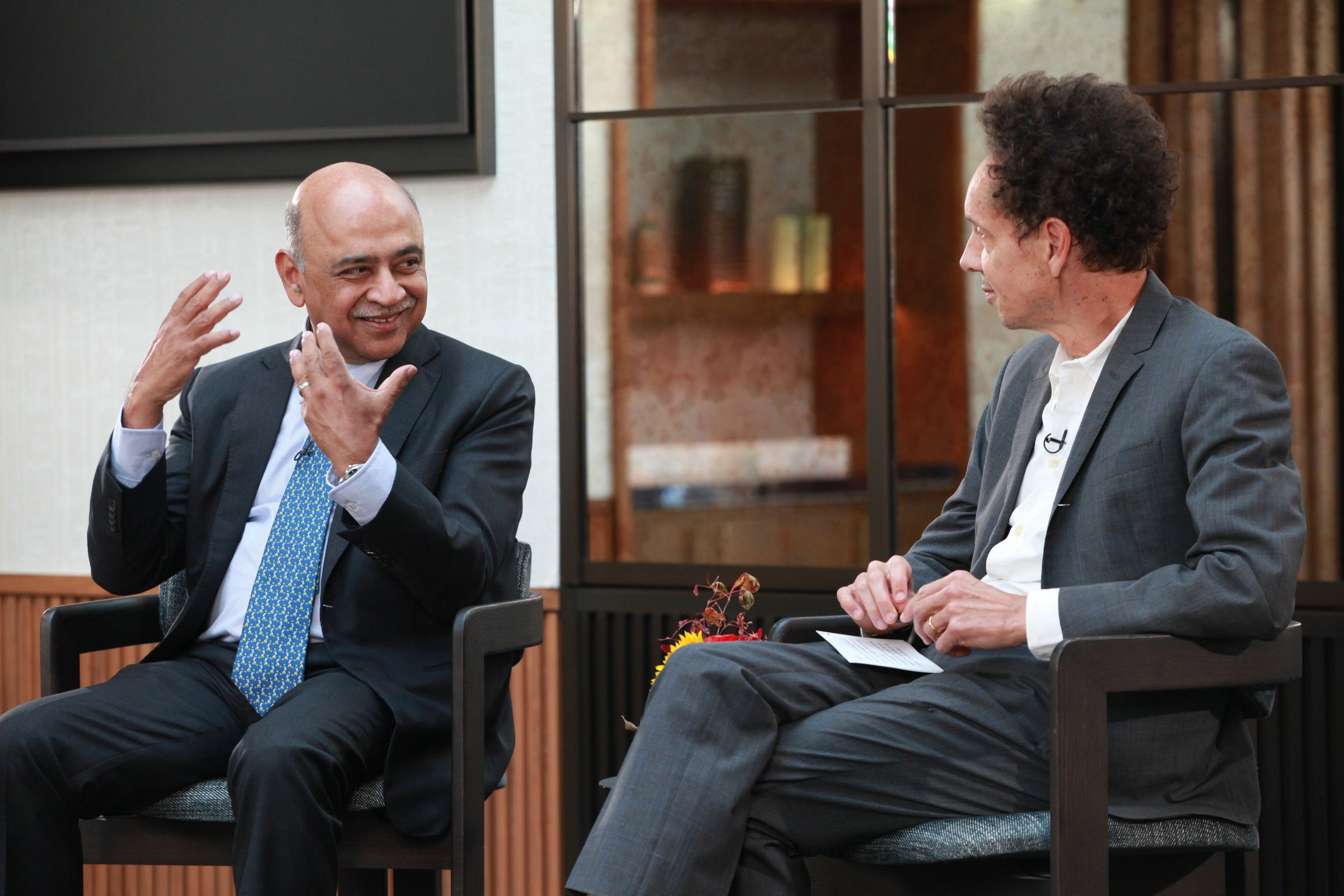
There is a more animated Krishna in the photographs of his conversation with Malcolm Gladwell at IBM’s New York office: hands raised, smiling, explaining. The subject is serious; the act of working it out need not be solemn. Across the researcher, the teacher’s former student and the executive buying the plumbing, the same task keeps returning: take a complicated system apart in the mind, then make its pieces work in the world.