Swaroop Jagadish had already helped build the machinery of a data-driven company when he made a rather useful confession. Talking with Viator data leader Kiran Padavala in 2024, he said, “I didn’t even know about the term governance” during his time at Airbnb. Here was someone selling a product with governance among its central concerns, cheerfully admitting that the vocabulary had arrived after the work. The plumbing, apparently, had been installed before anyone handed him the brochure.
It is a good place to begin with Jagadish. His career makes more sense through the problems he has encountered than through the categories attached to them. At Yahoo, he worked on ad-serving systems. At LinkedIn, distributed databases. At Airbnb, he led data platform and search infrastructure. Now, as co-founder and CEO of DataHub, he is working on the knowledge that lets other people, and increasingly other software, make sense of what those systems contain.
The recurring difficulty is easy to recognize. A company can collect an impressive quantity of information while becoming less certain about what any particular piece means. Storage keeps the numbers. Someone still has to remember the explanation.
An education in the plumbing
Jagadish’s formal education includes computer science degrees from B. M. S. College of Engineering and the University of California, Santa Barbara. His working education took him into the infrastructure beneath large internet businesses. Advertising systems and distributed databases are places where apparently modest technical decisions acquire consequences across many users and machines. They also demand an appreciation for dependencies: a component rarely gets to behave as though it lives alone.
His name appears among the initial committers in Apache Helix’s incubation record. The detail adds another strand to his later work with an open-source business. Before there was a company to build around a community, there was experience with infrastructure developed in public. The engineering background preceded the founder’s job title.
At Airbnb, where his official biography dates his leadership tenure from 2014 to 2020, the scope widened. His teams worked on Apache Airflow, Apache Superset, and Airbnb’s Dataportal. Airflow concerns the scheduling and coordination of workflows; Superset helps people explore and visualize data. Dataportal addressed another part of the working day: finding the data and understanding what one had found. Different jobs, connected by the need to make a complicated organization usable.
Jagadish also led development of Airbnb’s Knowledge Graph and search indexing and serving infrastructure, and served as engineering lead for its cloud cost efficiency program. That is a broader portfolio than a catalog alone suggests. Search, spending, discovery, and shared definitions all brought him up against relationships between systems. His later interest in metadata grew out of work where those relationships had practical consequences.
- YahooAd-serving systems
- LinkedInDistributed databases
- AirbnbData + search infrastructure
- DataHubEnterprise context
Two maps of the same mess
The founding partnership joined two experiences of a related problem. Shirshanka Das had created DataHub at LinkedIn. Jagadish had helped build Airbnb’s Dataportal. Each company needed ways to navigate data spread across a growing organization. Each had engineers with the resources to build an internal answer. The commercial opportunity lay in bringing those lessons to teams facing similar difficulties elsewhere.
Acryl Data emerged publicly in June 2021 with $9 million in seed funding led by 8VC, alongside LinkedIn and Insight Partners. At launch, Das was CEO and Jagadish was CTO. The distinction matters. The familiar description of Jagadish as DataHub’s CEO captures his present role, while the launch shows the technical position from which he began the business.
The first product combined the DataHub platform with design lessons from Dataportal. There is something appealingly economical about that arrangement: preserve an open foundation, carry forward useful experience, and make it easier for another company to do the work. The customers would bring their own complexity. The founders had already seen enough to know that complexity would arrive.
Metadata is the information around information: who owns a dataset, where it came from, what depends on it, and how it should be understood. A catalog makes those relationships discoverable. In Jagadish’s account of the fragmented data stack, the opportunity was to connect tools through this shared knowledge. A dashboard and a pipeline might serve different purposes while still needing to agree about the same underlying data.
The catalog needs to keep up
On an early podcast appearance, Jagadish discussed metadata while sipping cappuccino. The conversation included the possibility of cappuccino or espresso as an all-day drink, a small human flourish in a subject otherwise populated by systems and interfaces. It also contained an argument that now sounds particularly relevant: software itself would need to use the catalog.
“The catalog should serve both humans and systems.”
Swaroop Jagadish, 2021
That requirement makes freshness part of the design. A person can notice an odd result and ask around. An automated process needs usable information at the point it runs. Jagadish’s interest in keeping metadata close to real time was already visible in 2021. The eventual discussion of AI agents would give that engineering concern a larger audience.
By June 2023, Jagadish and Das were describing a shared control layer for the data stack. Their Series A announcement paired $21 million in funding with plans for Acryl Observe, bringing data quality monitoring into the same system as discovery and governance. The argument followed a familiar irritation: closely related questions had been assigned to separate tools. Finding a table was only part of the task; knowing whether it was reliable belonged nearby.
The community supplied concrete lessons. Stripe had extended DataHub to connect Airflow pipeline service expectations and observability, then shared the work at a town hall. The founders pointed to that example while explaining the next product direction. Here, open source supplied a working feedback mechanism. People encountering real problems could alter the software and show others what they had learned.
The engineer takes the questions
By 2023, Jagadish was publicly identified as Acryl’s CEO. His role now required explaining the problem as well as building around it. One revealing setting is Decoding Data Leadership, where he asks other practitioners about their work. In the conversation with Padavala, his questions turn toward business impact, the time required to show returns, and whether one data initiative can support several uses. The engineering remains present, with a customer’s calendar beside it.
His admission about learning the word governance comes during that exchange. It brings an abstract business category back to the practical work he knew at Airbnb. Rather than turn the moment into a grand theory of his character, it is enough to notice the sequence: experience first, terminology later. It helps explain why the conversation keeps returning to outcomes people can recognize.
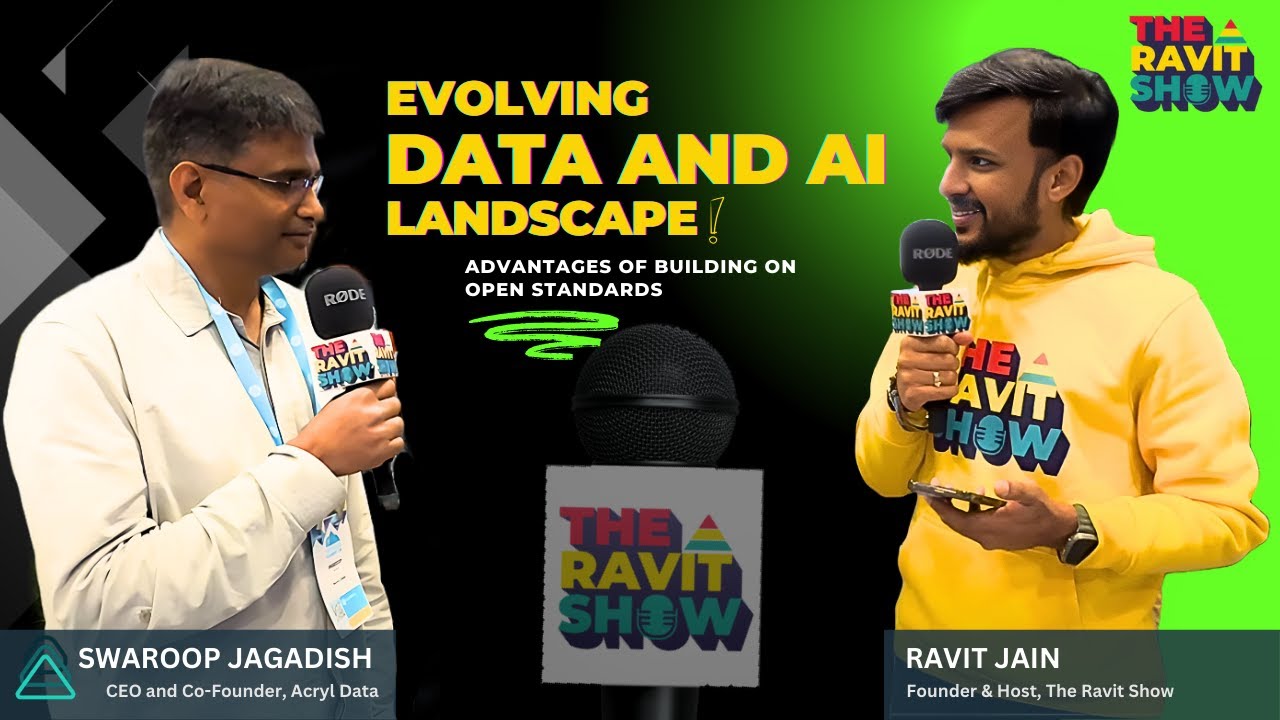
In his 2024 conversation with Ravit Jain, Jagadish described a related frustration with multiplying tools. Ownership was his example: an organization gains little from maintaining several incompatible ways of saying who is responsible for the same data. His preference was for common foundations across discovery, governance, and observability. The point was simplicity for the people implementing the system, who already had plenty to manage.
He also pushed back on the habit of attaching an AI label to existing products. His argument rested on architecture and first principles: some capabilities have to be built into the platform. It was a concrete objection from someone who had spent years building underlying systems. The label could be changed in an afternoon. The behavior underneath required engineering.
There is a practical distinction inside his open-source preference. A company using a catalog has its own tools, conventions, and exceptions. Building with practitioners exposes the platform to those differences. In his Ravit Show conversation, Jagadish described collaboration with companies including Netflix and Visa as a reason to work in the open. The product could benefit from experience gathered beyond the founding team’s former employers.
His responsibilities also extend to building the organization around the software. In December 2025, DataHub announced new product and engineering leaders, including an engineering leader responsible for its India presence. For an engineer who became a CEO, that is another form of infrastructure: the people needed to keep developing and supporting the product. The ambitions around AI context arrive with ordinary company-building work attached. Someone has to turn the argument into a roadmap, staff the teams, and help customers get started.
A new reader arrives
In May 2025, the company adopted the DataHub name and announced a $35 million Series B led by Bessemer Venture Partners, bringing disclosed funding to $65 million. The name brought the commercial business closer to its open-source identity. The financing supported a broader ambition around context for data, models, and AI agents.
Three announced rounds. $65 million total through May 2025.
Bessemer’s investment explanation emphasized the surrounding information an AI system needs: ownership, permitted uses, lineage, and reliability. Jagadish’s old discovery problem had acquired a demanding new reader. An agent could locate a table and still lack the background needed to use it correctly. More access would not, by itself, settle the question of meaning.
In early 2026, Jagadish outlined stages of context maturity, starting with knowledge held in people’s heads and scattered conversations, then moving toward knowledge usable by both people and machines. The progression gives his ambition a practical shape. Organizations need ways to preserve explanations so the next employee, analyst, or agent can use them without reconstructing the entire history.
That work remains underway. As of October 2026, he is listed among the DataHub leaders participating in the upcoming CONTEXT summit on November 4. The program brings the conversation back to practitioners putting systems into production. The setting has grown; the concern remains close to his earlier work.
Jagadish’s story follows the distance between possessing information and being able to use it. He has approached that distance through databases, internal platforms, open-source software, and a company of his own. Now AI agents are joining the people who need directions. A business can buy more storage with relative ease. Teaching the next arrival why a number means what it means is still a job for someone who understands the plumbing.