A business school student finds a database paper. It is an unpromising opening for an adventure: no garage, no midnight ultimatum, no villain with a corner office. Yet Justin Borgman has spent much of his working life following the question inside it. How do you make a growing pile of data useful to the people who need answers?
The student was at Yale. The research was HadoopDB, work by computer scientist Daniel Abadi and his collaborators, including doctoral student Kamil Bajda-Pawlikowski. Borgman joined Abadi and Bajda-Pawlikowski to turn the project into Hadapt in 2010. The assignment sounds tidy in retrospect: take an academic prototype and make something enterprises could use. Anyone who has tried to persuade a prototype to behave outside its birthplace will appreciate the distance concealed in that sentence.
HadoopDB brought together ideas from parallel databases and Hadoop, the software framework associated with storing and processing large datasets. Hadapt pursued SQL analytics on top of that foundation. SQL, the familiar language people use to ask databases questions, offered a bridge between a new way of handling data and tools businesses already understood. Borgman was helping translate research into a purchase somebody could justify.
He arrived with experience on both sides of that translation. He had studied computer science at the University of Massachusetts Amherst, where he was a Commonwealth Scholar. His early career included software development at Raytheon and MIT Lincoln Laboratory, followed by product development at anti-counterfeit technology company Covectra. Coding, product work, then commercializing a database: the sequence gave him repeated practice moving between what software can do and what someone needs it to do.
A sale, and another beginning
Teradata acquired Hadapt in July 2014. Borgman became a vice president and general manager responsible for its Hadoop products. The company he had helped build became part of an established data warehouse business, putting him inside the industry whose next chapter he was trying to imagine.
There he encountered Presto, the open-source query engine developed at Facebook. Its appeal extended beyond a single storage system: it could let people query data across different places. Index Ventures later described Borgman and his team adding enterprise features while still at Teradata. A technology built for one enormous internet company was being prepared for organizations with their own complications.
The next beginning came in 2017, when Borgman and colleagues started Starburst independently. His connections to Bajda-Pawlikowski and Matt Fuller, and to the original Presto team, matter to this story. A database company rests on more than a chief executive’s conviction. It requires people who understand what will happen when a customer asks an awkward question at an inconvenient scale.
The open-source engine that underpins Starburst is now called Trino. Borgman’s role has been to build a business around making that technology useful in enterprises. The continuity is easy to miss amid the changes of company name and software vocabulary. Hadapt, Teradata and Starburst all put him near the same tension: businesses want more freedom to analyze their data than their existing arrangements readily allow.
How do you make scattered data useful?
- 2010HadaptCommercialize Yale research
- 2014TeradataBuild inside the incumbent
- 2017StarburstStart independently again
Customers before the venture cheque
For a founder’s second attempt, Starburst took a deliberately patient approach to money. Borgman wrote in June 2020 that the company had bootstrapped to profitability before raising venture capital. Its first two and a half years had been cash-flow positive. Customers paid; expenses had to make sense. The discipline arrived before the large financing announcements.
By November 2019, Starburst had raised a $22 million Series A. A $42 million Series B followed in June 2020. Borgman’s explanation for taking outside money was expansion after establishing the business. That order is revealing. Funding could help a working company reach more customers, rather than carrying the whole burden of discovering what the company ought to be.
He also described a balancing act familiar to founders working with open source. The freely available engine needs to be useful enough for people to adopt it. The commercial offering needs features enterprises will pay for. Performance and scalability belong close to the heart of the open project; organizations also need security, connectors and practical help operating the software. A successful query is the beginning of the relationship.
In February 2022, Starburst announced a $250 million Series D at a $3.35 billion valuation, taking its disclosed total financing at that point to $414 million. Those are dated company figures, and they describe a particular financing moment. The more interesting personal detail is the route to them: Borgman had already experienced an acquisition, then chosen to spend years building another business before accepting its first venture cheque.
“We put customers first, we managed our expenses, and we built a real business.”
Justin Borgman · June 2020
The customer keeps the keys
The argument behind Starburst can be drawn on a napkin. An organization has information in several systems. Someone wants an answer that requires more than one of them. A conventional response is to copy the necessary data into a central place, then ask the question. Borgman’s recurring proposition is to make it possible to ask across those systems, with less compulsory rearranging first.
In conversation with Madrona, he described early users who knew the data existed but could not readily access it. They wanted to test a hypothesis and iterate. Waiting for new pipelines and a warehouse load could turn a promising question into a scheduling exercise. Freshness mattered too. An answer about yesterday’s business can be perfectly correct and still arrive dressed for the wrong occasion.
The position has a commercial edge: customers should retain choices about where data lives and which technologies they use. Starburst’s current architecture includes Trino and Apache Iceberg, an open table format. Its stated scope spans on-premises systems, multiple clouds and hybrid environments. These are technical choices with an organizational consequence. A customer’s infrastructure can contain several generations of decisions without every new question requiring a wholesale relocation.
Even the company name contains a database joke. Borgman has explained that “star” refers to the asterisk in SQL, associated with selecting everything; “burst” conveys speed. The candy association, he acknowledges, comes with pleasant memories. It is an unusually sociable name for a business concerned with distributed queries. Most people can pronounce it before they understand what is being distributed.
One question. Several places to look.
A conceptual view of federated access. Actual deployment depends on the customer’s systems.
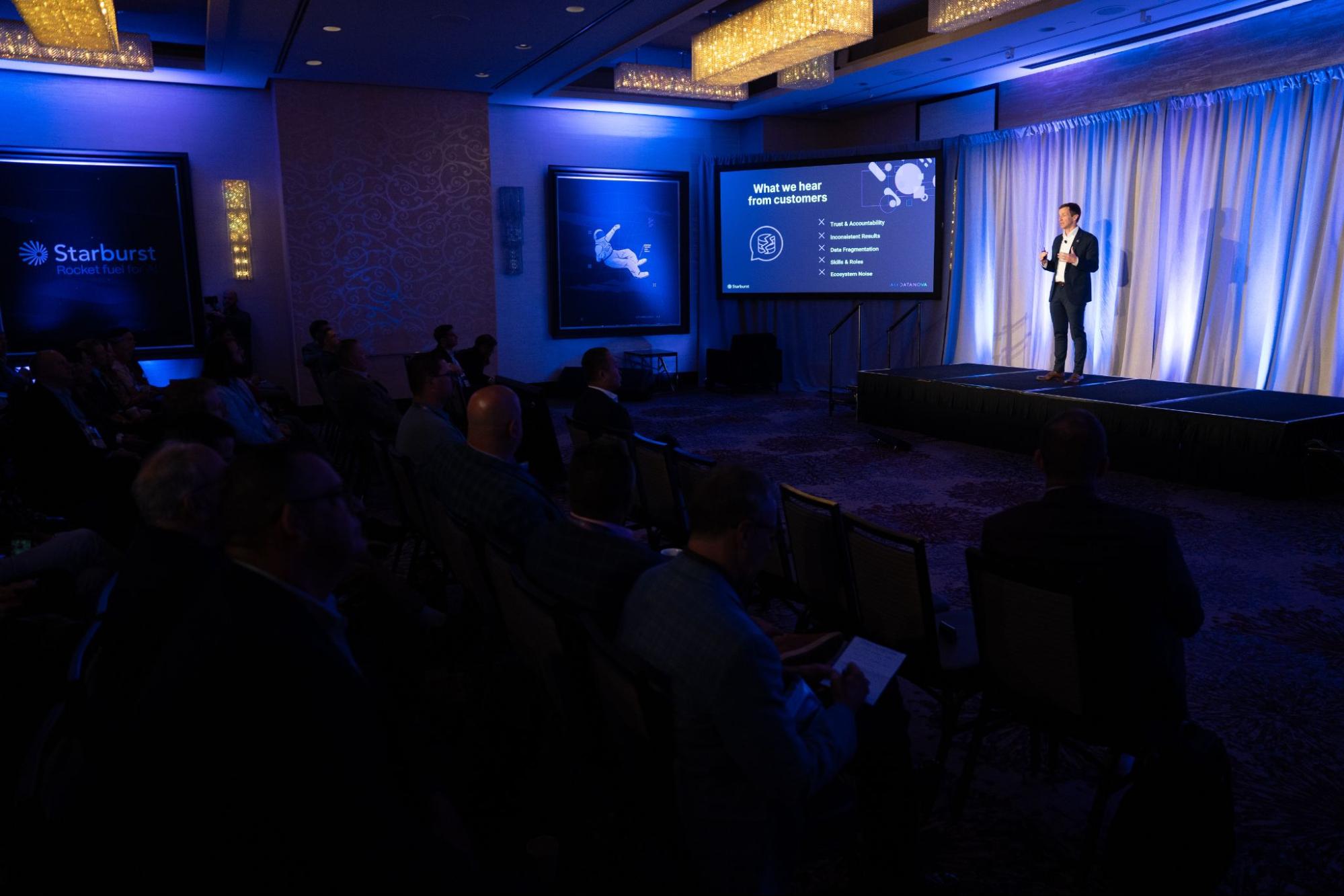
AI & Datanova 2025 · Photograph: Starburst
An old question gets an AI budget
Artificial intelligence has given Borgman’s data-access argument another audience. His February 2025 writing set out three requirements for AI architecture: access to data across the organization, practical usefulness for the business, and secure governance. His reasoning connects the newer ambition to an older operational problem. A model still needs relevant information, and a company still has to decide who may use it.
Starburst’s February 2025 business update supplied evidence of the scale of those customer relationships. The company reported customers among 10 of the top 15 global banks and an annual recurring revenue figure per customer above $325,000. It also described a multiyear financial-services contract worth eight figures per year. These company-reported measures help explain why enterprise requirements occupy so much of Borgman’s attention.
His May 2026 essay, Engineering the AI Leap, returned to business context: the meanings, relationships and operating conditions that make information useful in a specific organization. He argued that the transition needs deliberate engineering. The appeal of a more capable model does not remove the work of connecting it to the business in which it is supposed to operate.
By October 14, 2026, Starburst said it had surpassed $100 million in annual recurring revenue and served organizations in more than 60 countries. That announcement also recorded Goldman Sachs recognizing Borgman among its 2026 Most Exceptional Entrepreneurs. The recognition arrives years into the effort. For his current argument, the more relevant question is whether access to governed, distributed data can support customers as they move AI projects into everyday use.
Company-reported operating figures. The $3.35 billion valuation belongs to the February 2022 financing round.
A door held open at Yale
There is another measure of Borgman’s work that fits poorly into a funding graphic. In 2023, Yale School of Management students chose him for an inaugural SOMee, an award recognizing alumni who had helped current students. Their account was specific: he had helped create technology internship opportunities during a difficult recruiting period. For the students involved, access meant an opening on a team rather than permission to query a table.
That detail gives his university connection a second direction. Yale had provided the setting where a student could encounter research and help turn it into a company. Years later, students credited him with creating opportunities of their own. There is no need to enlarge the gesture into a theory of leadership. Making an internship possible is concrete enough.
Borgman grew up in Acton, Massachusetts, and attended Acton-Boxborough Regional High School. He has spoken warmly about public education and the range of perspectives he encountered at UMass. Those recollections sit alongside the executive biography: a Boston-area founder whose education crossed a large public university and a private graduate school, with engineering work between them.
The career now has several plausible endings, none of which he appears to have treated as the end. A research project became Hadapt. Hadapt was acquired. A corporate role led to another startup. Starburst’s customers brought the next set of questions, and AI has added more. The thread through it is Borgman’s willingness to return to a difficult, unfashionably practical problem: giving people a usable answer from information they already have. The data may stay where it is. He keeps going.