In November 2015, Databricks possessed a condition common to university spinouts and rare in fairy tales: everyone admired the technology and almost nobody was paying for it. Apache Spark, the fast data-processing engine born at UC Berkeley's AMPLab, had spread across the world precisely because it was free. Cloud vendors could offer it. Competitors could package it. Engineers could download it before lunch. The research had escaped beautifully. The business, less so.
Ali Ghodsi was not the obvious merchant for this predicament. He was a computer scientist with a doctorate in distributed computing, an adjunct appointment at Berkeley, and no apprenticeship in enterprise sales. He had joined Databricks part time as an engineer after co-founding it with six colleagues in 2013. When the company needed a new chief executive, he was reluctant. A laboratory whiteboard had been his native habitat. A quarterly pipeline review was foreign weather.
Yet the appointment made a kind of technical sense. Ghodsi had spent his career thinking about systems in which many parts compete for scarce resources. A struggling company is also a distributed system, except the nodes have opinions and request stock options. He began with the bottleneck. Databricks had credibility, adoption, and ingenious people. It lacked a commercial machine and a paid product distinct enough from the free one.
A child with the whole game in his hands
Ghodsi was born in Iran in 1978 and grew up in Sweden after his family left Iran. He has spoken in Swedish press about the abrupt change in class and circumstance: the family moved between student rooms, depended on public assistance, and later settled in Bagarmossen, a Stockholm suburb. The outsider's wish to prove oneself became, by his own account, fuel.
Computers offered a smaller, more obedient universe. He began programming games at about seven. In the late 1980s, as he remembers it, a child could make a game alone; there was no studio to assemble and no cinematic universe to maintain. At university, the hobby became a consulting business. He wrote software for companies while collecting an unusual pair of qualifications at Mid Sweden University: computer engineering and an MBA in logistics and marketing.
The combination looks prophetic now, but the next stop was academic. At KTH Royal Institute of Technology, Ghodsi completed a PhD in 2006 on algorithms for distributed hash tables. He worked in Swedish research before arriving at Berkeley in 2009 for what was supposed to be a year. Berkeley kept winning the annual argument about whether he should leave.
PhD in computer science from KTH, focused on distributed computing.
Joins the research community around UC Berkeley's AMPLab.
Co-founds Databricks with six fellow Berkeley researchers.
Becomes CEO and begins the commercial rebuild.
Databricks reports a $7 billion revenue run rate and closes funding at a $190 billion valuation.
The laboratory with two languages
AMPLab brought systems engineers into the same rooms as machine-learning researchers. The groups wanted different things. One cared about moving and scheduling enormous quantities of information. The other cared about extracting predictions from it. Their productive misunderstanding became the point.
Ghodsi has recalled watching young companies use old machine-learning methods and produce startling results. The algorithms had not suddenly acquired better manners. They had been given vastly more data and modern hardware. Facebook could infer intimate patterns at population scale. The researchers' response was characteristically Berkeley: this capability should not belong only to a few large companies. "We need to democratize this," Ghodsi said of the ambition.
Apache Spark was central to that project. Matei Zaharia originated it as a graduate student, and a wide research community developed the engine and the systems around it. The company that followed was unusually crowded at the top.
Seven founders can resemble a committee designed to choose a carpet. Ghodsi describes the advantage differently: a critical mass of people who trusted one another and knew each other's strengths. He also concedes the obvious danger. "Too many cooks in the kitchen could be a problem." At Databricks, the durable relationships mattered more than the head count. The company did not need a lone genius. It needed translators.
"We need to democratize this."Ali Ghodsi, on bringing large-scale machine learning beyond a few technology companies
The chief executive as bottleneck hunter
Once in charge, Ghodsi moved with a directness that did not resemble academic consensus. Databricks recruited experienced enterprise leaders. Much of the executive team changed within a year. In one revealing arrangement, replaced executives were invited to stay if they could report to their replacements. Most accepted. Ego, Ghodsi observed, could be placed beneath the work, though apparently it requires careful shelving.
The product also needed something customers could not obtain by downloading Spark. Databricks built proprietary services and performance advantages around the open engine. The bet was that openness would create trust and distribution, while the cloud platform would sell convenience, reliability, collaboration, security, and speed. The free thing was not the enemy of the paid thing. It was the road to it.
That distinction helped turn an admired project into enterprise software. Revenue reached a reported $12 million in 2016. Databricks later coined the "lakehouse" to describe an architecture meant to combine the low-cost flexibility of data lakes with the management features of data warehouses. The word was inelegant in the way that useful luggage often is. It carried what the company needed.
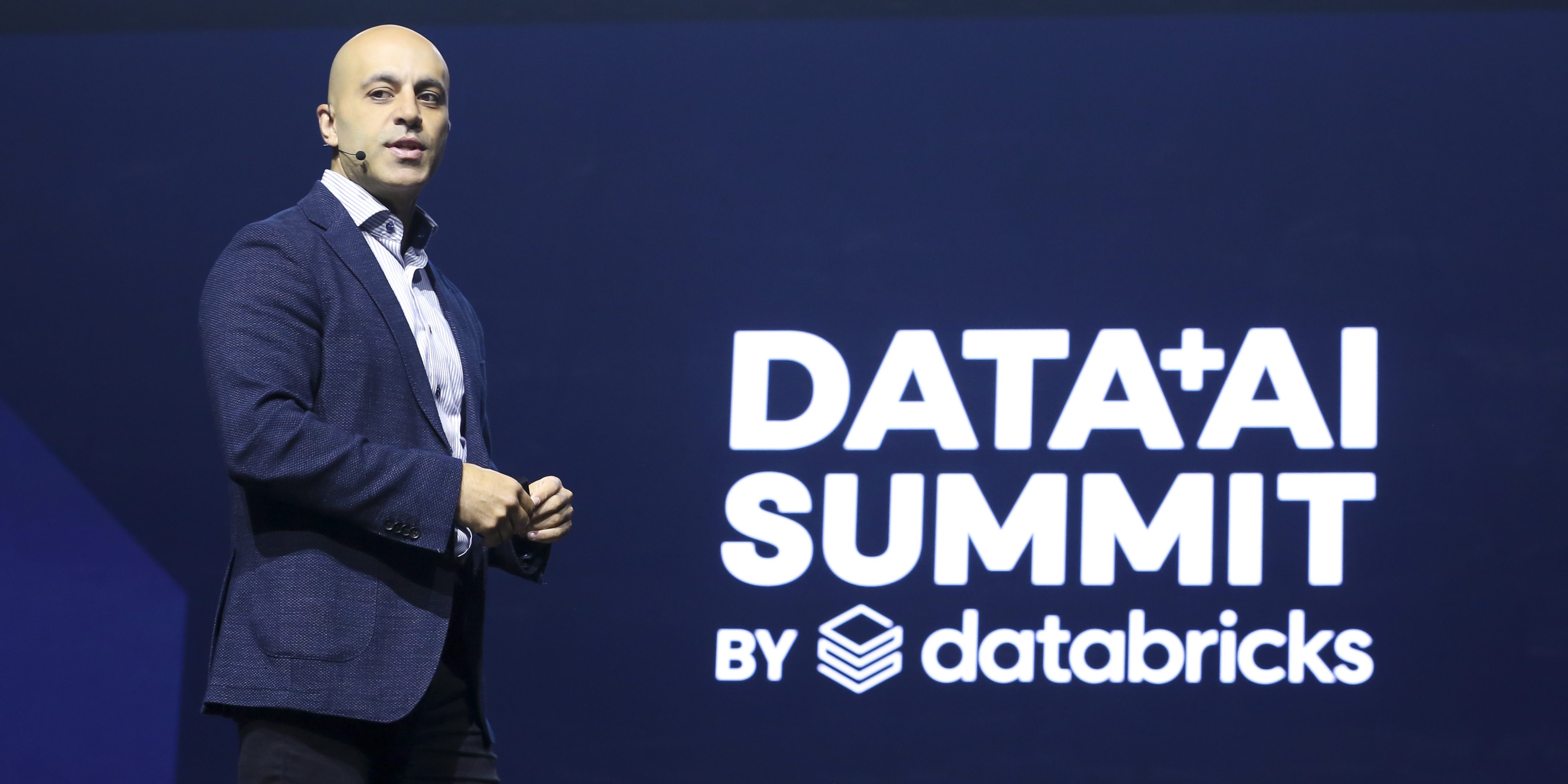
The public numbers trace the result, though private valuations deserve pencil rather than ink. Databricks was valued at $28 billion in early 2021, $38 billion later that year, and $62 billion in 2024. In August 2026, a $5 billion financing placed the company at $190 billion after it reported a revenue run rate above $7 billion. Forbes estimated Ghodsi's fortune at $7.6 billion in September 2026. It is an extraordinary outcome for someone whose first commercial asset was software anyone could inspect.
Boring plumbing in the age of spectacle
Ghodsi is now a salesman, but an entertainingly impolite one. At an Axios event in 2024, during a feverish week for AI financing, he declared, "It's peak AI bubble." His evidence was the existence of billion-dollar valuations attached to companies with little underneath them. Databricks had just announced financing at $62 billion, which made the observation either candid or cheeky. Probably both.
He has also argued that artificial general intelligence, under the definitions researchers used before the current boom, is already here. Machines can converse, reason across many subjects, write code, and find patterns in immense datasets. The arrival has been anticlimactic. "Never meet your heroes," he joked about finally encountering the long-imagined technology.
The provocative claim conceals a practical one. The difficult enterprise problem is context. A model may know the broad world and still fail to know what one company means by a customer, which table contains the approved revenue number, or who has permission to see it. Ghodsi's answer is Databricks' familiar territory: organize the data, govern access, preserve open formats, and connect AI to the definitions a business actually uses.
"If all AI progress was frozen today, I think we have what we need to proceed with what we are doing."Ali Ghodsi, 2025
He calls this work "the boring plumbing behind the scenes." The phrase is well chosen. Plumbing is invisible when it works, ruinous when it does not, and surprisingly expensive once a building becomes complicated. Databricks' newer products follow the metaphor into the AI era: Lakebase for operational databases, Genie for asking questions of business data, and Unity AI Gateway for governing models and costs. In September 2026, the company acquired Row Zero to connect governed data with the spreadsheet, still the office world's most tenacious user interface.
The professor has not entirely left
Ghodsi remains listed as an adjunct associate professor at Berkeley. His academic page contains the archaeology of the journey: distributed resource fairness, Mesos, Spark SQL, streaming systems, caching, and courses taught with Ion Stoica. The publication list is also a reminder that Databricks did not begin with a pitch deck looking for a problem. It began with a long argument among researchers about how computers should share work.
His management style carries the same appetite for inspection. Accounts of Ghodsi describe a chief executive willing to call deep into the organization to understand a product and willing to let disagreement become visible. He regards conflict avoidance as a dangerous executive habit. Truth-seeking sounds noble in a company value statement; in practice, it means asking the extra question when everyone would rather proceed to lunch.
There is a clean symmetry to his career. As a child, he liked games because one person could comprehend the whole machine. At Berkeley, he studied systems too large for one computer. At Databricks, he learned to operate a system too large for one founder. Each stage required giving up a little control and designing better coordination.
The company may eventually enter the public markets. Ghodsi has repeatedly resisted treating an initial public offering as a ceremonial finish line. His stated ambition is larger and less photogenic: make AI useful inside organizations today. It requires context, governance, reliable data, and all the pipes no one applauds until they burst.
The free engine is still there. That is the cleverness and the bargain. Apache Spark gave Databricks its community, its credibility, and its original inconvenience. Ghodsi's achievement was not to close the source. It was to build a company around everything difficult that remained.