At 17, Valerio Adrian Anacleto rented a shop near Laferrere station and began teaching computing. It was an early attempt to turn something he understood into something he could earn a living from. The school failed. Years later, with a computer science degree and two partners, he tried again. This time the business was Epidata, founded in 2003. Teaching people how to use computers had given way to helping companies build the software behind their operations.
The distance between those two ventures is the interesting part. A neat entrepreneur biography would hurry past the first classroom, award the university a supporting role and arrive promptly at the multinational company. Anacleto keeps returning to the classroom. His public reflections concern who gets to learn, what makes that learning useful and how someone acquires enough confidence to attempt work that once seemed beyond them.
Now, as the founder and CEO of a company operating across Latin America and the United States, he is facing a related problem at a different scale: how to build an organization that can keep learning without requiring its founder to handle everything himself.
A business before a degree
Anacleto was born in Laferrere, in the Buenos Aires province district of La Matanza. He grew up in a household with four children, where his parents relied on occasional work. By ten, he was working too, loading and unloading vegetable crates and helping at a local market. Study and saving were recurring messages at home. The prospect of an education existed alongside the immediate business of paying for food.
He paid for computing lessons with money he earned himself. Discovering an aptitude for programming mattered because it offered a direction, a subject that held his attention and a possible way to work. The teaching venture at 17 was an attempt to act on that discovery. He had a commercial partner, premises and a skill to pass on. He also acquired an unwelcome introduction to unemployment when the venture closed.
There is a practical, almost stubborn pleasure in how he describes his profession: making things that work and that people use. The appeal survives the change from student to programmer to executive. A program has to do something. A company selling programming has to do something useful for somebody willing to pay. Even an attractive idea eventually has to meet that rather impolite examiner.
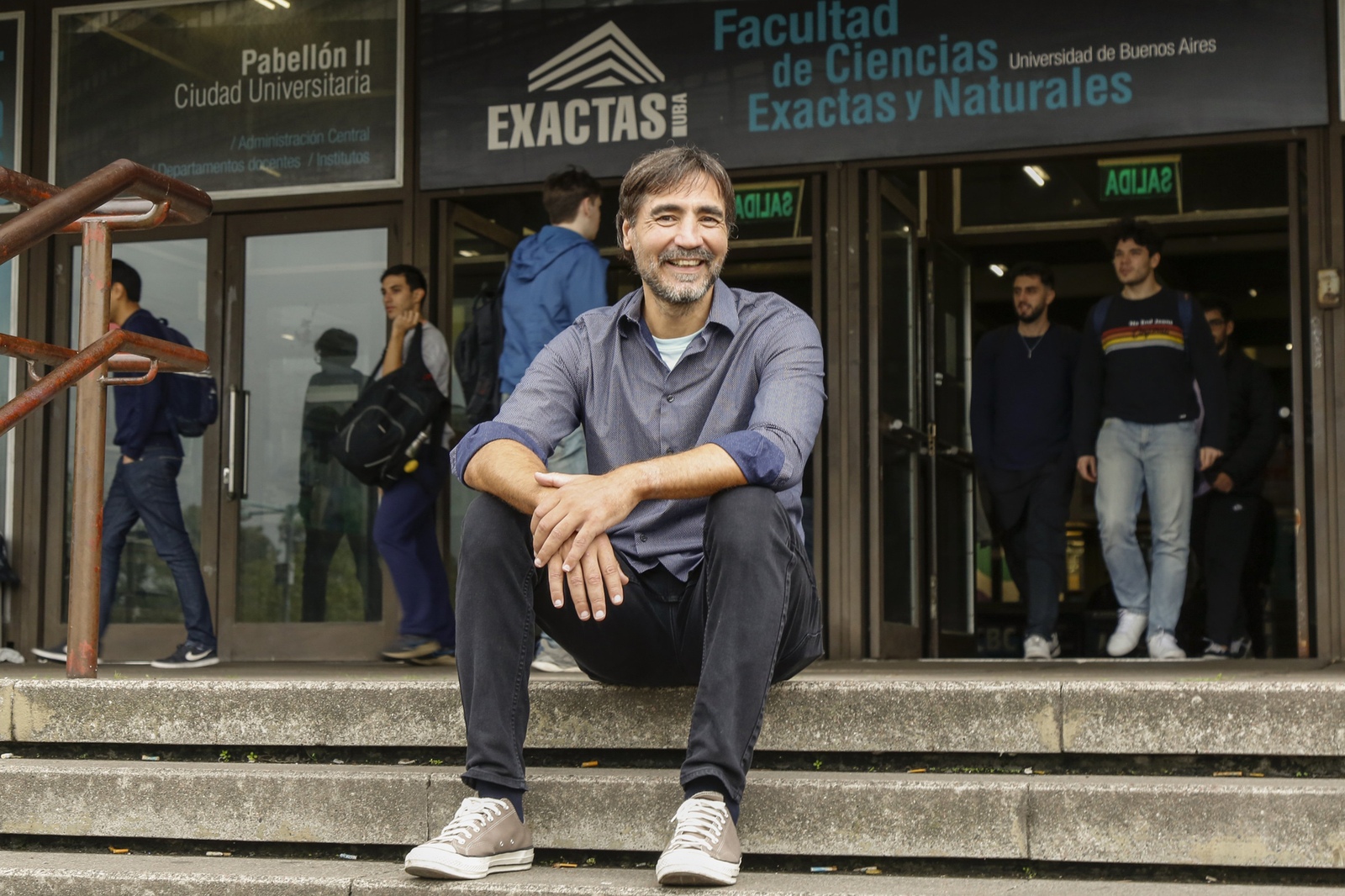
The campus that became a meeting place
At the University of Buenos Aires, Anacleto studied for a Licenciatura in Computer Science in the Faculty of Exact and Natural Sciences, usually called Exactas. The qualification was one result. The relationships were another: he met his wife, friends and future business partners there. Public education occupies a central place in his account of how he reached professional life.
His recollections of university are unusually domestic. There was mate in the library, work in the laboratories and lunch in the bar at Pabellón 1. It was somewhere to spend time, find people and return to. “Exactas fue como mi segunda casa, me dio todo,” he said. In English: Exactas was like his second home; it gave him everything.
He went on to teach computing at Exactas and at the Universidad Católica Argentina, and later served as a mentor in Manos Accelerator, a program for Latino entrepreneurs. Those roles extended the work of the teenage classroom into other settings. They also put him on both sides of a familiar question: how does someone who knows a subject help another person begin?
The connection between academic work and business became part of Epidata’s activity. By 2011, its Academic Cooperation Program included training, thesis supervision and collaborative research. Anacleto described research work with Carnegie Mellon University and an effort to bring universities and companies closer together. The graduate had become an employer, but the campus remained in the picture.
“Fuimos tres los fundadores, no fui yo solo.”
Adrián Anacleto on Epidata’s beginnings
“There were three founders, not just me.”
Three founders, then a wider map
Epidata began in 2003 with three founders. Anacleto has explicitly asked that his former partners receive their share of the credit, even though they are no longer shareholders. That small correction is useful in a story centered on one person. A founder’s name can become shorthand for a business so easily that the other people disappear from the sentence.
The company’s early specialty was software architecture. Integration became an important route to growth: clients needed pieces of software that could connect systems built with different technologies. Its later description, innovation outsourcing, covers a broader range of services, but connecting things remained a recurring theme. The commercial vocabulary expanded along with the work.
There are visible markers of the international ambition. In December 2010, Anacleto received Buenos Aires’s Young Entrepreneur award and its International Projection category award. In 2012, Polo IT recognized his contribution to the industry and the development of foreign markets. At that stage, Epidata had commercial offices in Santiago and clients in several neighboring countries, while preparing alliances for work involving the United States.
with two partners
recognition in Buenos Aires
for overseas market work
focuses on group strategy
The tenth anniversary brought new offices in central Buenos Aires. Epidata reported adding more than 50 professionals over the preceding year, and serving clients in more than 30 countries. Anacleto described the expansion as a response to increasing demand. International reach had become a matter of staffing, floor space and delivery, as well as ambition.
By February 2025, he was discussing annual revenue above US$30 million and growth of 24% in an interview about the company’s plans. Partnerships with Atlassian, Datadog and Salesforce formed part of that account. In December 2025, he described an organization with roughly 400 employees in Argentina and another 400 abroad. These are dated statements about a growing services business, whose scale brings an expanding collection of decisions to make.
An engineer in the AI argument
In his recent writing, Anacleto has become an outspoken participant in the argument about artificial intelligence and programming. He objects to predictions that programmers will disappear. He also objects to the older promise that someone could become a professional programmer in a few months. Both claims, in his view, underestimate the difficulty of building software well.
His July 2026 essay, Junior vs. Senior: la pregunta equivocada, approaches that discussion as a former computing teacher and an employer of hundreds of programmers. The title calls the junior-versus-senior distinction the wrong question. His position gives professional formation a longer horizon than a tool demonstration or a brief training course.
He is interested in what AI changes inside the business of software: contracts, reusable assets, automation and the relationship between time spent and results delivered. In September 2025, he argued for starting with bounded projects and measurements of time, quality and cost. Design, data and communication receive considerable attention in that prescription. They are responsibilities that remain even when generating code becomes easier.
His March 2026 essay on co-creation makes a related case for working with specialist partners. Companies have knowledge of their own businesses; technology specialists bring experience from implementations and other industries. Combining those kinds of knowledge, he argues, can help organizations redesign how work happens. Simply adding a chatbot to an existing process can leave the original shortcomings firmly in place, now with a more conversational interface.
The founder hands over the daily decisions
In April 2026, Anacleto announced Gabriel DOnofrio’s arrival as general manager. DOnofrio would take responsibility for operations while Anacleto concentrated on the Epidata group’s longer-term strategy: new markets, acquisitions, alliances, strategic communication and talent. The appointment gave a concrete organizational form to his next stage as founder.
He said DOnofrio had already been working with him for eight months. The announcement was warm toward the team he was handing over, and candid about expecting to miss working with them every day. He described the transition as a milestone that excited him more than other recent developments. The task ahead involved creating the structures that would allow the group to grow.
A separate announcement in March placed him on the Salesforce MuleSoft Partner Advisory Board, representing Epidata. He recalled that the relationship had begun when MuleSoft had only about 40 people. Years of integration work had produced a relationship in which he could now bring clients’ concerns into a strategic discussion with a technology partner. It is one example of the work he plans to give more attention.
Delegation has a particular consequence for a technical founder. The thing being built is increasingly the organization through which other people do the building. Decisions about partners, managers and markets become part of the product of his working day. For Anacleto, who began by teaching a subject he enjoyed, the circle of people whose work he must understand has grown considerably.
A swimming story without the business lesson
There is a revealing detour in his public writing. In August 2025, Anacleto said he had wanted to write about swimming, one of his passions. A colleague suggested comparing the discipline of sport with entrepreneurship. He disliked the resulting post because the comparison felt like a cliché he did not recognize himself in.
His own account concentrated on learning, training and the friends he found in his swimming team, Madagascar. Competitions and trophies occupy relatively brief moments, he observed; most of the time is spent practicing. He wanted to thank the people who accompanied him and describe an experience beyond work. A swimming pool was allowed to remain a swimming pool, without being promoted to a management consultant.
That preference gives the business story a useful ending. Anacleto’s life contains a failed school, a university education, colleagues, partners, classrooms and a company that has grown across borders. It also contains activities he enjoys for their own sake. As he rearranges his role at Epidata, he continues to speak about learning. Sometimes that means understanding an AI implementation. Sometimes it means returning to the water with friends.
Keep the conversation going
His work, his writing and a conversation on camera.