An agency that cannot sell a single project has a wonderfully unambiguous problem. In 2011, Michel Cohen and Damian Wasserman started Diractive, an online marketing venture. According to their account, it sold nothing. The two developers kept working together, eventually building a software shop and, in May 2018, founding BEON.tech. Somewhere along that route, the thing they wanted to sell changed.
- Latin American engineers join U.S. companies’ existing teams.
- Published senior-engineer rates run $6,000-$8,000 per month.
- Clients direct the work; BEON handles hiring and ongoing talent support.
The useful discovery was who to keep
The founders moved away from fixed-price projects toward changing scopes. Their company history also describes a particular kind of engineer, nicknamed “The Keepers”: people whose contribution made them hard to lose. BEON’s proposition grew around finding those people and keeping them engaged. The finished application ceased to be the whole transaction. The relationship with the person building it became the business.

There is a useful commercial distinction here. A project can be accepted, invoiced and forgotten. An engineer inside a growing product team accumulates knowledge: which decisions are fragile, which customers need special treatment, which shortcut everyone wishes they had avoided. Retaining that person preserves something a replacement’s résumé cannot contain.
The engineer joins your standup
BEON operates in nearshore engineering staffing, connecting U.S. buyers with Latin American talent. Its engineers work inside the customer’s team, using that team’s tools and reporting to its leaders. The geographical argument is practical: overlapping working hours make questions easier to answer while the person asking still remembers why they mattered.
The menu covers web and mobile development, cloud infrastructure, quality assurance, data science and AI engineering. The company screens technical ability, English and communication, with live assessments. Under its talent-partner model, it also handles contracts, payroll, equipment and benefits. The customer supplies the product direction and engineering management.
This puts BEON alongside nearshore staffing providers, with direct recruitment and project agencies offering different ways to solve the same shortage. Its distinctive emphasis is the work after placement: Talent Experience Managers remain involved in performance, expectations and professional growth. That is a more demanding promise than forwarding a shortlist.
The price of a seat
BEON’s staff-augmentation page publishes an all-inclusive range of $6,000-$8,000 per month for a senior engineer. Multiply by twelve and the annual commitment becomes $72,000-$96,000, assuming an unchanged rate for a full year. This is a fee for engineering capacity. It does not purchase a guaranteed release date.
For organizations that already have the machinery to employ and support people, direct hiring offers another arrangement. BEON’s pricing page specifies a one-time recruitment fee equivalent to three months’ salary. The client then takes responsibility for management and benefits. Contract-to-hire adds a route to working together before making a permanent hiring decision.
The choice concerns administrative capacity as much as price. A company with mature payroll and benefits may mainly need help finding candidates. A team entering unfamiliar employment markets may value someone else doing that work. Comparing the two solely by the first invoice leaves most of the decision outside the spreadsheet.
Twelve engineers, added one at a time
SimplePractice provides scheduling, billing, telehealth and documentation software for clinicians. In BEON’s detailed case study, the first engineer joined in under three weeks. The engagement subsequently grew into twelve engineers across full-stack development, QA and data. The sequence matters: an initial placement expanded into a team over time.
“We continue to be impressed with the high quality of the developers and quick onboarding into our environment and codebase.”Misak Melikyan · VP of Engineering, SimplePractice
Quoted in BEON’s customer case
Superhuman provides the smaller counterexample. BEON describes placing one React engineer in three weeks, for work requiring independence and adaptation to unfamiliar domains. Its account says the engineer continued working independently for more than a week during a colleague’s absence. One person, given meaningful responsibility, can be a better illustration than a wall of client logos.
These are the supplier’s accounts of customer engagements. They show what BEON sells: people who become useful within an established product environment. Other named customers include Kin, Evisort and Nasdaq Private Market, spanning insurance, contract software and private-share trading.
Remote work still needs a room
A distributed workforce makes the hiring map larger and the social map stranger. BEON’s Get Together in Your City program, launched in late 2023, organizes local gatherings across Latin America. The idea is almost comically ordinary: colleagues who meet on screens occasionally meet in person.
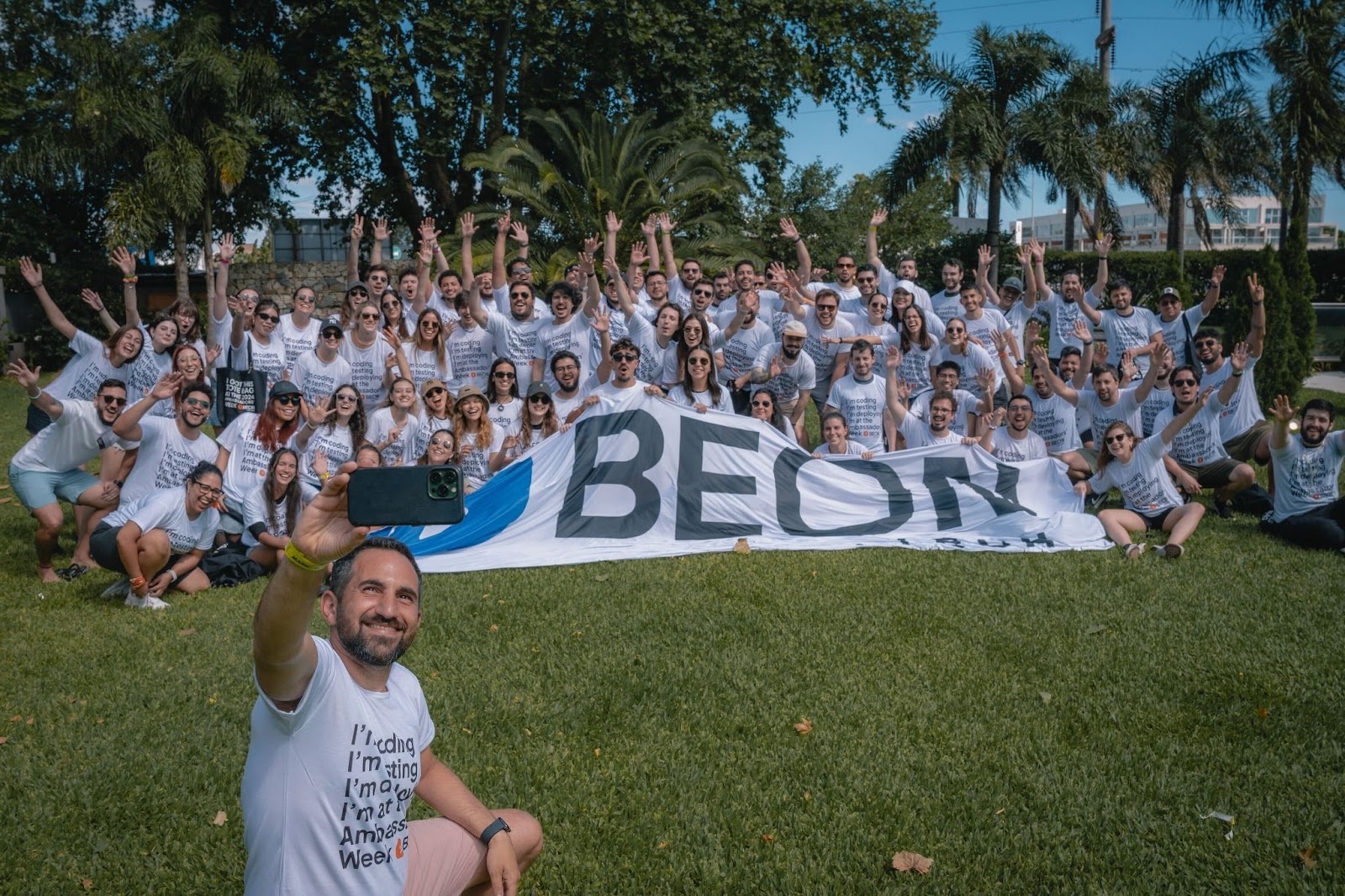
The less photogenic work continues between gatherings. Talent Experience Managers support onboarding, feedback and career development. Semiannual reviews bring engineers and clients into the conversation. The logic is straightforward: a staffing business dependent on continuity has a financial reason to pay attention before someone resigns.
A hiring model cannot supply a roadmap
The transferable lesson is to identify the missing capability before choosing a vendor. If you need more people inside a functioning team, embedded engineers can help. If you need an entire project delivered without internal supervision, this arrangement leaves you holding responsibilities you hoped to hand away. Additional talent also cannot settle contradictory priorities.
Start with a role, a manager and a real piece of work. Test communication while discussing that work. Decide who will review the code, answer questions and judge progress. These are modest habits, easy to copy, and much harder to repair after onboarding.
BEON’s current AI positioning adds another consideration: experienced engineers must evaluate generated output and understand its consequences. Cohen’s June 2025 article pairs AI workflow guidance with hiring talent able to implement it. The commercial argument comes back to judgment. Software teams need somebody who knows what should survive the next review. BEON has organized its business around finding that somebody, then making another Monday worth showing up for.