Wayne Slavin was flying from San Francisco to Las Vegas when turbulence gave him an idea. The passengers looked frightened. What if buying protection before a flight were as easy as buying anything else on a phone? It was a plausible beginning for a consumer app. The more interesting company emerged when Slavin started showing insurers how that app worked.
- Sure supplies the software behind branded insurance programs.
- Carriers bring underwriting; brands bring customers; Sure connects the transaction.
- The pivot offers a useful lesson: notice which part of your demo buyers actually want.
The audience changed before the product did
Founded in 2015 by Slavin and Jarod Kolman, Sure began with insurance sold directly to consumers. Flight and baggage cover were early offerings. In a later interview, Slavin described spending a few thousand dollars on ads for a weekend prototype. His reported 15.91% conversion measured attempted purchases: there was no live insurance, and checkout produced a simulated payment error. It demonstrated intent, with a rather inelegant ending.
The real app had its own opening-night mishap. Slavin recalls that the team mixed up Stripe’s test and production keys, stopping transactions until they corrected them. The business then faced a less tidy problem: small, occasional purchases had to carry the cost of finding customers. A successful test had not made repeat demand automatic.
In meetings with carriers, the visible app earned polite interest. The backend earned an audience. Executives brought engineers into the room to inspect the systems. Sure’s December 2025 account describes that recurring change in attention as the signal for its move into infrastructure. The company had built something other businesses wanted to use.
“We’re not going to be the marketing gurus, but we can be the tech gurus to do this.”
Wayne Slavin · recalling the pivot

The tenant who should not have to leave
Consider Alcove, a platform for leasing bedrooms in shared homes. Tenants could search, apply and sign a lease online. Then came renters insurance. According to the partners’ case study, tenants received an email telling them to find coverage elsewhere and return with proof. A supposedly convenient housing journey contained a small administrative expedition.
Sure put the insurance purchase inside Alcove’s existing flow. The November 2025 case study reports a launch in less than a month and policy purchase conversion 30% above its benchmark for partners using required-flow iframe implementations. That comparison is narrower than an industry-wide victory, but it makes the point: placement and continuity can matter as much as another feature.
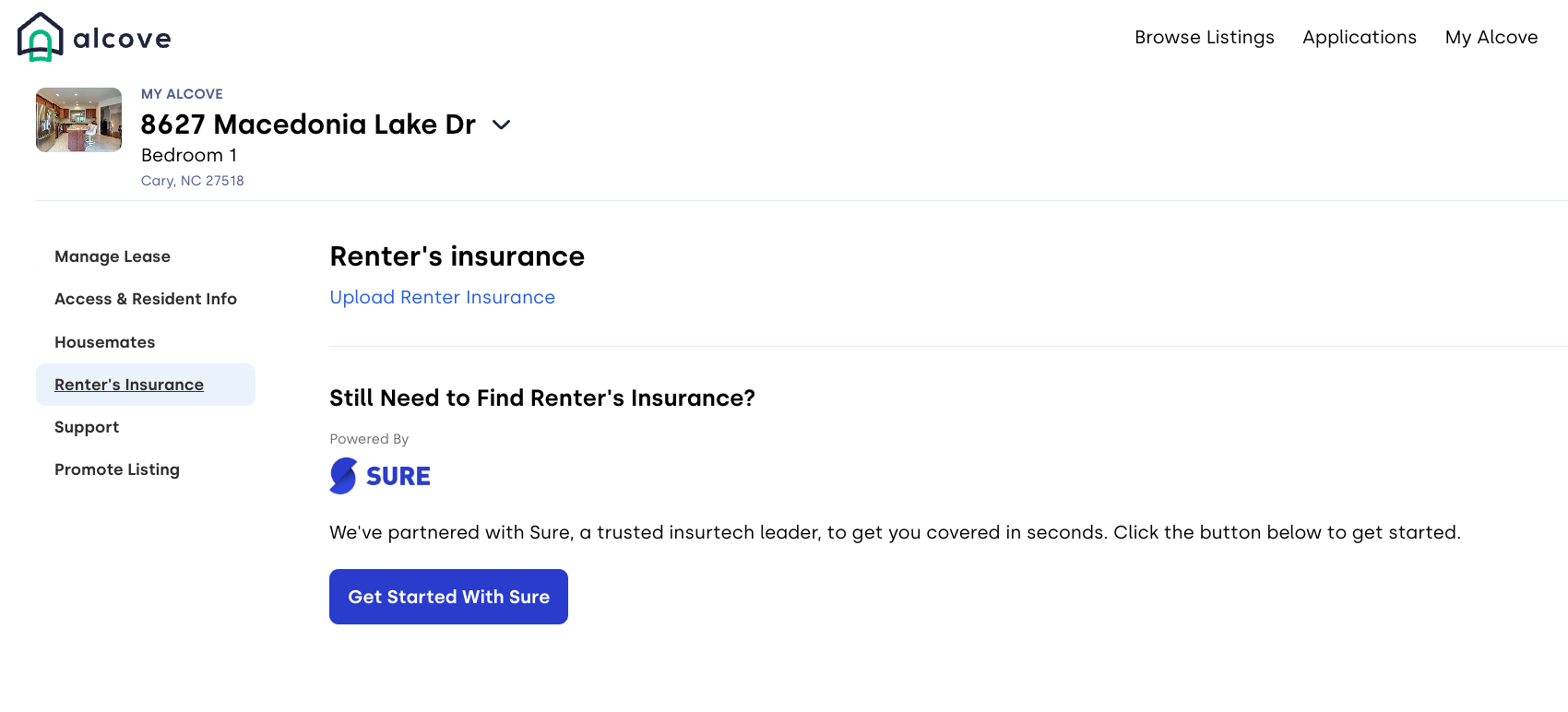
Alcove’s own help documentation adds a useful qualification: tenants may buy from another insurer if the policy meets their lease requirements. Convenience need not mean captivity. For the tenant, the benefit is fewer detours. For the platform, insurance becomes part of completing the original task.
The expensive bit is behind the button
Sure’s business is B2B software and infrastructure. Its buyers include carriers, brands and managing general agents, which administer insurance programs under delegated authority. The company names Chubb, Mastercard, Volvo, Revolut and Rentec Direct among the programs it powers. These customers need insurance to fit an existing relationship, rather than asking consumers to adopt another destination.
A checkout must connect eligibility, pricing, policy documents and money. Sure’s current platform presents one policy system of record, with modules for underwriting, rating, claims, service, launch, verification and payments. Payments alone include premium collection, refunds, adjustments and disbursements. Verify monitors coverage changes. The practical proposition is fewer disconnected operations behind a simple purchase.
Anywhere Insurance, launched in February 2024, tackles an earlier bottleneck. It pairs configurable insurance products, forms, endorsements, rates and rules with software and available actuarial support. An API cannot rescue a product whose insurance paperwork is still being assembled. Sure’s expertise therefore extends into the preparation of the program, alongside its distribution.
The latest specialty example is Jewelers Mutual’s March 2026 digital jewelry program. JM Specialty Insurance Company underwrites it; Sure supplies the configurable platform. That division of responsibility is central. The software can simplify delivery while the carrier supplies the category knowledge and insurance backing.
Alternatives depend on the job. Cover Genius also offers embedded protection for digital brands. Core software providers cover other portions of the operating stack. A brand can build internally or integrate directly with carriers. Sure’s distinguishing proposition is the breadth of connected work, including the branded purchase experience. Buyers should compare that scope with the work they actually need.
Capital, patience and a smaller payroll
Building that machinery required money. Sure raised an $8 million Series A in 2017, a $12.5 million Series B in 2019 and a $100 million Series C in October 2021. Declaration Partners and Kinnevik led the last round, intended to support expansion and product launches. Enterprise customers buy through negotiated arrangements rather than a public, uniform price list.
Growth brought strain, too. The Insurer reported approximately 70 layoffs in February 2025 while Sure pursued further funding. In November, Sure said more than $1 billion in premium flowed through its platform annually. Premium belongs to the insurance transaction; it is not Sure’s revenue. Both facts belong in the portrait of a business whose scale does not make its costs disappear.
Copy the observation, earn the distribution
The transferable lesson is to observe buyers closely and find the task they already want to complete. Put protection where the need arises, reuse information appropriately and make the experience fit its surroundings. Sure’s published values emphasize clarity and the end customer; its careers page also expects staff to use AI daily.
There are conditions. Distribution helps when a brand has relevant customer demand and a carrier can support the program. Poor coverage, unavailable underwriting or weak economics survive a prettier interface. In a 2025 interview, Slavin acknowledged the difficulty of depending on other parties. Sure’s current AI platform retains carrier authority and audit logs. The promise of an easy transaction still requires someone to do the difficult work properly.