Before HawkSoft was a software company, it was an insurance agent's impatience made executable. Paul Hawkins kept seeing work that a computer could do faster: client records, policy details, the small repetitive chores that multiply across an agency until the whole office seems to be serving its filing system. In 1984, Paul and his 9-year-old son, Sean, began programming together on a Tandy 1000 bought at Radio Shack. They built a check register, a recipe book and a genealogy program. The experiments were modest. The habit was not.
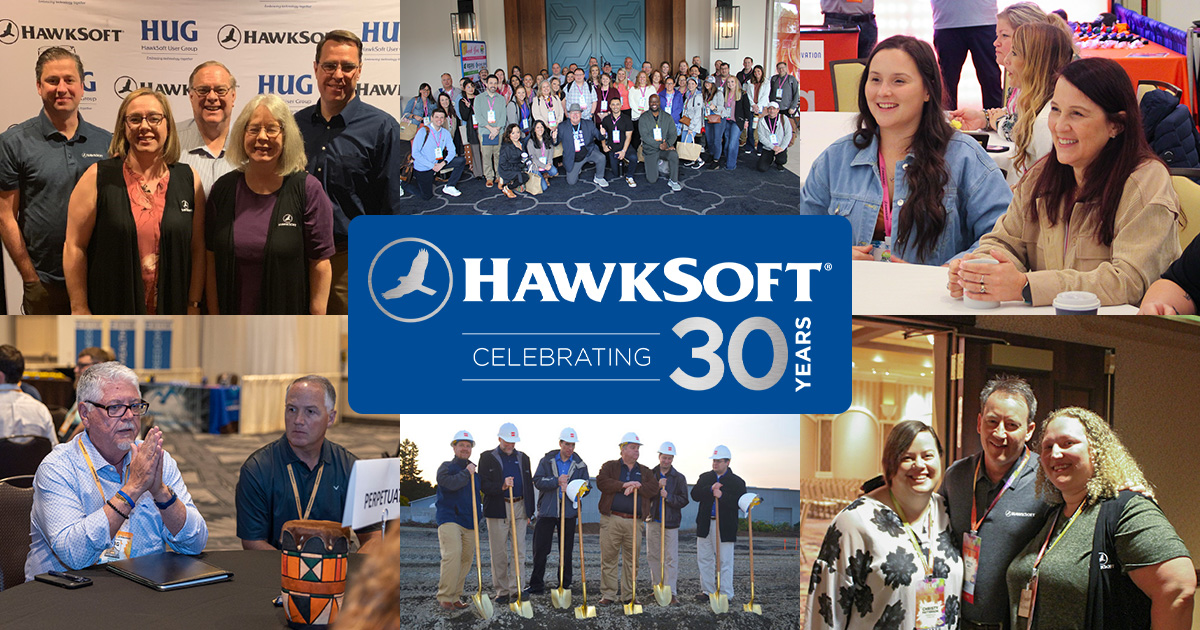
Paul opened an insurance agency in 1990 and wrote a tool called PC-Client for the job in front of him. In 1993, father and son began developing the system that would become HawkSoft. By 1995, with son-in-law Jason Hansen involved, the project had become a company. It started in a rented two-bedroom apartment shared by the family. Three decades later, HawkSoft employs more than 150 people, operates from a 15,000-square-foot headquarters in Canby, Oregon, and says thousands of independent agencies run on its software.
This is not a consumer app with an insurance skin. HawkSoft sits underneath the working day of an agency. It holds client and policy records, receives carrier downloads, stores documents, tracks tasks, handles trust-accounting and commission workflows, sends texts and signature requests, and turns the book of business into reports. A producer can see a pipeline. An owner can watch retention. A service rep can get an alert before a premium jump becomes an angry renewal call. The product is less like a shiny dashboard and more like a well-organized back room where every door opens quickly.
The moat is muscle memory
Most agency management systems can perform much of the same basic work. HawkSoft itself has said roughly 80 percent of capability across the category overlaps. That admission is more useful than the usual feature-page fog. Its wager is that the remaining 20 percent - how many clicks a task takes, how a note documents itself, whether a support person understands a commercial-lines workflow - decides what an agency can tolerate for eight hours a day.
The design principle is blunt: insurance agents know their jobs better than software developers. HawkSoft gathers suggestions in an online customer community, where agencies propose and vote on improvements. In 2024, customers submitted more than 700 product ideas. The company says it implemented 180, about one in four. That does not mean every request should ship. It means the roadmap begins with observed friction rather than a product keynote in search of a problem.
That closeness also shows up in support. HawkSoft hires people who have worked in agencies, offers phone, email, live chat and remote-login help, and reports a 97 percent first-call resolution rate. The customer user group runs conferences, webinars and peer education. In a category where a bad conversion can strand years of policy history, support is not the department after the sale. It is part of the product.
What the cloud changed - and what it didn't
HawkSoft 6 moved the company's data model into the cloud while preserving a full-featured Windows desktop application. The compromise is deliberate. Staff get the speed and density of a native app for the whole system; a browser supplies mobile access to client and policy details, tasks, reports, accounting, downloads and administration. Automatic backups and encryption come with the platform. Agencies can export their data on demand.
The cloud also made the integration strategy more important. HawkSoft's Marketplace connects agencies to tools for rating, marketing, payments, phone systems, intake, e-signature and automation. The Partner API is documented publicly, but production credentials go only to vetted partners because the data includes personally identifiable information. In 2023, the program counted 22 API partners, 12 with two-way connections. More than 38 percent of HawkSoft agencies used at least one API partner, and more than a quarter used two or more.
Recent partnerships push this loop into AI without pretending the management system should do everything itself. Liberate and Sonant automate and document calls. Exdion checks policies and compares quotes during renewal. Gaya moves policy data into carrier portals and forms. Broker Buddha connects submissions and adjacent workflows. RevitPay brings payments and reconciliation into the accounting flow. The AMS remains the ledger of agency work; partners do specialist jobs and write the useful result back.
Security has to survive that openness. HawkSoft says it undergoes an annual SOC 2 review and independent penetration testing once or twice a year. Data in transit uses TLS 1.2, with an additional AES-256 layer for personally identifiable information, and HawkSoft 6 encrypts cloud data at rest by default. Those controls are table stakes for insurance data, but stating them plainly matters when the sales pitch involves letting more applications touch the record.
The $7,000 warning
What does HawkSoft cost? The cleanest public number is in the company's migration FAQ: $99 per user per month was identified as the HawkSoft 6 retail price in an example for customers moving from local servers. Some services, including e-signature, carry an additional charge, while Agent Portal and core features are bundled. HawkSoft sells month to month without a long-term contract. A real quote still depends on users and add-ons, so $99 is a reference point, not a universal invoice.
The more revealing cost story belongs to agency owner Jay Arneson. Before HawkSoft, Arneson's agency spent more than $7,000 on training and setup for a system from a large insurance-technology company. The first thing to fail was the conversion: key policyholder data did not move. Then the daily work exposed too many steps, especially across personal, commercial and farm lines. Support marketed as one-to-one became email with a three-to-five-day wait. The agency trained for six months, so unfamiliarity was not the culprit.
What changed Arneson's mind was not another demo. It was the mismatch between the promised system and the work his team actually had to complete, followed by recommendations from agency peers. He cut the sunk cost and switched. HawkSoft moved the data, supported the necessary lines and connected the accounting workflow to QuickBooks. The case study is published by HawkSoft, so it should be read as a customer success story, not a controlled trial. Yet the failure pattern is painfully portable.
What failed first
- Critical client data did not survive conversion.
- Common workflows required too many steps.
- Human support arrived days after the problem.
What a buyer can copy
- Test a real sample conversion before signing.
- Time the five tasks staff repeat every day.
- Call support during evaluation and measure the answer.
The practical buying test is simple. Export representative client, policy, document and accounting data. Make the vendor import it. Have the people who do the work complete a renewal, issue a certificate, find a document, log a call and run a commission report. Count the clicks. Confirm which integrations write back and which merely open another screen. Ask what it costs to leave with all your data. Then call support with a hard question before the contract exists.
Independence as product architecture
HawkSoft competes with Applied Epic, Vertafore AMS360, EZLynx, NowCerts, QQCatalyst, Jenesis and AgencyBloc. Several rivals sit inside larger product portfolios. That can be convenient for an agency that wants one vendor across rating, management, CRM and other functions. HawkSoft takes the other side: keep the core independent, bundle the essentials, and let agencies assemble specialist products through vetted integrations.
The company says it has turned down acquisition offers. It frames private ownership as accountability to two groups - customers and employees - rather than outside investors seeking a quick return. This would be sentimental fluff if it did not alter decisions. Month-to-month terms reduce lock-in. Data export reduces the hostage risk. Customer voting influences development. Partner APIs admit that the best adjacent tool may belong to someone else. The ownership story becomes credible when it leaves fingerprints on the product.
There are conditions where this approach will not work. HawkSoft is purpose-built for independent agencies, especially personal and commercial property-and-casualty shops. A carrier, a captive agency, a benefits-only brokerage or a global enterprise may need a different operating model. Teams demanding complete browser-only parity should inspect the hybrid architecture closely because the full experience remains a native Windows app. Agencies that prefer a single corporate suite over a chosen stack may value consolidation more than independence.
There is also a limit to customer-led product development. The loudest users are not always representative, integrations create more vendors to govern, and familiarity can preserve awkward old logic as easily as useful muscle memory. HawkSoft's task is to keep listening without turning the product into a town meeting. Shipping 180 community ideas in a year sounds impressive; the harder metric is whether each change makes the common workflow clearer.
Still, the lesson travels beyond insurance. Start inside the work. Watch the experienced user, especially when the process looks boring. Make switching costs visible before a customer asks. Treat support, portability and contract terms as product design. Integrate where another company is better. And if independence is your pitch, prove it in the architecture. HawkSoft began as one agent removing friction from his own day. Thirty years later, that remains a surprisingly sturdy business plan.